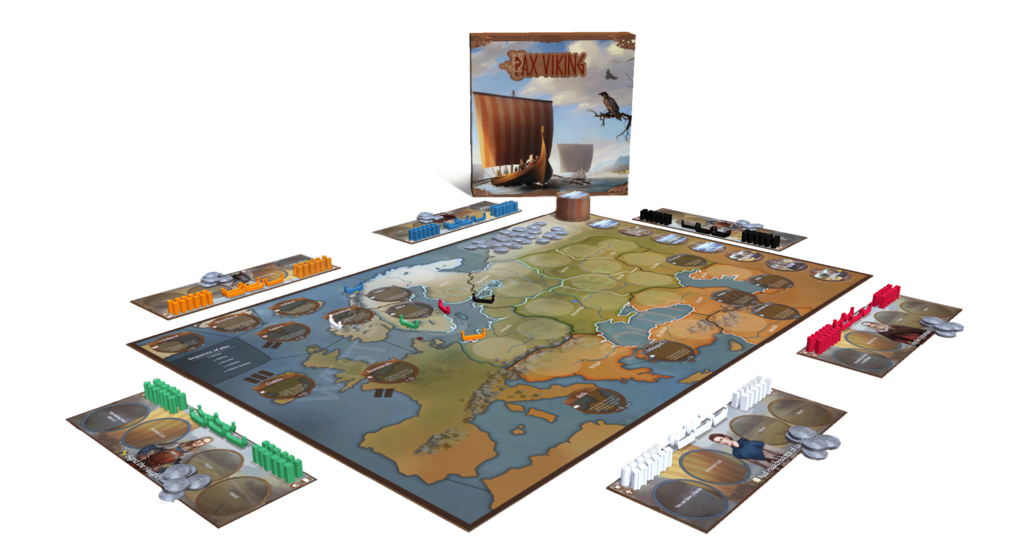
Ahhhhhhh the Pax series of games: complex, interactive, with inscrutable victory conditions and a cliff of a learning curve all inside tiny boxes with minimal components. With Pax Viking, now we have one that is not complex, and has (fairly) understandable victory conditions in a huge box! The question is: is this good? I think it is, as long as you set aside all thoughts of it being a Pax game or a Viking game.
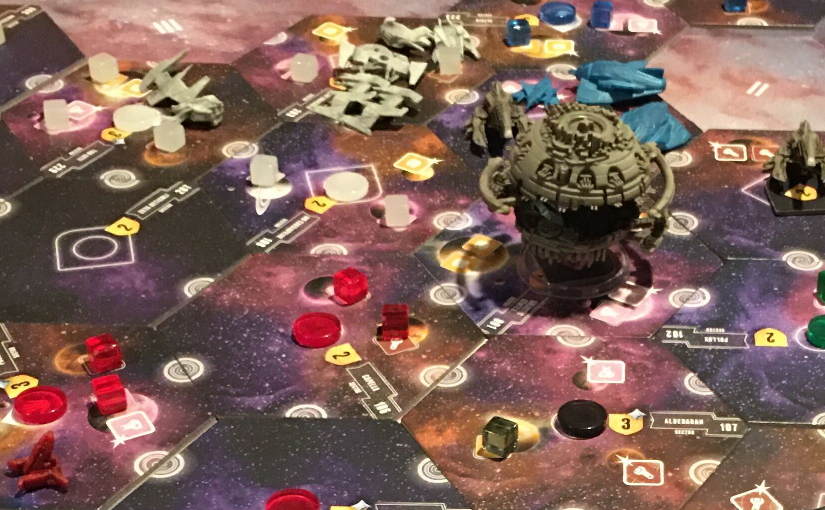
I did not take any shots of the game so this one will have to do for now.
Our first go was with a whopping 5 players, and I think this is a bit too many for a first time out, not due to complexity, but due to the fact that no one knows what they are supposed to be doing and there’s quite a bit to unpack with the interactions.
You play as a Jarl who has a fleet of trading ships which are used to collect followers and open up areas on the map to trade with. This is not a viking/pillaging game regardless of what it says on the box: it’s a trading game.
Scoring (not necessarily the win conditions) is done via four tracks which indicate your Jarl’s influence over each of the four factions in the game: The Rus, the Swedes, the Jarls (warriors) and Religion. When you have majority control of one of these factions, you get a special action you can take that the other players can’t use.
Like all Pax games, Pax Viking has a market with 4 different types of cards: Gods (a type of follower), Patron (followers), Events (fuck you cards) and “Posts” which are places on the map that you can go and exploit/trade. As far as I can tell, posts represent opportunities on the map that only turn into actionable areas after you go there with your ships and open the opportunity up.
Turns consist of buying from the market, playing events, and moving your ships around the map or sitting them on a post to take the actions available there. The game reminded me a little bit of a rondel game (Great Western Trail) where you take actions at various spaces to build up resources for some other thing you are trying to do later. Unlike those games, you can move your ships around anywhere you want on the map. This makes planning a bit more difficult because there is no ‘on rails’ rondel you are following to force your choices.
Battles are super simple with no dice. If you have more ships, you remove one of the enemy ships and then push the rest out. No battle takes place with an even number of ships on both sides and you can never suffer losses as an attacker. It made me laugh as the act of killing is called “Parlay” in the game. ha!
Winning consists of fulfilling certain conditions before other players. There are 4 win conditions and these do not change–they stay static for the entire game an all four of them are open to be fulfilled from the outset. In contrast to the other Pax games, you do not beat the other players in some sort of contest after a comet/topple nor do you trigger the availability of a win condition that is now open to all players via an event. Instead, you race them to complete one of the conditions to win.
In thinking about this game and what it is mostly like– I would say certainly this is not like the other Pax games. The closest cousin to Pax Viking in my humble opinion is Merchant of Venus and Wasteland Express. If you like those two, you should definitely check out Pax Viking. It’s really not a traditional Viking game, it’s an ‘open up markets and trading game’ at it’s core. I’m interested to play this again with that in mind. When I squint my eyes a bit at this design I see a deep space trading game where you have two empires, a religion and some other faction that you are trying to succeed as a space trader in context of. That theme seems to fit this system a lot more than Vikings.
Rulebook is good. Graphic design is fair, components are good, Map looks good, though it’s tough to see all the rivers/access points sometimes. Character artwork is really boring and mundane, from the cover of the box to the pictures of the gods and the Jarl’s themselves. When you own TWO Viking games with art from the LEGENDARY Adrian Smith, it’s tough to stand against that favorably. When you are doing art representing a Norse god, it should not look just like any of the other normal characters in your game.
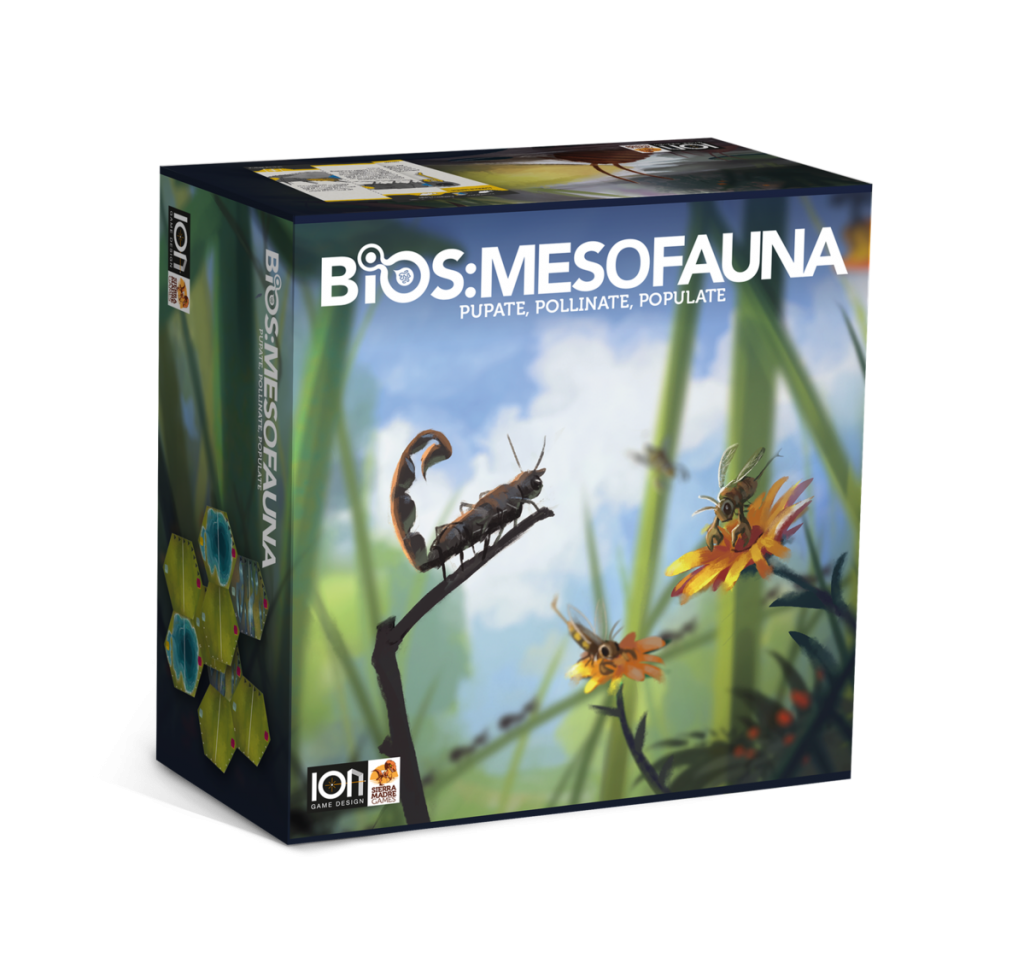
Next up for me from Ion Games is Bios Mesofauna– probably game of the year unless something comes out of the blue.
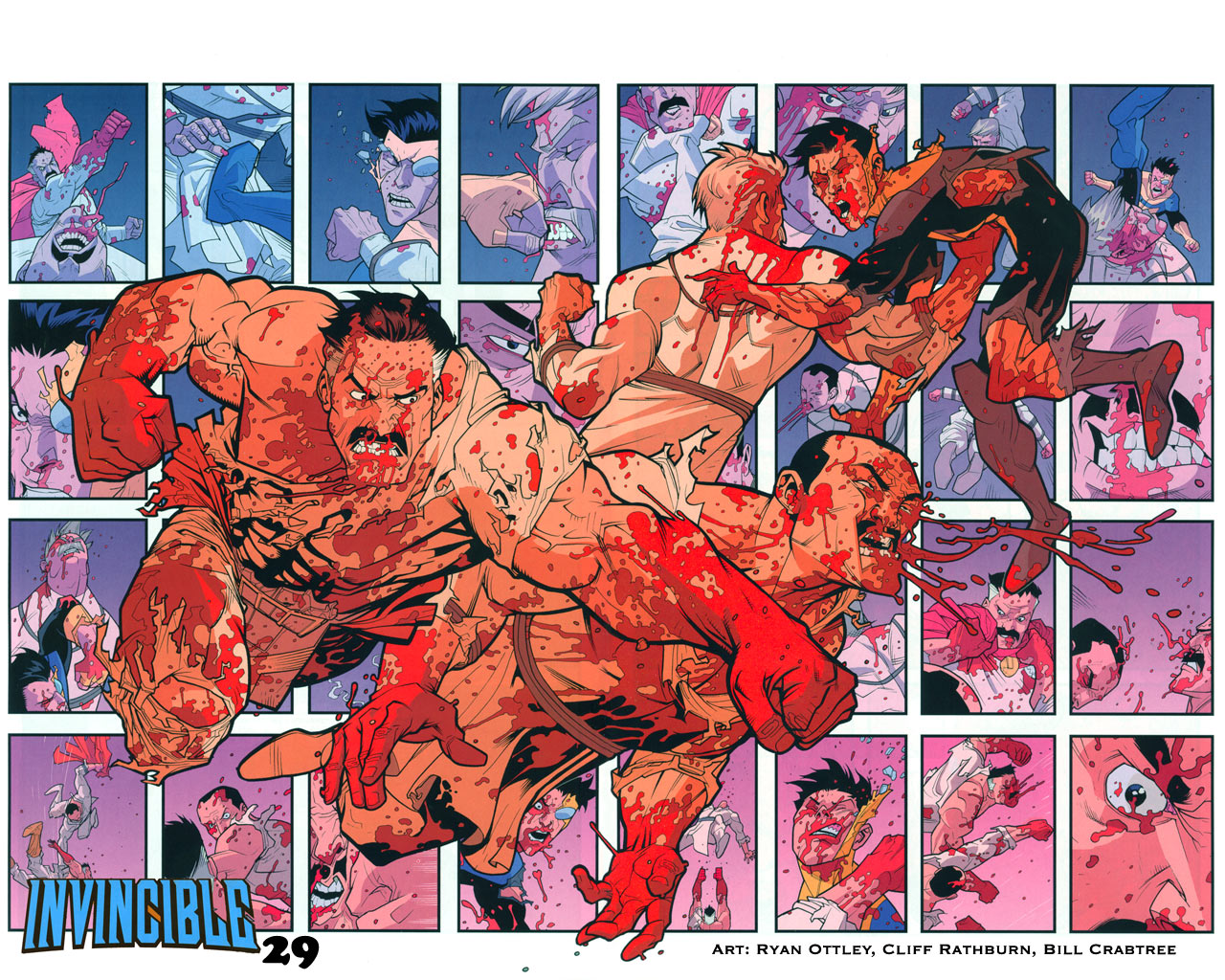
While my daughter said “this looks like it has a 2$ budget” from the trailer, she will be forced to watch at least the first episode of Invincible on Friday.
I passed the comic up at the comic store based on how…. lame the main character’s uniform is. It’s striking, but looks like Elastic Man with different colors. However I gave it a try and the comic is good, easy reading, especially after I’ve been on the Alan Moore stuff for so long that is both text and artistically dense as hell (mostly due to Kevin O’Neill–wow) and let’s see how the show follows suit. There is a BIG twist in the series that doesn’t suck at all, mostly because when the twist happens, that’s when the story really starts– If you find it slow at first, stick with it early on until, well, you will know.
There are some parts that get tedious, but when the fighting starts it gets good in the same vein as Savage Dragon (who is in the series as well). The super hero battles deliver on a level rarely seen in DC or Marvel stuff and because the characterization and development is so strong outside the fights, they don’t turn into just your standard early Image constant battle comics (see 90’s Cyber Force, Brigade, Youngblood, Supreme, WildCATS, Stormwatch… did I miss any?).
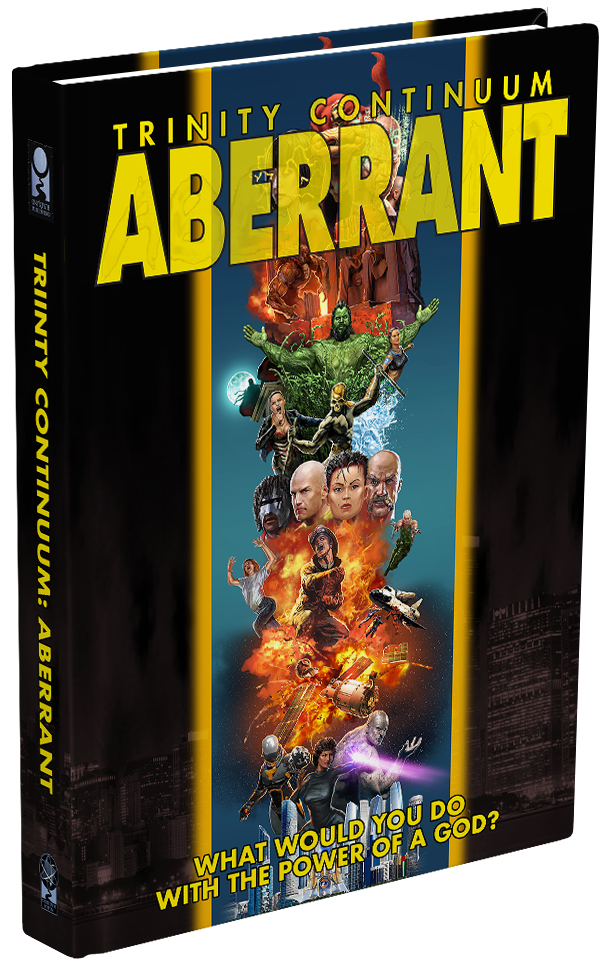
I just finished reading the new Onyx Path Trinity Core rules and it looks like they fixed Stunts, albeit too late for Exalted 3.
Years ago I did a post about the really bad design of STUNTS in Exalted 2nd Edition, that was not improved by Exalted 3rd. This wasn’t a review of Exalted 3 as a whole, just a note that the way stunts were designed were a huge problem as it puts the onus on the player to come up with something cool, that may not happened due to the dice being rolled AFTER the description. In 2nd edition, stunts were tied to Mote-regeneration (the stuff that let’s you use your powers) and that turned out to be a very bad idea*. White Wolf was never known for their playtesting ability…
Feng Shui 2’s solution to stunts was the simple and best one– roll the dice, see what happens and if you roll high enough in the situation, then you get a stunt. In Mythras, the opposed combat rolls determine levels of success, which may allow special effects (which are fucking brutal). Lastly, the 13th Age Rogue has a power that gives them one stunt per battle, that ALWAYS happens regardless of the roll of the dice. I like this, but that’s probably because I play using a rogue in 13th Age!
The way it works in the new Trinity/AEON/Aberrant is you make a roll vs a difficulty and then spend your successes to overcome the difficulty first, next spend any excess for effects of your attack. Doing damage to your opponent is considered an effect, for example, as well as tripping, blinding, added dice for your next attack, disarming: all of it are purchased with successes– successes realized and explained AFTER the roll. So if you even up successes vs difficulty, you effectively succeeded, but you don’t have any additional successes for that success to have an effect.
What this avoids are players mulling over more than just their attack moves, but an over-blown description of their attack moves before the dice hit the table to show that it happened. You can declare a ‘medium attack to no specific location’ the same as D&D, but if the dice come up GREAT for you, that medium attack can become a dry gulch to the throat, disarm and knee to the nuts!
Added to this is the ability for characters to do multiple actions during their turn up to their Cunning stat– so punching a mook, grabbing his gun and shooting the kneecaps off a couple of other mooks is entirely possible. With the scaling rules, a character with a 3+ scale difference in skill vs his opponents simply DICTATES what occurs during their combat action. Love it.
I’m not super interested in Aeon (the sci fi game), but let’s see if Onyx Path can pull off D10 superheroes with Aberrant! There are a million superhero games out now, and most of them don’t even compare well to FASERIP, especially all of them made during the “RPG microlite” or FATE years that hand wave all powers into some generic die roll.
While this will likely be missing the hard-edge 90’s conspiracy and nihilism we’ve come to love from White Wolf, after reading the Trinity Core Rules, I bet system wise, it’s a winner.
*for the record: Excellency + Shadow over Water [or Seven Shadow Evasion] + Reflex Sidestep Technique + Leaping Dodge Method. This combo costs 10 XP to purchase, is friendly with Infinite Mastery, allows the character to perfectly defend against any attack, allows the nullification of unexpected attacks and allows the character to break most flurries. Invoke this combo for every single action in combat, using a 2-die stunt to restore the expended Willpower. Thank you Jon Chung: why were you not on the Exalted 3 playtesting team?
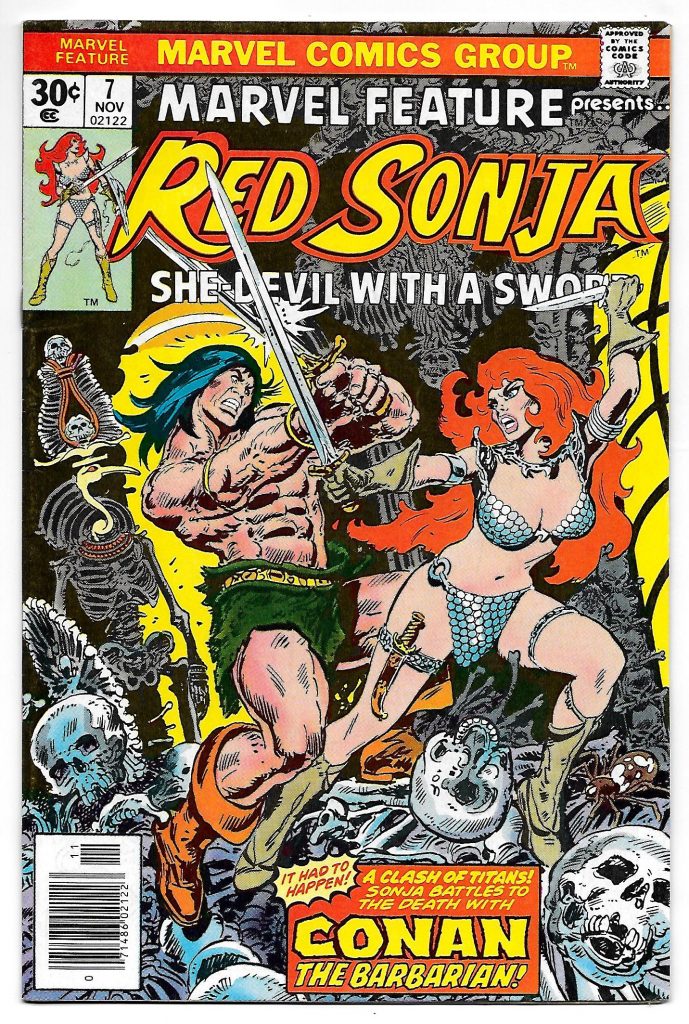
With the passing away of Frank Thorne, I pulled out Red Sonja #7 which I think is the only Red Sonja I own. I would have been to young to see this on the comic rack, so I must have picked it up in either a box grab situation (where older kids would let you grab a handful of comics from their box for 5$) or some other random set. I gave it a good read.
It was fantastic. It has Conan and Belit, as well as Red Sonja, of course, and they are after some sheet of paper that various sorcerers want for their own nefarious purposes. Sonja tricks Belit, Conan tricks Belit, Sonja tricks Conan–and they all get tricked by some priest. The art (Frank Thorne) is fantastic and the interstitial prose and dialog is just crazy good for a comic book of this era. Frank Thorne was an artist that we all noticed as kids, but of course never knew the name of. RIP.
I’m going to track down either a trade or more of the original Red Sonja comics– I gotta find out what happens!
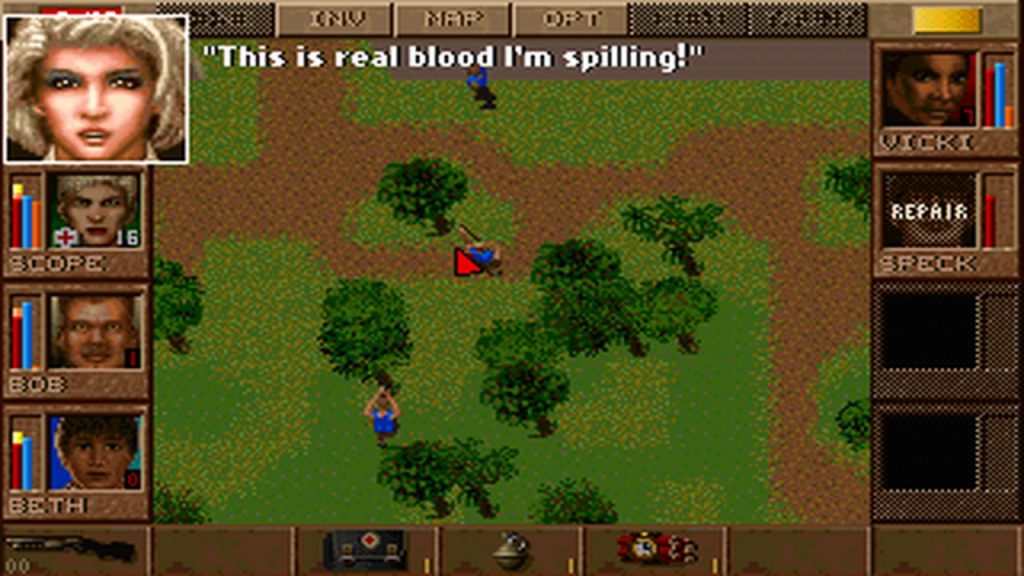
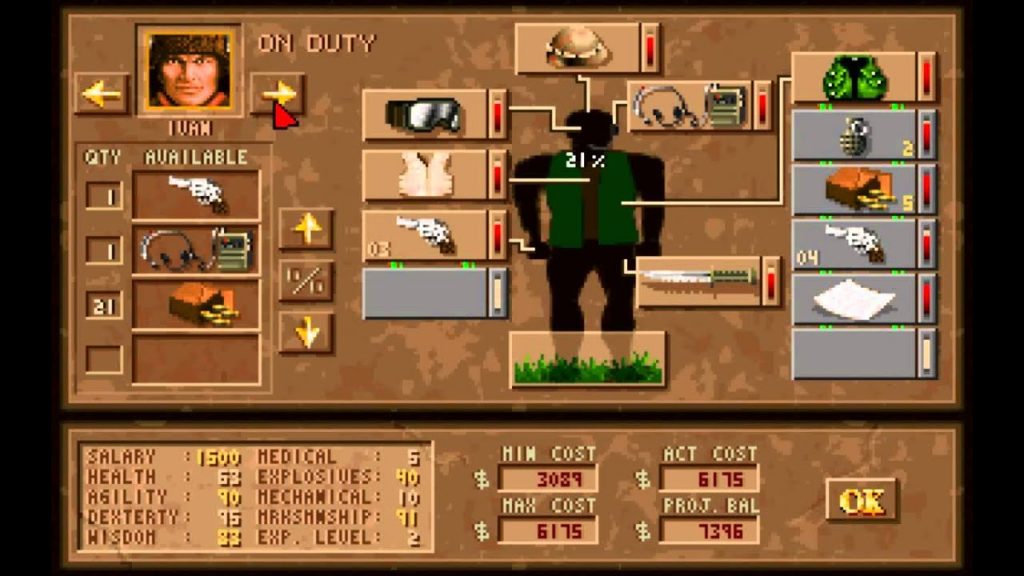
Remember this little game that you played HUNDREDS of hours on a tiny screen and made you get a CD drive for your computer?
Yes you do, it’s JAGGED ALLIANCE for me along with DOOM and Master of Orion, was the most influential pieces of media that I’ve ever consumed.
But this is not a post about Jagged Alliance. This is a post about what influenced this game from real life: Executive Outcomes. I was a history major in college, specifically due to my main Professor, Dr. Claude Sturgill, focused on low intensity conflict in American history. We studied Africa a bit as the West coast was having serious problems to put it lightly and while I was in school, Executive Outcomes, a mercenary company that spawned out of the dissolution of the South African Defense Force was heavily active. They work ONLY for legitimate governments and in their short time of activity, they settled two major disputes — until the UN forced those governments to stop using them and bring in UN ‘peacekeepers’ who got their asses handed to them and both countries went back into turmoil.
And now, after requests from African leaders, Executive Outcomes is back in business. It will be very interesting to see where they start operating first. “African solutions to African problems” to me says FUCK YOU to the UN who failed so badly in Angola and Sierra Leone (with catastrophic results) after EO was cut loose.
This is a deep rabbit hole to go down– I encourage you to read and weigh the issues as this is where matters become very grey and murky. While I definitely don’t think military contractors in general end up being the good guys– let’s see if EO is different.
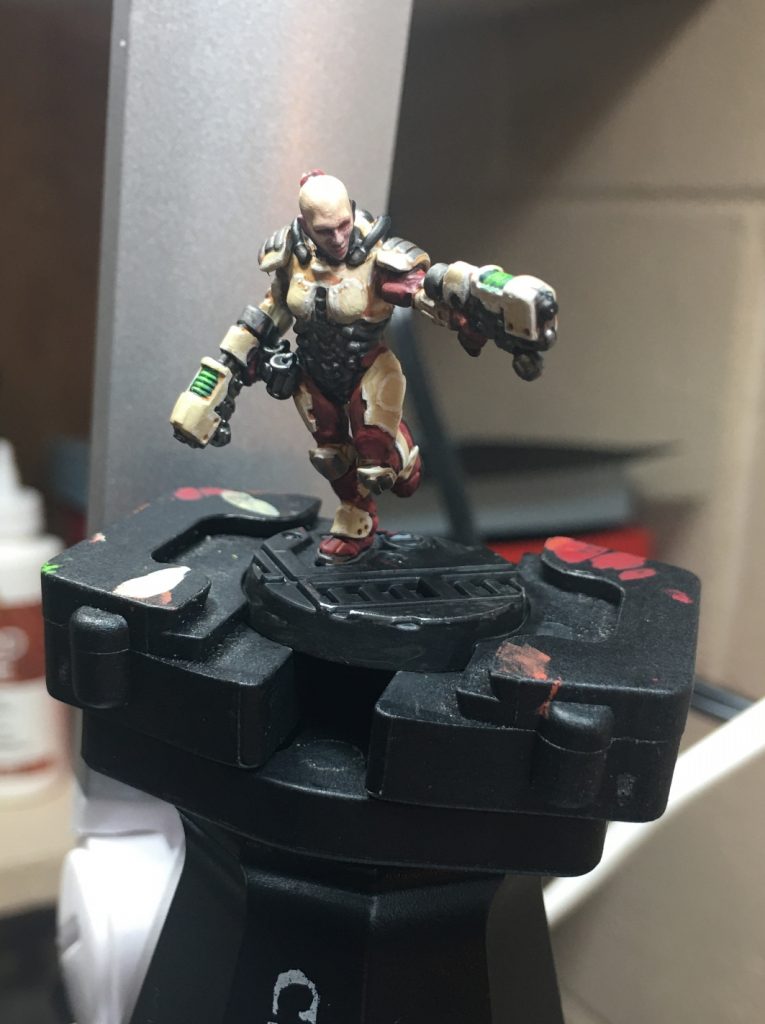
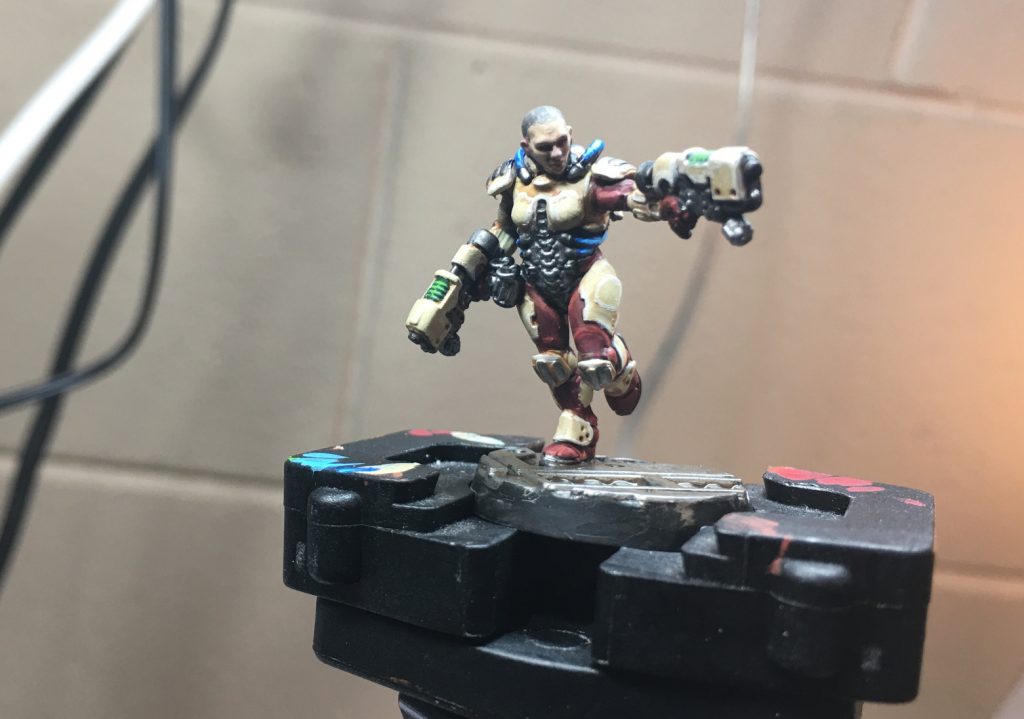
I wanted to start the year as I mean to go on, and PAINT SOME SHIT. I’ve actually done quite a bit of painting recently trying to get my copy of The Others to a state where I can play a game with all painted minis, but this week, with (almost) no more Goliaths to paint, I started a test model for my Van Saar gang.
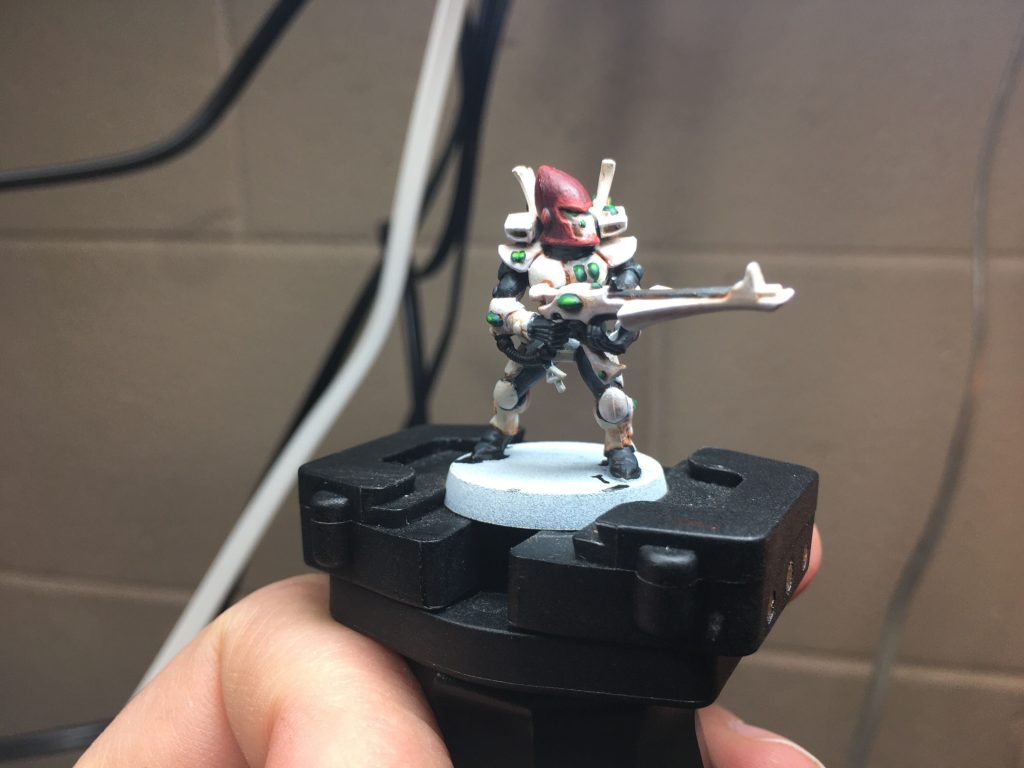
I started with a spare Eldar Guardian to test out the scheme and it turned out almost good enough to continue on to one of the Van Saar models from the excellent but very difficult to build GW kit. I have a bit of patience for painting, but NONE for putting shit together. Please help me.
I’m a very sloppy painter, so fantasy miniatures and grungy stuff (like Goliaths and Orlocks) are much easier for me. The Van Saar will take a lot of precise edge highlighting, which is not my strong suit.
Any way here’s the guardian:
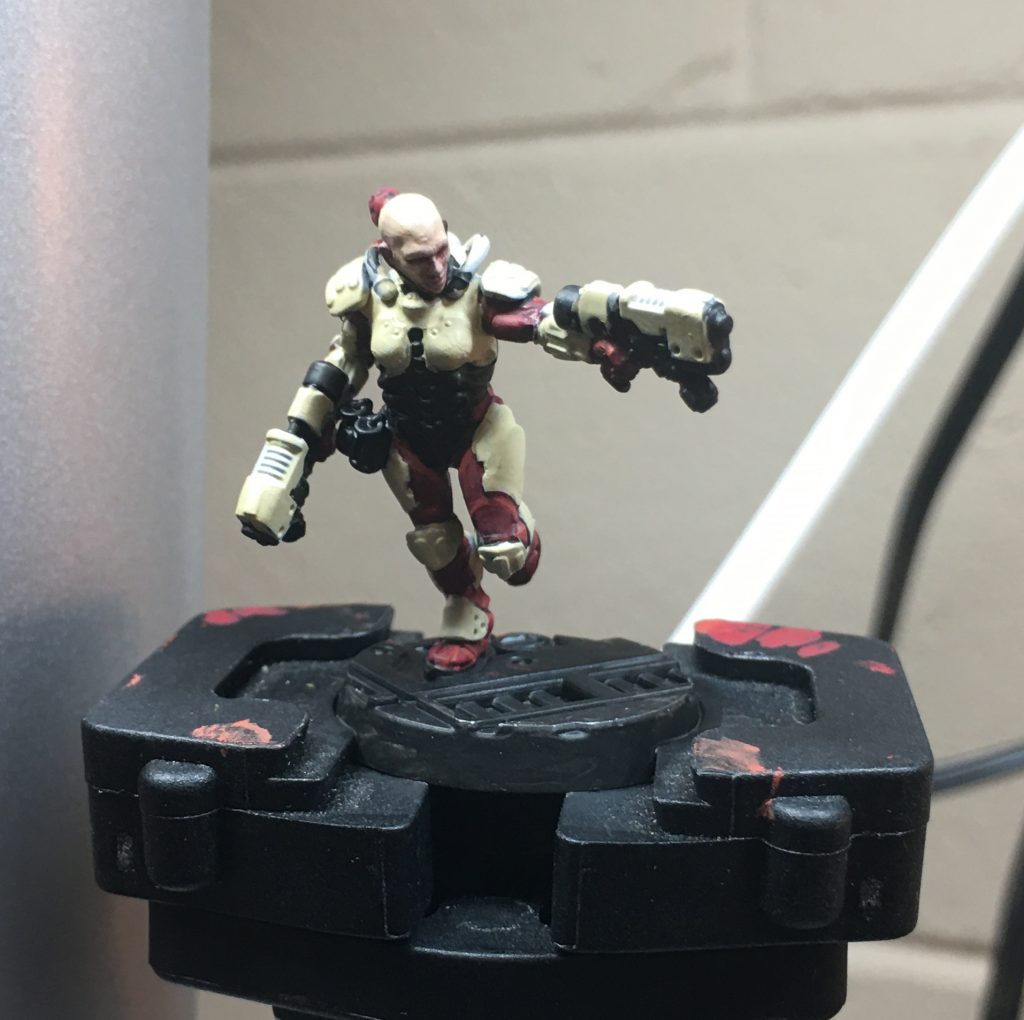
And here is the progress on the Van Saar.
Base ColorsJust after doing the metal, lots left to do but hard parts are done.Getting close to done.
The female heads in this kit have no hair, and it can look OK with just a pure bald head, but as I looked at it more, I just thought it looked lame with this color scheme as the skin color is not totally far from the high armor color, so I did a light grey wash over her tonsured scalp and there you go–looks a lot better. I’m going to get the Forgeworld Van Saar heads for the other females and other dudes. Those gals have hair!
She ended up looking a bit like Thug Rose (not that a Van Saar would ever smile).
Anyway, a start to the year of painting at least. If I can get these guys done by summer, it will be a miracle.
What came out this year that was great? Not much. 2018-to-now the majority of board game design has pretty thoroughly descended into extremely formulaic games with three specific traits in all: very little player interaction, a focus on engine building, with a point salad at the end (again, because if you knew who was winning, you would target them, and that’s a no no these days).
Root was a breath of fresh air last year in this rather fetid tide of same-gameness. Root showed to many people that you CAN and should have constant player conflict and this won’t hurt people’s feelings and most importantly, can be extremely fun. The body of my board game collection is held up by the spine of Cosmic Encounter, Dune, Shadowfist, Eclipse, Study in Emerald, Root and now the Pax games with everything else sort of filling in niche interests for me like euros (Brass) or co-ops / dungeon crawls (Massive Darkness). Almost all the games I like the most have direct player conflict and the potential for massive hamstringing, which is in direct opposition to the current trends in design. I’m hoping the success of Root will engender more designers to build COIN style games and gamers to take an interest in Cole Wherle, Phil Ecklund and the COIN series (and offshoots).
For many people this was a tough year to get gaming in face to face, but we managed it quite a bit later in the summer and especially Fall. Due to this, not quite as many games hit the table, especially anything new. Frankly having to learn new stuff this year felt tiresome with the infrequency we got to play– we went for the meat and potatoes this year: mostly shit we already knew how to play. I only played three new games this year, and one was a new version: Eclipse: Second Dawn, Godzilla: Tokyo Clash and Fort. Fort was not my type of game at all, and we only got one play in before I traded it, so game of 2020 that was released in 2020 is definitely Eclipse: Second Dawn... which is really just an update of a 2011 game after all.
Second Dawn is good, but it’s MUCH harsher than the first edition with serious players. You get one shot for the win now that it’s down to only 8 turns, and if you have a bad run of tiles, a really bad dice run in battles, there is no chance to come back into the game– you just can’t pivot to another strategy like in the old game. Some players will like this, others will not. I will definitely need to play Eclipse more before deciding on which of the versions is better. I hate to say it because I absolutely despised Twilight Imperium 3rd edition, but I have to give TI4 a try before calling Eclipse the reigning king of 4X space games. You know, ones that can actually hit the table instead of just sitting on a shelf because they are too complicated or system-heavy to actually play.
The game of 2019 was Root, and I really played the shit out of that last year and quite a few times this year as well, we shall see if lightning can strike twice with Leder games upcoming Oath game– which looks very…. strange.
This year the game I liked most to play was Pax Renaissance, and this isn’t even my favorite Pax game (which is Pax Porfiriana of course), it’s just the one that shows off what this type of tableau and conveyor market type of game can really do. Instead of just drawing cards or chits from a cup (a la Gangland, the Great Khan Game, King of the Tabletop), you can see what’s coming and control events to some extent. This is one of the best aspects of the Ecklund (pretty much everything) and Wallace games (Princes of the Renaissance, Study in Emerald) I love the most. Pax Pamir is a solid game, but because it uses points for victory, which is very strange compared to the other Pax games, it’s out of the running for the best Pax games– still really good though.
In light of 2020, I don’t think there will be much in 2021 that can compete with existing games, hopefully there will be some surprises. Kickstarter-wise I’m waiting on Oath, Bios Mesofauna, the new edition of Pax Renaissance, Pax Viking and what will probably be another mountain of boxes mistake: Bloodborne from CMON.
I didn’t read that much this year in terms of volume of books. I found an old book on Davey Crockett I read as a kid and plowed through that, finished a book on early colonization called The Barbarous Years and a few manga here and there which don’t really count. I did get through a big one this year which was really rough going but extremely solid and worth the effort: Game of Kings by Dorothy Dunnett. This is the first novel in the Lymond chronicles.
Normally, I would never even look at this series of books based on the covers, even when when I was in my heavy reading phase of life (so far). But I saw a reference to it when reading about Pax Renaissance that it was a large influence on Ecklund when he was designing the game, so I gave it a shot. I had no idea what I was getting into. Instead of a light Bernard Cornwell historical romp– this is an absolute BEAST and took me all Summer to read.
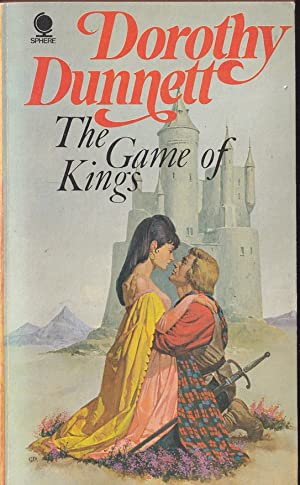
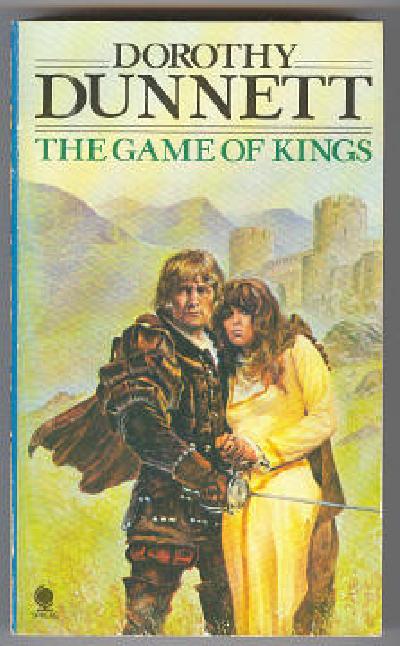
Note that while the modern cover of the book is extremely bland, the older versions look like cheap medieval romance novels!
There’s no scene where this happens…
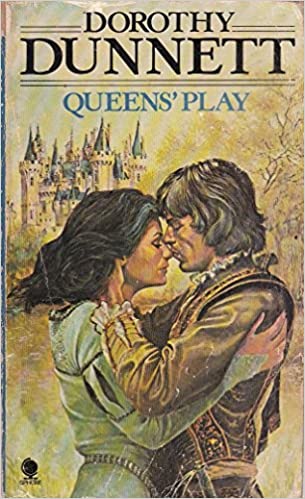
Later books in the series double down on the Romance novel cover action.
Is that the Disney castle in the back there?
Despite the fantasy romance covers, this book is nothing of the sort. It is an extremely challenging historical fiction about an exiled lord who returns to Scotland after being wrongfully imprisoned in France, starts up a band of thieves and rogues and starts messing with the coming conflict between England and Scotland over the hand of Mary Queen of Scots (who became the queen of Scotland 6 days after she was born!). This was the author’s first novel, and is nothing short of remarkable. While extremely difficult to follow due to Dunnett’s overly-liberal use of character’s other/landed names*, the plot is both one of conflict between nobles, a war novel (of the Rough Wooing) and a mystery all in one. Sound familiar? If this didn’t influences Game of Thrones, probably one if it’s main influences, call me a one legged cat trying to bury a turd on a frozen pond.
While this is a 600+ page beast and a very slow read in parts, it all comes together in the end with an exciting and intricate finale and builds up the main character, who seems at first like a complete arsehole and a Mary Sue ninja as well, to simply have had secret motivations and a brutal existence to explain both. Highly recommended if you can get through the name issue. Maybe you can find a cheap copy in the used book store with the romance novel cover!
*for example, the main character is called Francis, Lymond of Crawford, the Master, Crawford, Master of Cutler, not to be confused with his brother, Richard, the Baron of Cutler, Lord Crawford, and so on. This happens with ALL of the landed characters and sometimes I couldn’t tell if Dunnett was referring to the father or the son in some scenes. Anyway, you get used to it.
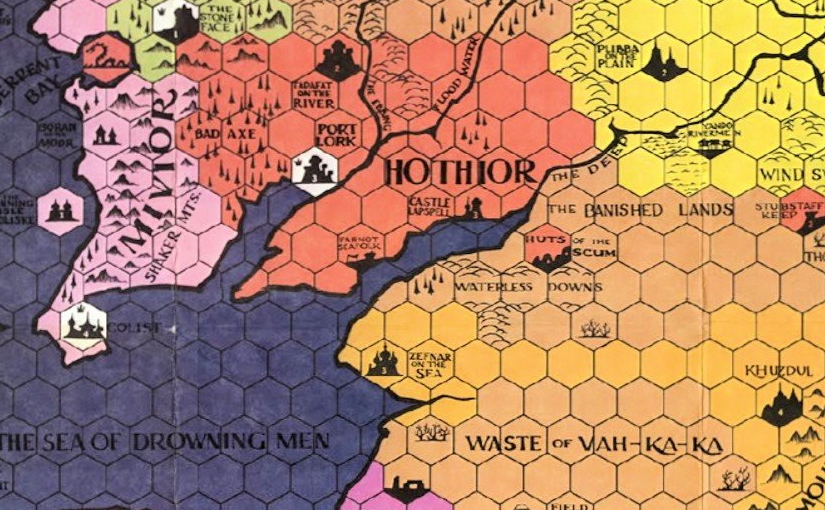
You read that right, 13th Age in Minaria— the campaign setting from TSR that never was, and could have been.
For the non old-person, Minaria is the fantasy world created for the Divine Right board game, which many of us had as kids in the 80’s. While the game was a bit labyrinthian for a 9-12 year-old as a hex and counter, the map board was on the wall of my bedroom for at least 15 years. The map and counter art is by Dave Trampier, and is amazing. The Tower of Zards, Invisible School of Thaumaturgy and all the awesome mercenary units (like Hamhara the dragon) were incredibly fertile ground for the imagination as a young and now older mainge.
The mystery is why this was not turned into a Greyhawk style campaign setting by TSR as all the assets were right there– just needed someone to start writing modules for it! There were multiple articles in Dragon Magazine on Minaria and it’s environs. Anyway, time to redress this issue!
13th Age and Minaria are a great combo as the 13th Age world itself is godless and pretty generic fantasy, especially since it has no gods which I’ve always found very strange. While Runequest has a bit too much to do with the gods for me, the 13th Age world just doesn’t seem grounded. The Icons in 13th Age are really just basic concepts and with Minaria, there are oodles of Icons that are far more interesting and engaging than the stock 13th Age ones. Yet on the plus side, you have the amazing 13th Age system, which is probably my most run RPG in the last 5 years or so. While Minaria is not explicitly high fantasy, it has enough of those elements to fit well with the more gonzo fantasy of 13th Age. Minaria and Divine Right are still products of the Gonzo TSR age.
I’m not GMing this one, which is a great break from almost always GMing and I get to play a rogue, so far my favorite class for the game (among many awesome class selections). The fun part about the rogue is that you can bounce around the combat area almost at will, you rarely get stuck, and you can hammer enemies.
I’ve only been in two sessions with the group so far and we are in some rather familiar house by the sea near Port Lork at the moment… and we’ll see where this goes.
I want to do a long post about CK3. This is an amazing game. Here’s the TL:DR.
FIRST: it’s much easier to get into than CK2, which I gave the good colleddged try a few times and failed to figure out what to do and it definitely failed to pique my interest and I just yearned for Stellaris… this one is totally smooth. SMOOTH.
SECOND: this is not a conquest game like Total War, this is a medieval FUCK simulator with war-like…um… consequences. It’s all about relationships, both hierarchical and personal, hereditary and romantic. You don’t have winning goal– you set that for yourself which is extremely different than Total War or Stellaris. As a strategy buff, this seemed odd to me, but it’s great. It’s a sandbox and it’s huge.
THIRD: The things you can do are absolute madness. Eating prisoners, seducing relatives of either gender, creating a naked, satanic religion and then forcing it onto your subjects, running a bene gesserit style breeding program with your children and grand children to create what later amounts to a kwizatch haderach (or transalpine dwarfs….).
So what the hell is this game?
CK3 is a game where you play as a single person, specifically a landowning noble of some kind. When that person dies, if they have kids who can inherit their wealth and status and holdings (not just spawns that can’t inherit anything), you play as one of those children, otherwise it’s game over. You are incentivized to continue your bloodline and make sure you have enough heirs, so that with the high death rates of the early medieval period, you don’t lose the game.
You can start as anyone: a king, a queen, a count or a duke but not Barons or unlanded nobles (ie: no banking families— yet). You can start anywhere in the ‘old’ world (Europe to the western edge of China) as well as amazingly, Africa. You can play as nobles in the Califates, in the late dark age Viking kingdoms or as leaders of the Hausa in Africa. The scope is nuts.
Once you start, you will have a holding, house you belong to, family and a court that you need to manage. This comes with a small or large military, alliances, a current religion with all of the rules and complexity that goes along with these.
And here’s how this fucking madness can play out.
lots of kids, lots of useless males…
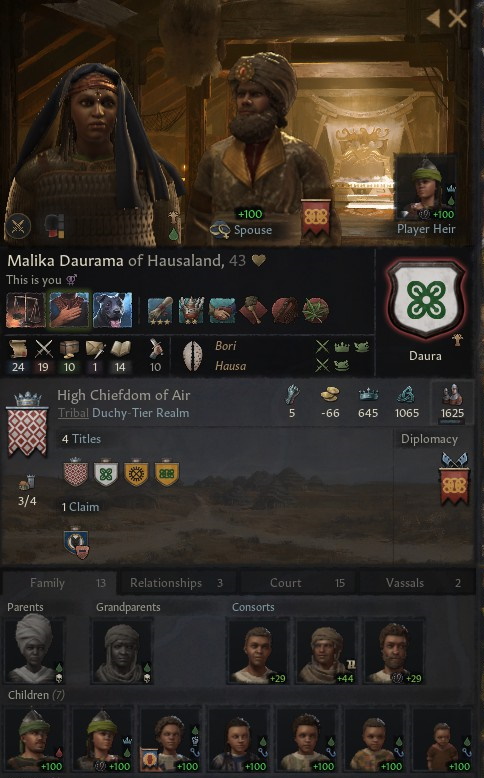
On my first play, I chose Malika of the Hausa, a matrilineal, tribal area in Africa. I got a husband and other mating partners (totally OK in Hausa culture, not at all OK in most others) and started the full auto birthcannon, just firing out kids. The issue was, they started to try to kill each other as there were no laws of primogeniture. Eventually my first character had about 7-8 kids– quite a horde and 2 of them died early. When my first character died, I thought: ‘Ok, I’ve built quite a power-base here and my oldest daughter is going to continue to kick total ass.’ NOPE! The rules of succession split everything among the female heirs equally and my main daughter immediately had to go to war with two of her sisters to reclaim (or claim rather) the lands that were rightfully hers. Meanwhile she racked up the consorts and started firing out kids of her own– but NO girls. So if she got killed, she I would end up playing as one of her sisters that I was now at war with, or at the last minute would have to switch to a patriarchal culture. Fan, fucking, tastic.
Being my first play with no clue as to what I was doing, I quit to start over. After running through the tutorial that starts in Ireland, then I began as Eudes, a little kid count in Western France, beset by enemies all around him with a couple of powerful uncles, one of which is his liege who has bigger problems to worry about.
Other than making sure I was not going to get immediately destroyed by the Vikings nearby, the first thing I had to find was a good woman just like the Hausa lady finding a set of good men to breed children, this is essential, and in Catholic France, you likely get only one shot at this. I have a certain… uh… type of lady that I like so I was like: why not let’s go look at Spain/Portugal and I found a similar age kid that fit the bill and had a positive congenital trait as well– boom! Betrothed which gave me an instant ally across the Pyrenees and some claims on some counties in the Basque region. I married off a sister which gave me another ally nearby. Then…
Dwarf.
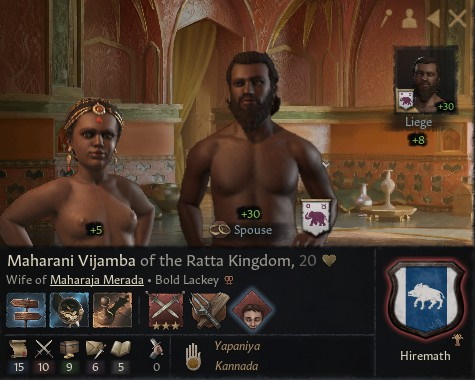
… I got– distracted. The map is gigantic, just mind-bogglingly large. I started looking at India and environs on a whim and BOOM: there were tits. Granted they were on a lady with dwarfism… Then the deep dive into the mystery of the naked rulers in India began– and then I found one in Eastern Europe. Why? What the hell and how can I get everyone naked?? How? I won’t spoil anything, but this led me to some deep respect around the religious aspect of this game. There are 15 Islamic sects alone and I have no idea how many Christian ones, including the Gnoscists, your leaders can, of course, create their own religions. These each have different mechanics and change the rules of the game, including, you got it: NUDITY.
I played as Eudes until he passed away happily having quite a few children and a few un-legitimized bastards and then the madness and obsession really began. When you start with one of the ‘try this first’ factions you feel a bit like you are on rails (you are not) but when that guy or gal dies, you know everything can and will change drastically, a lot like some of the better Total War games. Eventually, France collapsed under the constant conflict between rival counts and dukes, meanwhile raided from Vikings in the north and pressure from the south from the Islamic empire that had rolled across Spain. Eventually ALL of southern France was part of a massive Islamic empire who had also encroached into Italy. The only thing for it was for the Pope to call a Crusade and madness began again.
While the urge is to get the biggest Kingdom/Dukedom or solid heirs, sometimes, you just need do things out of spite. A few generations down I had an absolute rake seducer as a duke as well as some unruly vassals and they went and rebelled. The rebellion was crushed and I captured a couple of the rulers, most of which I tortured and then let go. But one of them had a comely lass for a spouse and no children yet! I left him to rot in jail, seduced his wife who must have been oh so lonely (she hated him anyway) and as soon as she was impregnated, I turned him loose from jail to cope with the fact that his primary heir was not his own child. This did nothing to advance the cause of my realm, but real good fun.
Another event was that I needed a good spymaster. I found some Teutonic broad in the low countries with a shockingly high intrigue stat, seduced her to my court, then my rakish duke had some kids with her. Over the years, I noticed one of her daughters had some amazing congenital traits and seduced her too (this was her daughter from a previous husband/lover) and when the Duchess died, married the duke to the daughter. Eventually, since her mom was the spymaster, she exposed the secret to her daughter that the duke had also humped her mom and there was an incident… luckily my duke had a high likability, otherwise you start to see murder after murder of your dynasty members from inside your own court.
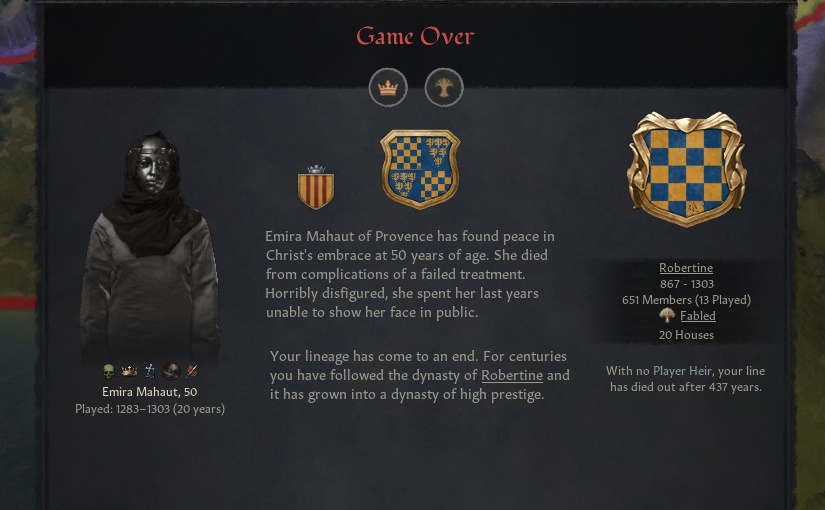
Eventually my dynasty was stripped of all other Duke level titles and was stuck with just a Duchy of Provence (between Italy and France) and even though I had kidnapped my liege multiple times to get concessions, due to disease, murder and accidents at war, I was down to a barren duchess with zero male heirs in her line of succession and it was game over.
Again, this game has no ‘winning’ goal: you make your own goals and it’s just brilliant. You can play as a warlike Richard the Lionhearted, a foppish lout who whores and drinks, or a Bathory style torturer and murderer and anywhere in between. Then, next generation, you get to decide how to play again.
Lastly, I love how small, seemingly insignificant decisions later become massive problems or boons. Marrying off an ugly, scaly daughter to some bastard child of one of your vassals ends up accidentally with you controlling the province as the father murdered his bastard and a month later his son and heir, one of your knights, is killed fighting in a crusade.
They really knocked one out of the park and this will be played all Winter…I can’t wait for expansions: especially if there are BANKING expansions where you can play as the FUGGERS, etc. and not worry about all the owning land stuff.
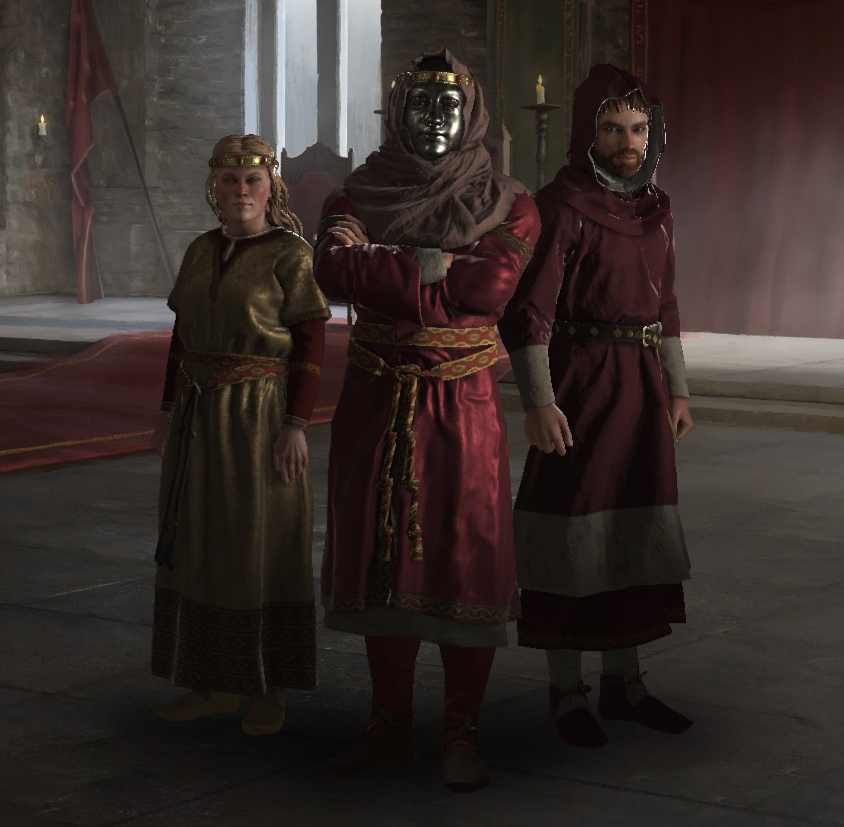
My horribly scarred ruler, his drunk lesbian wife, and bastard son.