Great minds think alike right? My brother and I both (separately) got one of Tom Russel’s choo choo games– Iberian and Irish Gauge respectively. We got to play one of them this weekend and it was GOOOD.
The design goal of these games was to boil down the essence of the huge 18XX genre into a playable, short game that is just a bit more complex that Ticket to Ride, but VASTLY more fun and engaging for the more serious gamer. These games have a synthesis of very basic mechanics that are greater than the sum of their parts strategically. The essence of 18XX is buying stock in train companies, influencing where they place their rails to deliver goods and bring you (the owner of stocks across multiple train companies) the most MONEY.
Irish (2014) and especially Iberian Gauge (2017) are so stripped down they reminded me of two of my favorite abstracts: Sid Sackson’s Acquire and Knizia’s Tigris and Euphrates– both NASTY games that both hide a crazy amount of chaos with their venires of abstraction.
In both games, you start by buying into companies and then proceed to lay track and attempt to connect up cities and towns. In Iberian, the connection is enough to pay out dividends, but in Irish, players have to deliver goods (abstractly) to various cities and towns in order to get a payout. The trick comes due to the fact that companies will be owned by multiple or even ALL the players in the game and it’s all about trying to out score your opponents by trashing some companies and pumping others.
If you are interested in the most recent ‘engines’ to these games, I would check out Iberian for a more streamlined experience, or Irish for a bit of a meatier run at it. Also definitely look at Hollandspiele’s Dual Gauge system— also by Tom Russel. They also publish a lot of other cool stuff.
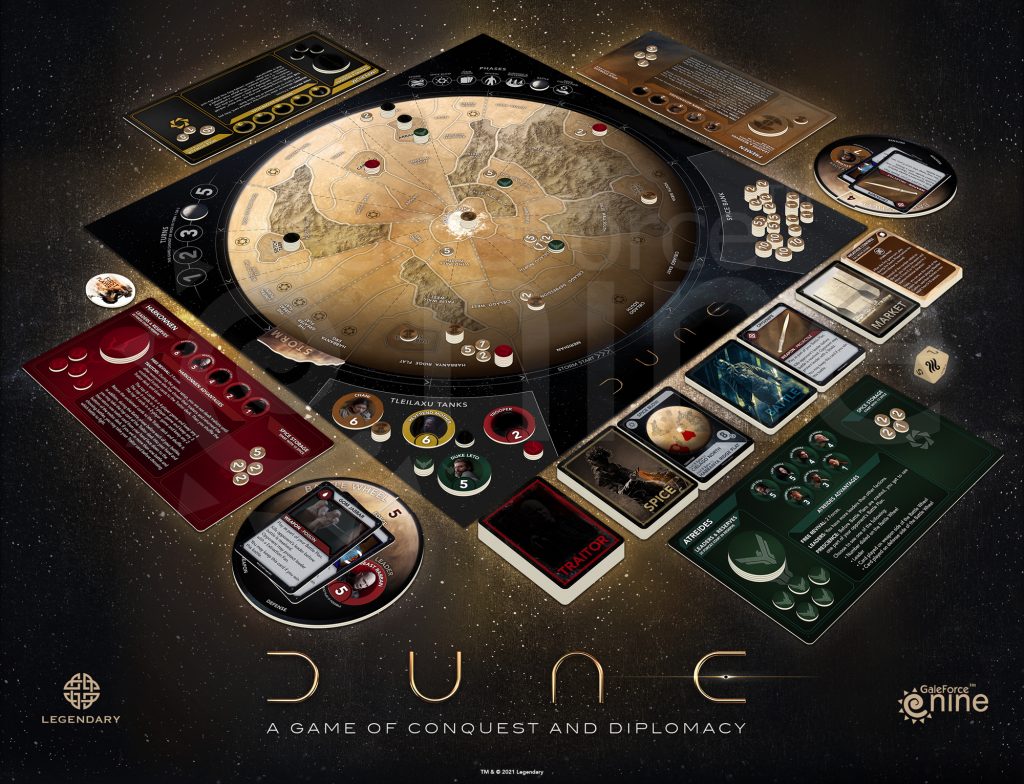
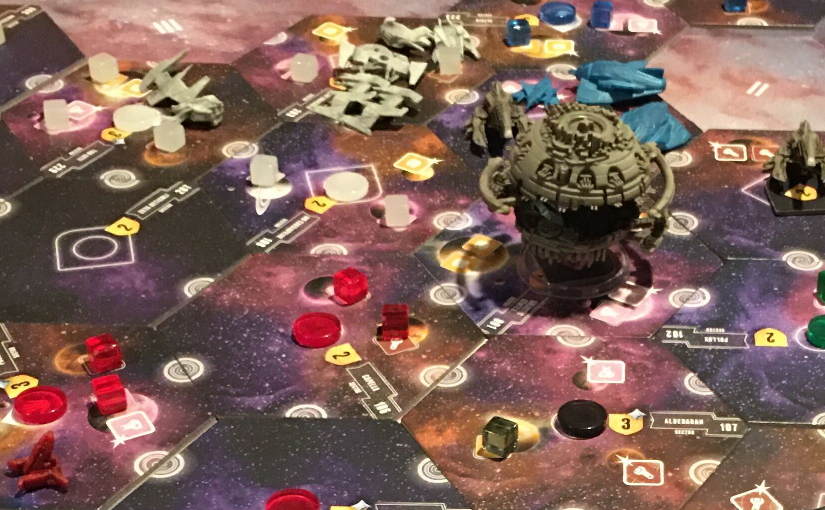
Design by the Cosmic Encounter / original Dune board game team the Olotka’s, Kitteredge, Eberle, Reda this looks to be a high speed version of the original Dune– and it’s coming FAST (September) so you can even pre-order it.
I’ve been impressed with Galeforce 9 games as they were just some dudes that made wargaming trays and measuring sticks awhile back. Spartacus is classic, Sons of Anarchy is a fantastic game and though I do not like the ART from the Dune reprint, there’s a lot of love there.
Let’s see how this one plays and I have yet another reason not to waste any gaming hours on the Euro-Dune.
I decided to break my rule of 10 plays with Pax Transhumanity and do a review with only 7 plays. Most of them were 2-3 players, but one game was solo to remember how to syndicate and commercialize ideas before playing again! This may be a bit long, there’s a lot to talk about here as this is a very intriguing game and one that is easier to play than Pax Ren, but much more difficult to strategize around to win because it is about solving problems and creating companies and not destroying Sultans or triggering the military phase of the Reformation. The first time we played, two of the players did not like the game, but we have played since and that feeling has changed, for some of us at least.
Form Factor
This is your typical Sierra Madre /Ion Games game that is a MASSIVE game in a teeny tiny box, with minimal components and lots of cards. Like Greenland, I can grab this off the shelf and go anywhere with it. Sierra Madre’s efficiency of components is a wild post-Fantasy Flight concept and one everyone should copy. There is a folding board for the game, but you do not need it at all. This game made me look at a lot of the games I have that come in huge boxes, that don’t need them at all (Condotierre, Hit Z Road, and a few others) based on the included components. I think there’s a stigma of small box games in that they are always light and generally have limited gameplay and especially replay-ability. While there are entire sections in the game store for the ‘light smallbox games, looking at Pax, Bios and Innovation/Glory to Rome, the ‘we need a big ass box to be taken seriously’ should be re-assessed: pronto.
The Theme
Pax Transhumanity assumes that mankind is going to have a technical renaissance that will improve our lot as well as some nuclear or biological warfare exchanges which we will survive rather than succumbing to a The Road style post-apocalyptic dark age. In the game you play as very strange societal benefactors/investors. One is a Doctor, one is a Citizen, one is a Colonel and one is… a Blogger? I’m not sure where these came from or what thematically they are supposed to represent. What they are good at though is 1) having a patent in a specific scientific discipline at the start of the game 2) being able to raise a SHITLOAD of money from investors 3) having a secret goal that may score them points at the end of the game.
Your goal? Create a bunch of companies (tycoon victory) or solve a bunch of very serious problems in the world (like pollution) that score points at the end of the game based on the ‘regime’ in play at the time. You are competing with other players to have the most of these rather than attaining a certain goal (like Pax Porf where you become the head of most of Mexico, either on your own or as part of the United States, or Pax Ren where you usher in a certain type of society in Europe and go down in history as it’s architect and financier).
There are multiple ways to score, and multiple ways to win, but this is not a point salad, in fact it is distinctly an ANTI point salad game. Every single point is hard fought and precious and with the exception of your secret goal, open to easy assessment by the other players at any time. End game scoring takes about a minute or two, which is a breath of fresh air for everyone who got suckered into playing Coimbra or Everdell at some point and can never get that time back.
The cards in the game represent future tech and are the heart of the game, there are oodles of conjecture from all over the sci-fi map from Open Source Sexuality (oh yeah!) to a trapped AI ‘God’ to Reverse Cyborgs and rather mundane techs like Bio-printing, electronic textiles and a universal biometric database whos black heat is Secret Police of course. Some are game-change powerful and some are barely worth bothering with except as a research project to get another tech. With only 38 of these in any given game, you won’t see all the cards for a long time.
Art is OK, not stylish or taking any chances, it’s very passable and safe (like Pax Viking, which was a bit of a shame). Graphic design is fantastic for usability.
The Play
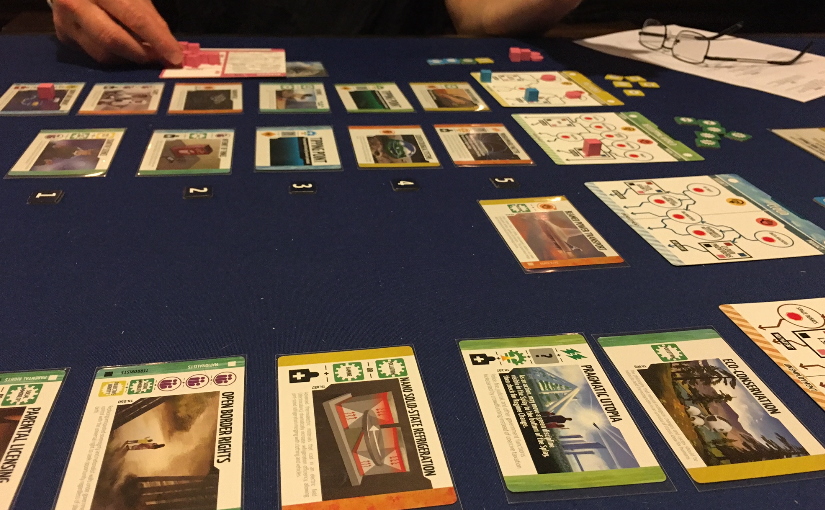
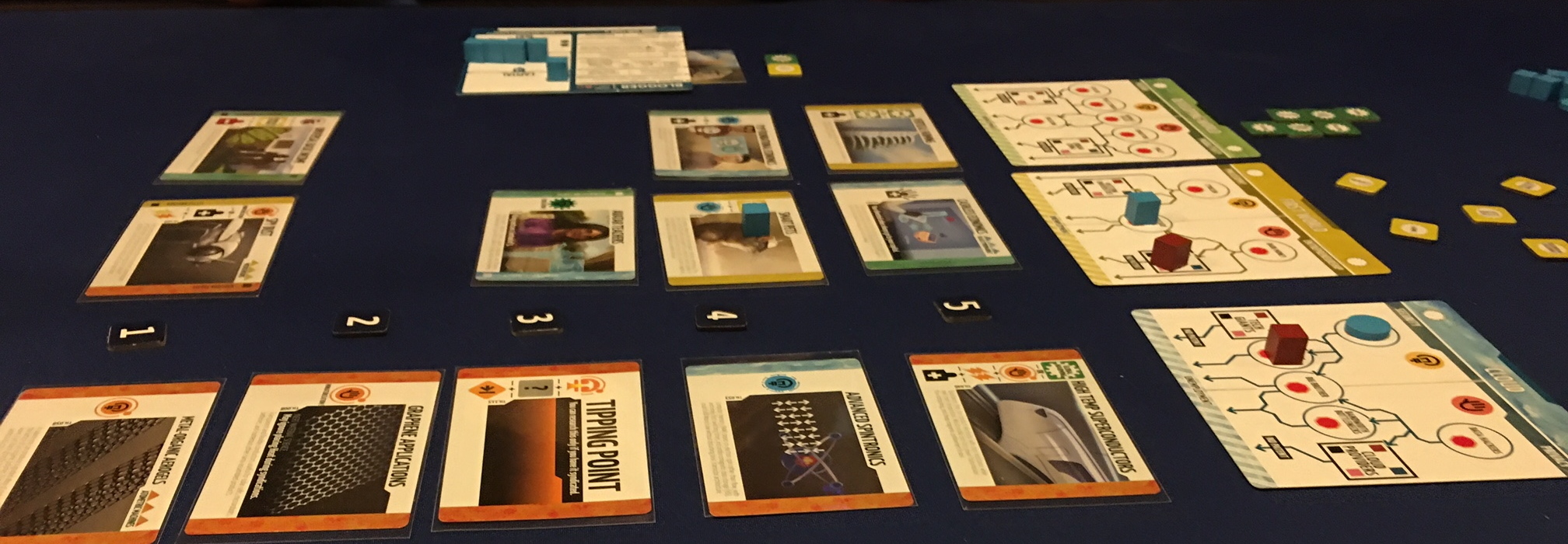
There are four major interlocking parts to Pax Transhumanity. First is the Market which is a conveyor of cards that replace a card auction, random draws or drafting. Each of which may or may not effect play during the game depending on what the players do. These cards can be funded by syndication, researched to give patents or commercialized to score points or have other effects.
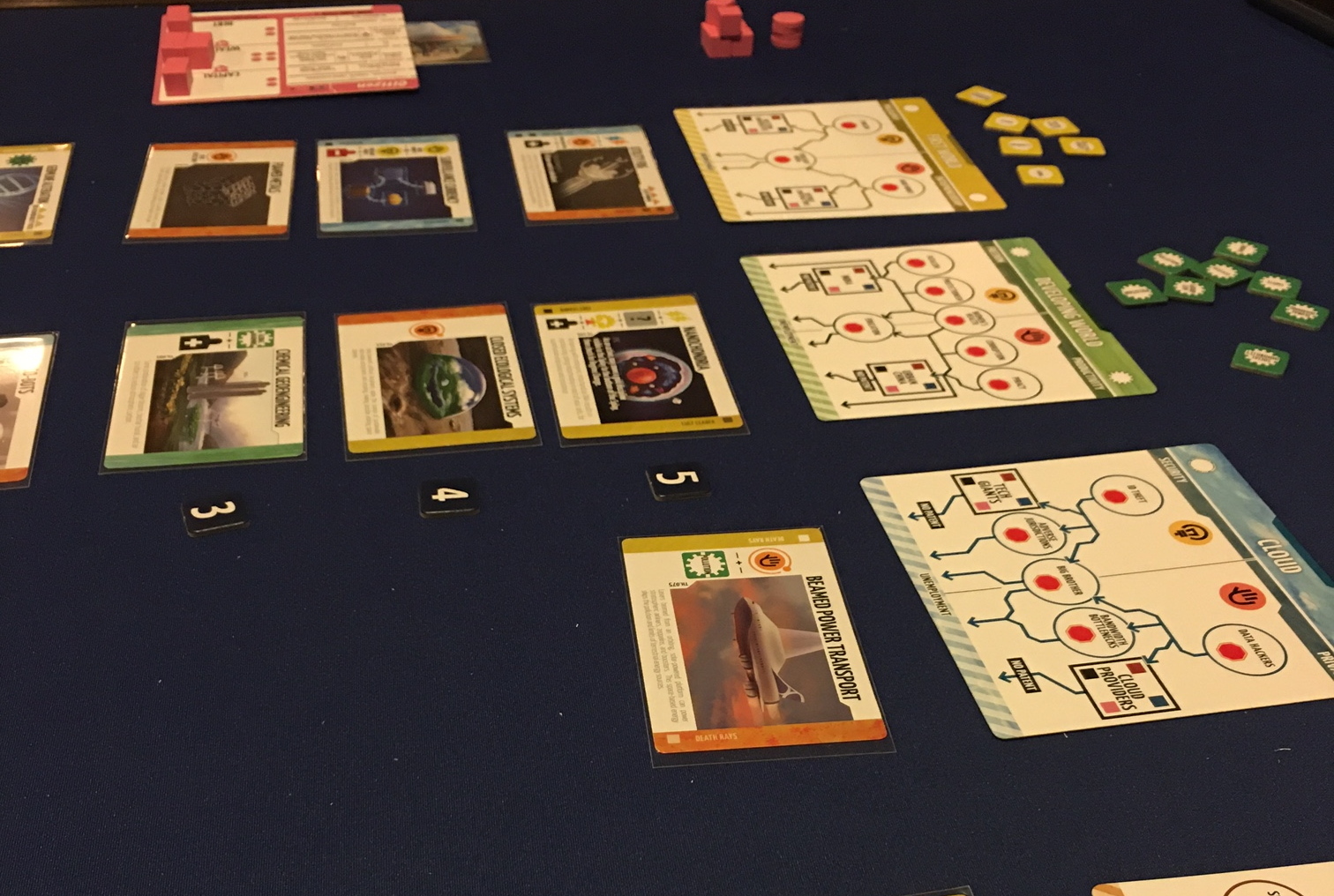
Second is the finance board, which totally removes the need for money chits or tokens from the game and was obviously the inspiration for the Riverfolk in Root. On this board each player has cubes that reside in Capital (best), Wealth (OK) and Debt (not good). They move down to generate needed money or move upwards when players fundraise. This is the only currency in the game, and it’s brilliant.
Third are the ‘Sphere’ boards which are assigned to each of four markets. These spheres represent areas in the game where the market is active, much like the refugia from Bios Genesis. The spheres are First World, Third World, Cloud and Space. These also hold where the problems reside as well as sphere-specific companies and utilities. Spheres are the strangest and most important part of the game, so if you sit down to play this, make sure you know what these do.
Spheres allow players to generate the work needed to do research and to commercialize from either companies or public utilities by hiring workers. Workers are represented by player cubes (employees) that move down the Sphere boards when they do work. For example, if a player wants to research an idea in the Cloud, he must have an ‘idea’ worker in the cloud sphere. If he would like to commercialize that same idea, he must have a ‘maker’ worker in the cloud sphere. This was difficult to grok at first, especially since where the worker comes from (a company or utility) defines what can be done with the work in the case of research (patents or the think tank).
Fourth is the human progress splay which represents technological progress for all human kind, or at least, for the player’s technology companies. The splay serves two purposes. First it makes ideas in the market viable for commercialization based on the color pairs in the splay. For example if there is a color pair of blue/green in the splay, blue/green idea cards are viable for commercialization from that point on. Second it is a repository for agents that are keeping down ‘heat’ around a technology advance or exposed heat that will come back to bite the players up the ass when there are nuclear exchanges (representing periods where society becomes unglued). For example, Dr. Fauci and his catamite Christian Andersen would be considered agents in this game, agents whose sole purpose is to keep the heat off of people working on gain of function research on coronaviruses which their controllers (i.e.: you in this game) funded and commercialized in the form of a coronavirus vaccine (which is an amazing technological advance if they can make one that works for more than a few months and doesn’t cause 300+ standard deviations above the mean serious adverse reactions compared to the flu shot @_@). Funny how that is all modelled in this game!
The idea market seems familiar to Pax players (and Bios too) but you never ‘own’ any of the cards in the game and there is no player-only tableau. Cards in the market can be Syndicated which means their special rules text applies to that player or in a player’s think tank (also allowing special rule effects) or residing in the ‘human progress splay’ which again is a marker for the technological progress of human society as a whole.
Idea cards have a color pair (like blue/green) and various impacts that happen once they are commercialized. Most of these solve some problem and the player that commercializes the idea gains that problem chit as a potential victory point. Idea cards may also allow companies to be created, more agents to be added to player’s finance boards or other positive or negative game effects.
The pathway to victory lies in choosing cards you want to commercialize and then work towards that by making them viable either via patents you have or your think tank (both created via research) or wait until it becomes viable for all via the human progress splay. You need work for all this, so hiring workers into companies, creating companies or using utilities effectively is a big part of the game.
The kicker is that the human progress splay controls what the current ‘world regime’ is, which determines what scores more points than other problems. If you want to cut out the mystery, go for the Tycoon victory and create companies. If you go the problem route, you need to make sure that the global regime is in line with your problems/companies when the game ends, or alternatively NOT in line with your opponents. Game ends when a “tipping point’ card is commercialized (most of the time…).
Orange-Orange all the way up inside the Cloud.
Whew, that’s a lot. Like Pax Ren, there are some difficult mechanisms to deal with in the game and timing them is critical. For example, when to research, when to commercialize or when to move cards from one market to another are clutch choices to stop other players from going after things you don’t want them to. Most of this won’t be evident the first time you play the game, so you have to get over the hump a bit with plays before the strategy is able to come out. Again, I equate this to the timing and orchestrating of revolts in Pax Ren– not an easy thing to handle since there are so many types with so many different effects.
Now to the review part (finally). There are some ticky-tacky parts of this game that may reduce your enjoyment of it, even after a few plays, but what will start to fascinate your and other players is the sheer madness that starts to occur when the market is laid out at first and then when the Cloud and Space markets are all filled with cards. The possibilities become maddening as there are just so many mechanics to play with. There is a shitload of idea cards and only 38 of them will show up potentially in any game. If Open Source Sexuality is a critical part of your strategy, there’s no telling whether it will be in any game or not. Sometimes a bunch of very powerful idea cards all start in the game at the same time and cause chaos in the market and human progress splay, or set the game up for massive casualties later with tons of black heat that player’s couldn’t afford a Dr. Fauci to cover up early game.
This chaos mitigation is what I love most about the Pax series of games. You just never know what will happen either from other players actions or the market. Opportunities must be seized but at what cost and what will happen next. Transhumanity is less cut-throat than the other Pax games with little direct attacks (remember, there is no tableau in the game), however subtle moves or firing up a combo that lets you research critical cards out of the game or control the global regime via the splay are just as satisfying as the black and orange cards from Pax Porf.
Pax Trans has a very rough learning curve, and at times I thought it was more difficult to learn than Pax Ren, but if you stick with it, there is an amazing and nuanced game here that rewards multiple plays even in the same day. The game is not particularly long at all, and can be hammered out in about an hour and some change after your first game.
Player counts. I think at higher player counts, say 3-4, this is a bit of a rough ride due to turn angst. I would hazard to say that 3 is the max I would want to play with and this is quite a good 2-player game. 4 players– I’ve never played with that many but I might go insane waiting for my turn.
Heuristic issues are very few in this game, especially compared to something like Twilight Imperium, but there is one that bothered us and that’s remembering the two actions per turn. You only get two, which is the same as Pax Pamir and Pax Ren, but for some reason it’s hard to keep track if you have taken 1 or 2 actions in a turn. I think it’s because a few of the actions are very complex, such as research and commercialize where you are making work, spending money and triggering effects on cards. I know during all of my games I either took an extra action or didn’t take my second action and certainly so did my opponents.
Strategy and subtle combos abound in this game and reward multiple plays. They aren’t as bullrushy as Pax Pamir with it’s Free Action / Switch Suit /Free Action trickery, but combining favorable impacts with some of the powers that you’ve syndicated or think tanked is probably more satisfying. Winning the game is about either preventing the Tycoon company rush or doing it yourself most games. When that doesn’t happen and it defaults to problem scoring, you need to make sure the global regime favors your secret problem suit or you have overwhelming ‘open’ problems solved in that suit. It can be very tricky as the game goes on and more and more technologies become viable, the Human Progress Splay can become crazy. Lastly, you can destroy other players by posting your agents on black heat in the splay, so watch for those opportunities and especially card powers that let you retroactively add agents to heat late game. When the nukes go off, your companies will still be there and others will not, this is way more important than it seems in early plays.
Bottom line, this is an amazing design that has a ridiculously steep learning curve. It’s a cheap game (45$) and has a very small box so there’s little reason for you not to give this a shot, or coerce someone in your game group to buy it and try it out. Despite the difficult rules, this is very much worth giving a few tries.
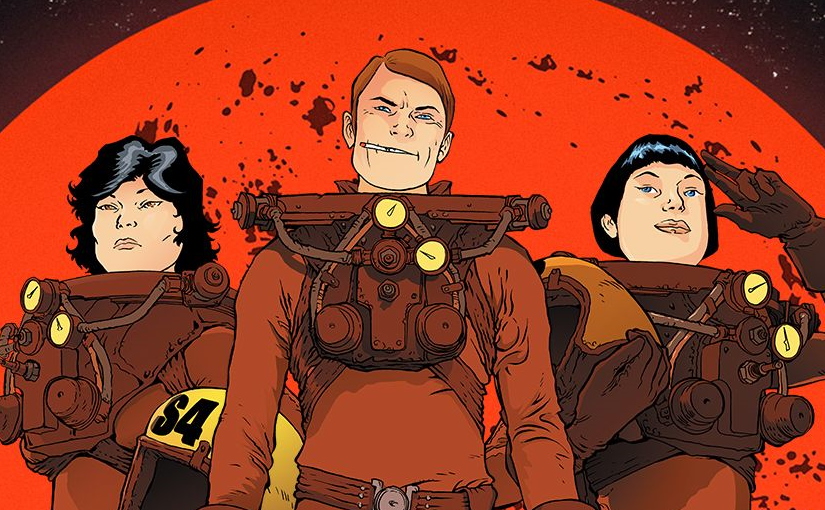
Another indy kickstarter I failed not to back. Based on a Graphic Novel (or maybe the other way around), this looks to be a similar game in theme to Stationfall as in: Space, Aliens, Paranoia, except this one is a deck builder. I got suckered in by the art, and then read more about the game and was impressed by what it is trying to do.
I’d like my character ability cancelled by Jenna Scott too.
While there’s a lot of the appearance of FOMO created around the CMON kickstarters, the recent purge of old Kickstarter exclusive content on Miniature market for SMOG, the Others, Hate (kickstarter only in the first place!) and other games means that no matter what is labelled ‘exclusive’ by CMON, it will always come out eventually, and sometimes at very reasonable prices.
The real FOMO is these little kickstarters from new companies that barely make their funding goals and if they don’t the games never come out. I remember an adventure game a few years ago with a really cool map/art that didn’t hit it’s goal, and was never heard from again.
Yes, you may be tempted by CMON, FF or various large publishing company’s kickstarters, but it can really pay off to check out what the small guys are doing (Dungeon Degenerates!), even if you get burned by some mediocre games from time to time (such as Murder at Devil Pines).
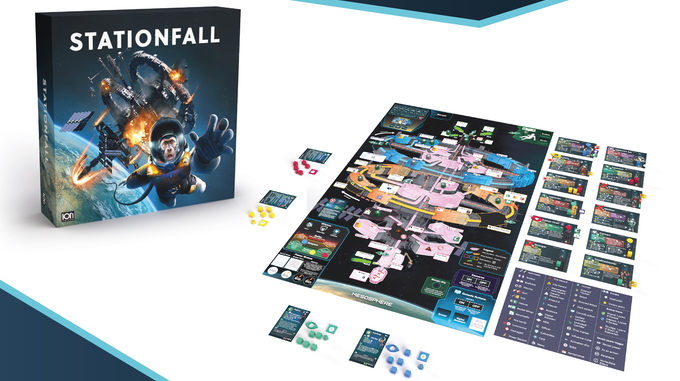
While my current stance on big publishers kickstarting games is— don’t back, I’ve been a sucker for some small or new publishers having their first go, as it should be. Making an exception with Ion Games (publishers of Pax, Greenland, Bios series games) is due to Matt Ecklund’s (and Phil Ecklund and Jim Gutt) Pax Porfiriana being astounding and becoming a new bell weather for what makes a good games. His last published game, Pax Transhumanity, is also an amazing design, and really grows on you the more you play. After listening to Phasing Player’s interviews with Matt on his games, I became stoked for his new game that just hit kickstarter: STATIONFALL.
This is a 1-9 player game that takes place on a collapsing space station where players have their own goals (not just the characters in the game). What this looks like to me is the Paranoia RPG in a board game– where people are trying to get characters back to base alive to tell the story about how X or Y other character wrecked the station/mission. All lies of course! Here is the BGG page.
There are so many… so damn many design-by-the-numbers worker placement engine building point salad games, anything that is in opposition to that gets my attention and should yours!
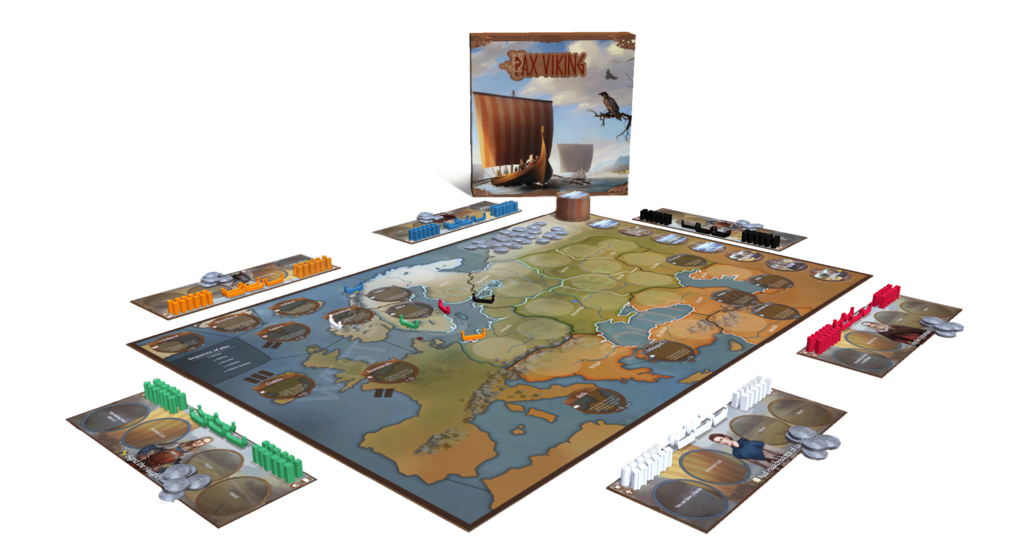
Ahhhhhhh the Pax series of games: complex, interactive, with inscrutable victory conditions and a cliff of a learning curve all inside tiny boxes with minimal components. With Pax Viking, now we have one that is not complex, and has (fairly) understandable victory conditions in a huge box! The question is: is this good? I think it is, as long as you set aside all thoughts of it being a Pax game or a Viking game.
I did not take any shots of the game so this one will have to do for now.
Our first go was with a whopping 5 players, and I think this is a bit too many for a first time out, not due to complexity, but due to the fact that no one knows what they are supposed to be doing and there’s quite a bit to unpack with the interactions.
You play as a Jarl who has a fleet of trading ships which are used to collect followers and open up areas on the map to trade with. This is not a viking/pillaging game regardless of what it says on the box: it’s a trading game.
Scoring (not necessarily the win conditions) is done via four tracks which indicate your Jarl’s influence over each of the four factions in the game: The Rus, the Swedes, the Jarls (warriors) and Religion. When you have majority control of one of these factions, you get a special action you can take that the other players can’t use.
Like all Pax games, Pax Viking has a market with 4 different types of cards: Gods (a type of follower), Patron (followers), Events (fuck you cards) and “Posts” which are places on the map that you can go and exploit/trade. As far as I can tell, posts represent opportunities on the map that only turn into actionable areas after you go there with your ships and open the opportunity up.
Turns consist of buying from the market, playing events, and moving your ships around the map or sitting them on a post to take the actions available there. The game reminded me a little bit of a rondel game (Great Western Trail) where you take actions at various spaces to build up resources for some other thing you are trying to do later. Unlike those games, you can move your ships around anywhere you want on the map. This makes planning a bit more difficult because there is no ‘on rails’ rondel you are following to force your choices.
Battles are super simple with no dice. If you have more ships, you remove one of the enemy ships and then push the rest out. No battle takes place with an even number of ships on both sides and you can never suffer losses as an attacker. It made me laugh as the act of killing is called “Parlay” in the game. ha!
Winning consists of fulfilling certain conditions before other players. There are 4 win conditions and these do not change–they stay static for the entire game an all four of them are open to be fulfilled from the outset. In contrast to the other Pax games, you do not beat the other players in some sort of contest after a comet/topple nor do you trigger the availability of a win condition that is now open to all players via an event. Instead, you race them to complete one of the conditions to win.
In thinking about this game and what it is mostly like– I would say certainly this is not like the other Pax games. The closest cousin to Pax Viking in my humble opinion is Merchant of Venus and Wasteland Express. If you like those two, you should definitely check out Pax Viking. It’s really not a traditional Viking game, it’s an ‘open up markets and trading game’ at it’s core. I’m interested to play this again with that in mind. When I squint my eyes a bit at this design I see a deep space trading game where you have two empires, a religion and some other faction that you are trying to succeed as a space trader in context of. That theme seems to fit this system a lot more than Vikings.
Rulebook is good. Graphic design is fair, components are good, Map looks good, though it’s tough to see all the rivers/access points sometimes. Character artwork is really boring and mundane, from the cover of the box to the pictures of the gods and the Jarl’s themselves. When you own TWO Viking games with art from the LEGENDARY Adrian Smith, it’s tough to stand against that favorably. When you are doing art representing a Norse god, it should not look just like any of the other normal characters in your game.
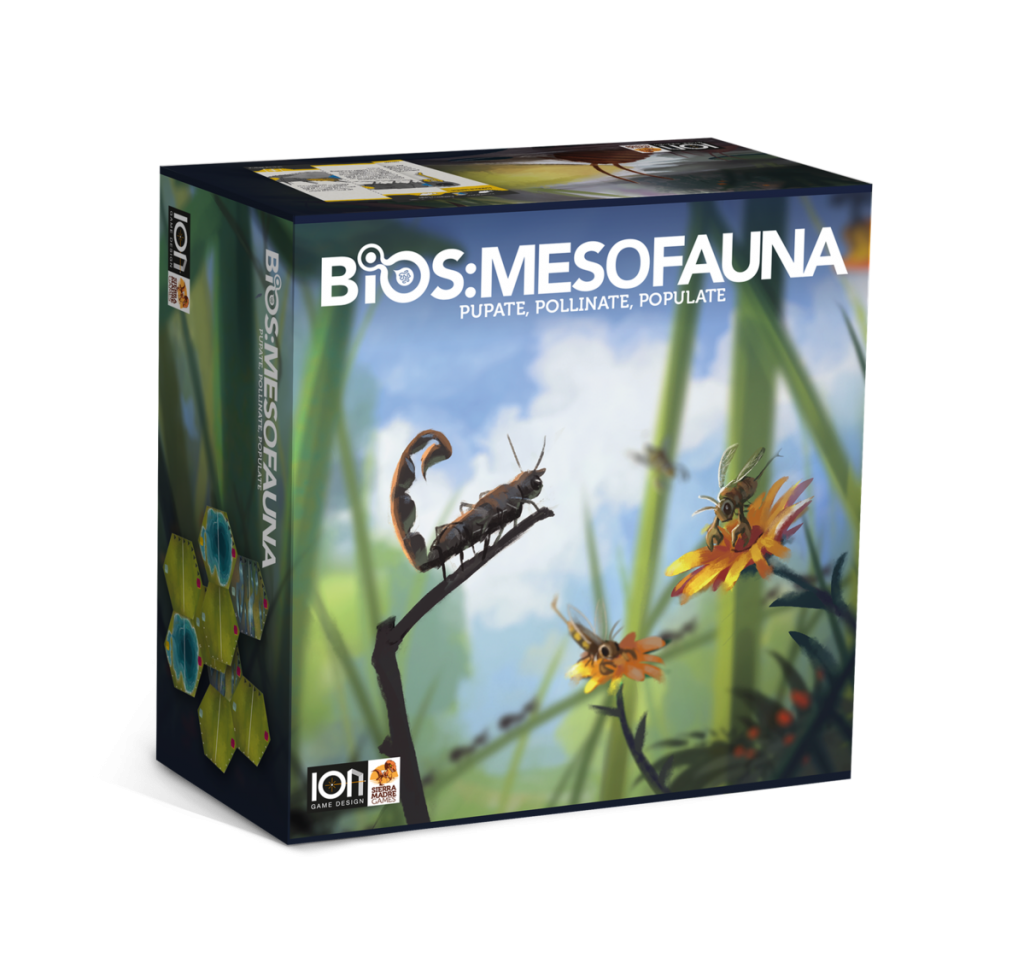
Next up for me from Ion Games is Bios Mesofauna– probably game of the year unless something comes out of the blue.
I wanted to start the year as I mean to go on, and PAINT SOME SHIT. I’ve actually done quite a bit of painting recently trying to get my copy of The Others to a state where I can play a game with all painted minis, but this week, with (almost) no more Goliaths to paint, I started a test model for my Van Saar gang.
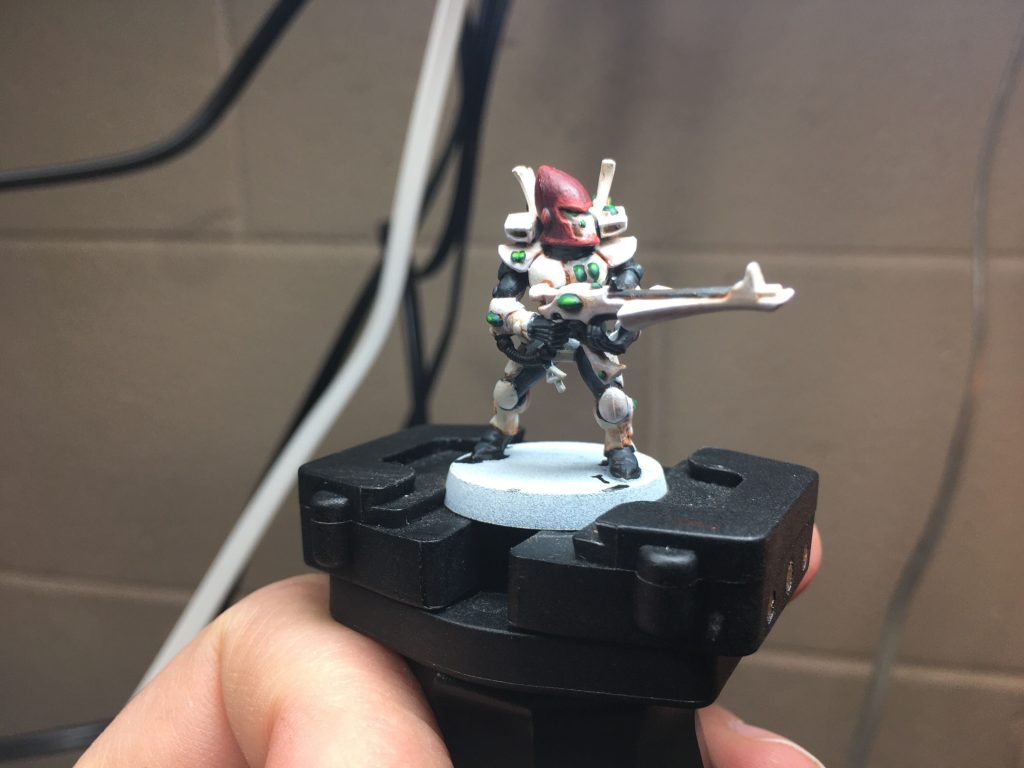
I started with a spare Eldar Guardian to test out the scheme and it turned out almost good enough to continue on to one of the Van Saar models from the excellent but very difficult to build GW kit. I have a bit of patience for painting, but NONE for putting shit together. Please help me.
I’m a very sloppy painter, so fantasy miniatures and grungy stuff (like Goliaths and Orlocks) are much easier for me. The Van Saar will take a lot of precise edge highlighting, which is not my strong suit.
Any way here’s the guardian:
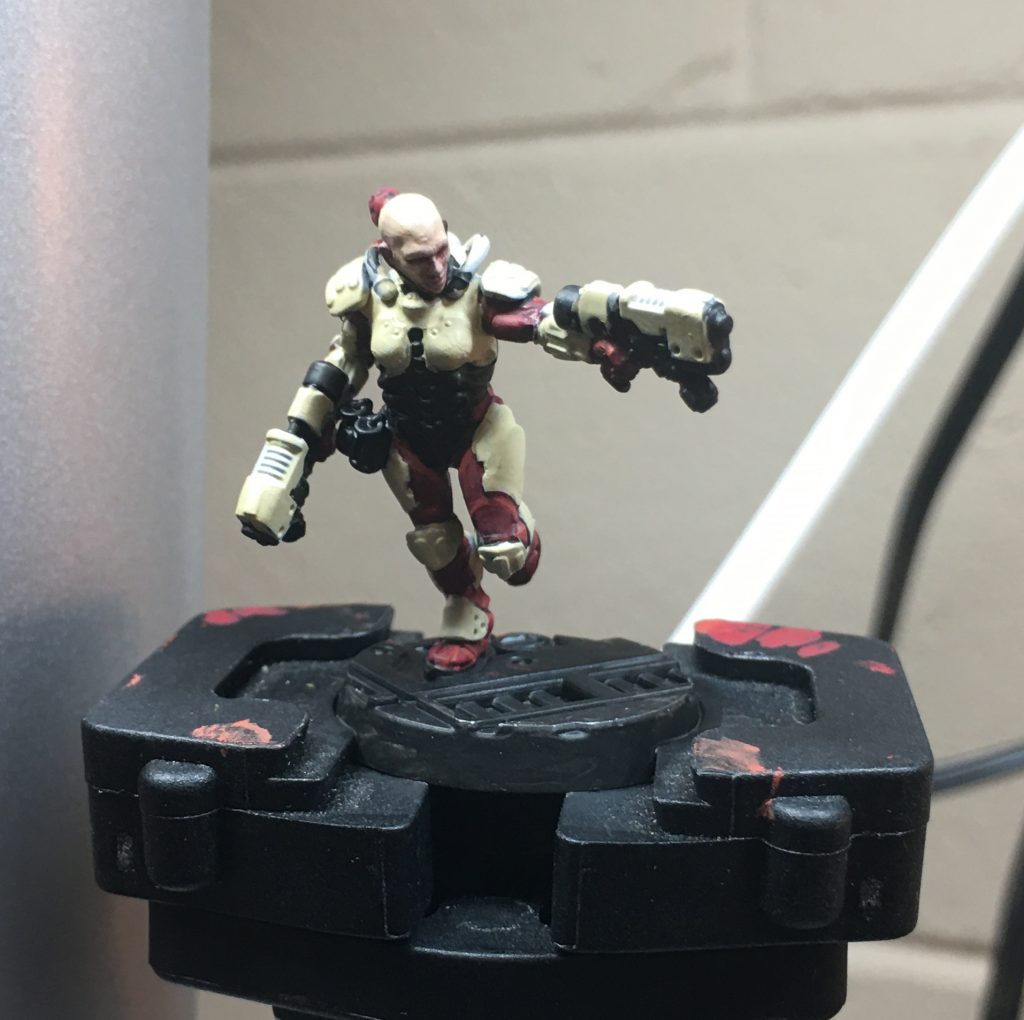
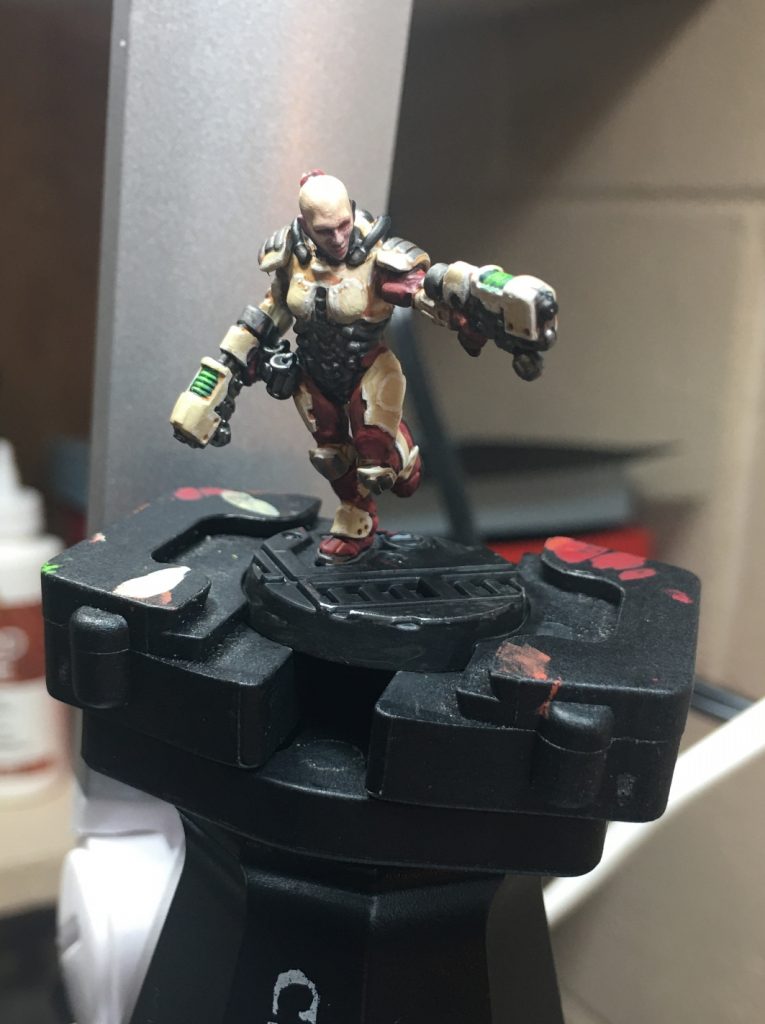
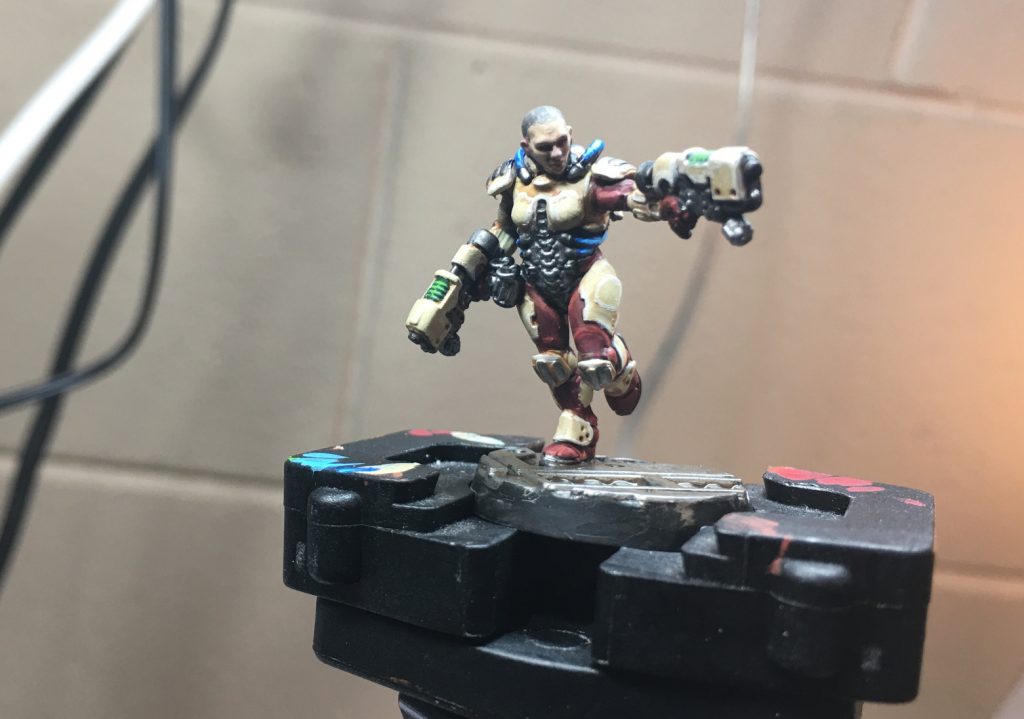
And here is the progress on the Van Saar.
Base ColorsJust after doing the metal, lots left to do but hard parts are done.Getting close to done.
The female heads in this kit have no hair, and it can look OK with just a pure bald head, but as I looked at it more, I just thought it looked lame with this color scheme as the skin color is not totally far from the high armor color, so I did a light grey wash over her tonsured scalp and there you go–looks a lot better. I’m going to get the Forgeworld Van Saar heads for the other females and other dudes. Those gals have hair!
She ended up looking a bit like Thug Rose (not that a Van Saar would ever smile).
Anyway, a start to the year of painting at least. If I can get these guys done by summer, it will be a miracle.
What came out this year that was great? Not much. 2018-to-now the majority of board game design has pretty thoroughly descended into extremely formulaic games with three specific traits in all: very little player interaction, a focus on engine building, with a point salad at the end (again, because if you knew who was winning, you would target them, and that’s a no no these days).
Root was a breath of fresh air last year in this rather fetid tide of same-gameness. Root showed to many people that you CAN and should have constant player conflict and this won’t hurt people’s feelings and most importantly, can be extremely fun. The body of my board game collection is held up by the spine of Cosmic Encounter, Dune, Shadowfist, Eclipse, Study in Emerald, Root and now the Pax games with everything else sort of filling in niche interests for me like euros (Brass) or co-ops / dungeon crawls (Massive Darkness). Almost all the games I like the most have direct player conflict and the potential for massive hamstringing, which is in direct opposition to the current trends in design. I’m hoping the success of Root will engender more designers to build COIN style games and gamers to take an interest in Cole Wherle, Phil Ecklund and the COIN series (and offshoots).
For many people this was a tough year to get gaming in face to face, but we managed it quite a bit later in the summer and especially Fall. Due to this, not quite as many games hit the table, especially anything new. Frankly having to learn new stuff this year felt tiresome with the infrequency we got to play– we went for the meat and potatoes this year: mostly shit we already knew how to play. I only played three new games this year, and one was a new version: Eclipse: Second Dawn, Godzilla: Tokyo Clash and Fort. Fort was not my type of game at all, and we only got one play in before I traded it, so game of 2020 that was released in 2020 is definitely Eclipse: Second Dawn... which is really just an update of a 2011 game after all.
Second Dawn is good, but it’s MUCH harsher than the first edition with serious players. You get one shot for the win now that it’s down to only 8 turns, and if you have a bad run of tiles, a really bad dice run in battles, there is no chance to come back into the game– you just can’t pivot to another strategy like in the old game. Some players will like this, others will not. I will definitely need to play Eclipse more before deciding on which of the versions is better. I hate to say it because I absolutely despised Twilight Imperium 3rd edition, but I have to give TI4 a try before calling Eclipse the reigning king of 4X space games. You know, ones that can actually hit the table instead of just sitting on a shelf because they are too complicated or system-heavy to actually play.
The game of 2019 was Root, and I really played the shit out of that last year and quite a few times this year as well, we shall see if lightning can strike twice with Leder games upcoming Oath game– which looks very…. strange.
This year the game I liked most to play was Pax Renaissance, and this isn’t even my favorite Pax game (which is Pax Porfiriana of course), it’s just the one that shows off what this type of tableau and conveyor market type of game can really do. Instead of just drawing cards or chits from a cup (a la Gangland, the Great Khan Game, King of the Tabletop), you can see what’s coming and control events to some extent. This is one of the best aspects of the Ecklund (pretty much everything) and Wallace games (Princes of the Renaissance, Study in Emerald) I love the most. Pax Pamir is a solid game, but because it uses points for victory, which is very strange compared to the other Pax games, it’s out of the running for the best Pax games– still really good though.
In light of 2020, I don’t think there will be much in 2021 that can compete with existing games, hopefully there will be some surprises. Kickstarter-wise I’m waiting on Oath, Bios Mesofauna, the new edition of Pax Renaissance, Pax Viking and what will probably be another mountain of boxes mistake: Bloodborne from CMON.
You read that right, 13th Age in Minaria— the campaign setting from TSR that never was, and could have been.
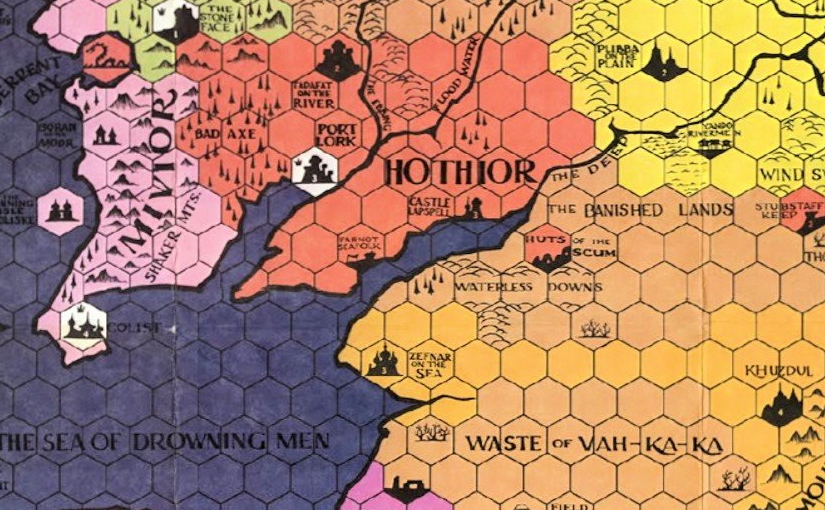
For the non old-person, Minaria is the fantasy world created for the Divine Right board game, which many of us had as kids in the 80’s. While the game was a bit labyrinthian for a 9-12 year-old as a hex and counter, the map board was on the wall of my bedroom for at least 15 years. The map and counter art is by Dave Trampier, and is amazing. The Tower of Zards, Invisible School of Thaumaturgy and all the awesome mercenary units (like Hamhara the dragon) were incredibly fertile ground for the imagination as a young and now older mainge.
The mystery is why this was not turned into a Greyhawk style campaign setting by TSR as all the assets were right there– just needed someone to start writing modules for it! There were multiple articles in Dragon Magazine on Minaria and it’s environs. Anyway, time to redress this issue!
13th Age and Minaria are a great combo as the 13th Age world itself is godless and pretty generic fantasy, especially since it has no gods which I’ve always found very strange. While Runequest has a bit too much to do with the gods for me, the 13th Age world just doesn’t seem grounded. The Icons in 13th Age are really just basic concepts and with Minaria, there are oodles of Icons that are far more interesting and engaging than the stock 13th Age ones. Yet on the plus side, you have the amazing 13th Age system, which is probably my most run RPG in the last 5 years or so. While Minaria is not explicitly high fantasy, it has enough of those elements to fit well with the more gonzo fantasy of 13th Age. Minaria and Divine Right are still products of the Gonzo TSR age.
I’m not GMing this one, which is a great break from almost always GMing and I get to play a rogue, so far my favorite class for the game (among many awesome class selections). The fun part about the rogue is that you can bounce around the combat area almost at will, you rarely get stuck, and you can hammer enemies.
I’ve only been in two sessions with the group so far and we are in some rather familiar house by the sea near Port Lork at the moment… and we’ll see where this goes.
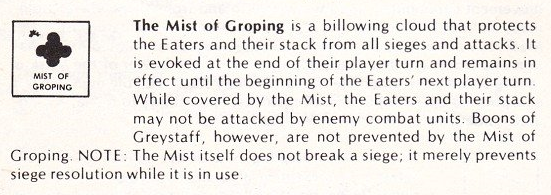
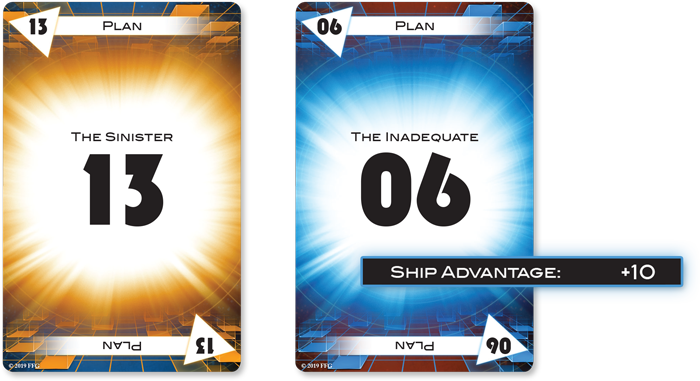
I have no idea how this plays, but am very curious. I don’t play a ton of 2-player games, preferring the 3+ for most of my board gaming, but of course, it has to be purchase because it’s Cosmic Encounter.
I LOVE the titles on the ‘attack’ cards (a few listed above). They should put that into every new version of Cosmic from now on.