Why do we play board games? It’s a question I’ve rarely asked myself or group as it’s been so ingrained in my hobby time that it really needs no answer at this point other than “because we do.” Yet, I think the WHY is all about creating the dynamics of conflict within an explorable system that is outside the realm of any real conflict. Of course, Cormac McCarthy put it better in the words of the Judge:
“Men are born for games, nothing else. Every child knows that play is nobler than work. He knows too that the worth or merit of a game is not inherent in the game itself, but rather in the value of that which is put at hazard. Games of chance require a wager to have meaning at all. Games of sport involve the skill and strength of the opponents, and the humiliation of defeat and the pride of victory are in themselves sufficient stake because they inhere in the worth of the principles and define them. But trial of chance or trial of worth, all games aspire to the condition of war, for here that which is wagered swallows up game, player, all.”
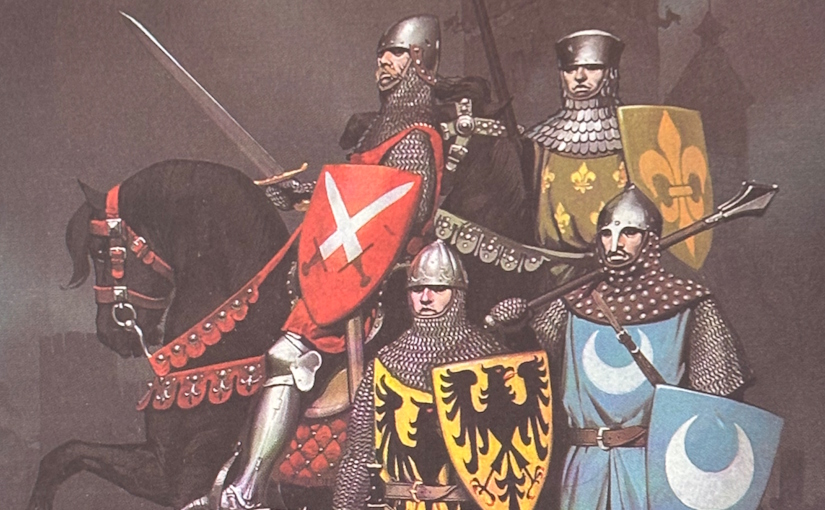
Yet a lot of games these days aren’t about conflict at all, they are more like a knitting circle where people sit around for awhile and then show what they made (I did not make this up, there’s a meme around that I got this from). Root and other games like it pushed against this trend hard, but for a long time, there were tons of games with actual ‘dudes on a map’ conflict. With that, let’s talk about Derek Carver’s 1985 classic Warrior Knights, later redeveloped completely by Fantasy Flight into their version. Both are good representations of design ideals of their time (1980s, early 2000’s respectively), the 1985 game especially so.
To start with, I have huge respect for Carver who has given several telling interviews about his design process. He simply made games and played then every week at his house with friends. Games like the ones he wanted to play did not exist (1970’s and 1980’s), so he just went and made them, not to fill a gap in published games (like area-control deck builders after deck-builders were a thing) but just to play. People that came to his house spread the word about some of these games (like Durance Vile which later became GW’s Dr. Who and if I was to guess, influenced Dungeonquest and Talisman in no small way) and some of these folks were at Games Workshop and asked to publish them. Carver did not make games to shoot out the door for publishing and hit some market, he just invented games and played them– a lot. It wasn’t playtesting, it was just play. This is quite a difference from what happens when I go to protospeil events or playtest with friends to the point where personally I will never ask anyone again ‘do you want to playtest a game for me’ but rather ‘would you like to play a game I made?’
After a long time of owning the game (almost 8 years!) I was on a Warrior Knights kick (the Fantasy Flight version) and wanted to do a comparison, so I dragged out Carver’s Warrior Knights and I was shocked even while learning the rules: the game is the absolute antithesis of modern board game design with the following aspects that HORRIFY modern gamers:
- very long (3+ hours) with an emphasis on the +.
- potential player elimination (people can come back, but they are weakened badly)
- insanely random events that can wreck not just the leader, but any of the players, which cannot be avoided when they happen
- A political phase with tons of negotiation that is central to player advancement /victory in the game
- Stealing cards from other players both via voting and on the battlefield
- Requires pencil and paper for various things in the game
- Has a combat CRT using a single D6
- You can trade money and cards back and forth between players at any time
What was amazing is that despite everything listed above, everyone had a total blast. The rollercoaster this game generates is absolutely insane. For example, I sent my noble with the biggest army I had to Acre to do a little crusading for cash. All was going well and the siege of Acre was well underway. An event showed up that targeted my noble, but I though ho ho! he’s outside the normal map, but as it turns out, a peasant that noble had somehow offended had snuck onto one of the ships and murdered him in revenge, dissolving my biggest army in an instant. My only benefit was to be able to use that as a wedge to get people to attack someone other than me, or help me with votes in the Assemble. Broken-wing style players can constantly complain about bad events they got to get sympathy votes politically, and people to ease up on them in military conflict, people can sneak in stronghold attacks on unsuspecting players, players can be voted off the island in the Assembly phase and watch while their barony is schralped out by vulture players.
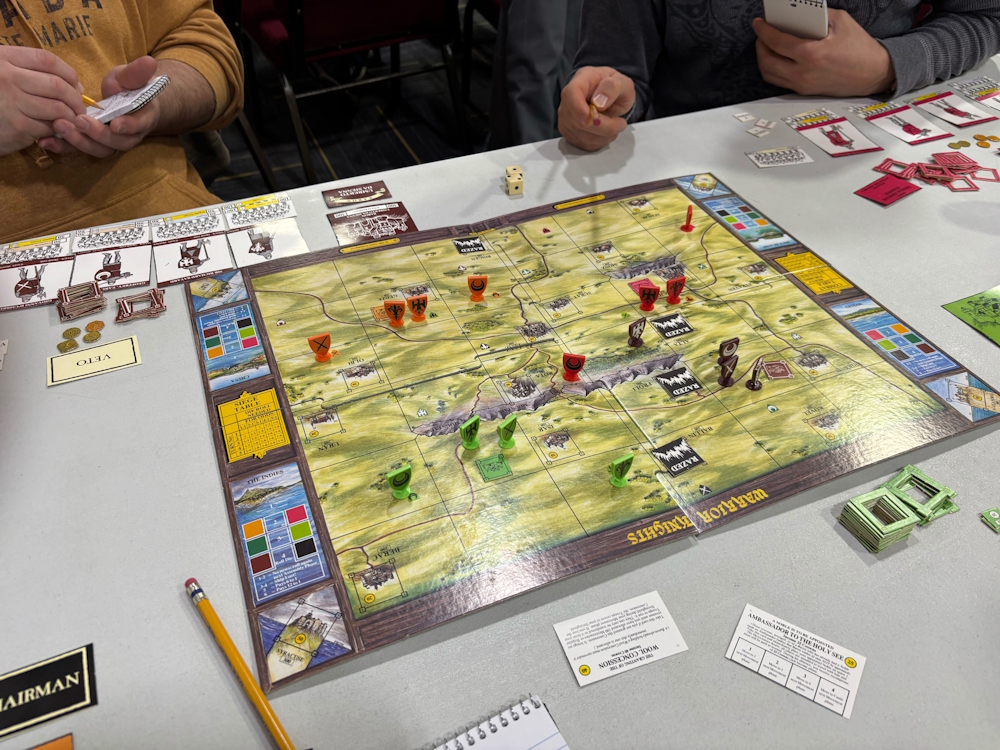
This version of the game accomplishes this with few rules, and what rules there are, are usually quite simple. It is absolutely possible to pick up the rules in the first turn of the game and have a decent chance of winning against experienced players because like few other games of this depth, the rules get out of the player’s way so they know what their choices mean.
A few weeks later, I got a 5 player game and while longer, it was also really quite excellent, though one of the players’ goals was to end the game as quickly as possible so went around and razed as many cities as possible to reduce the win conditions. This reduced incomes to a trickle, forcing the massive legions of the mid game to dwindle to shells of armies.
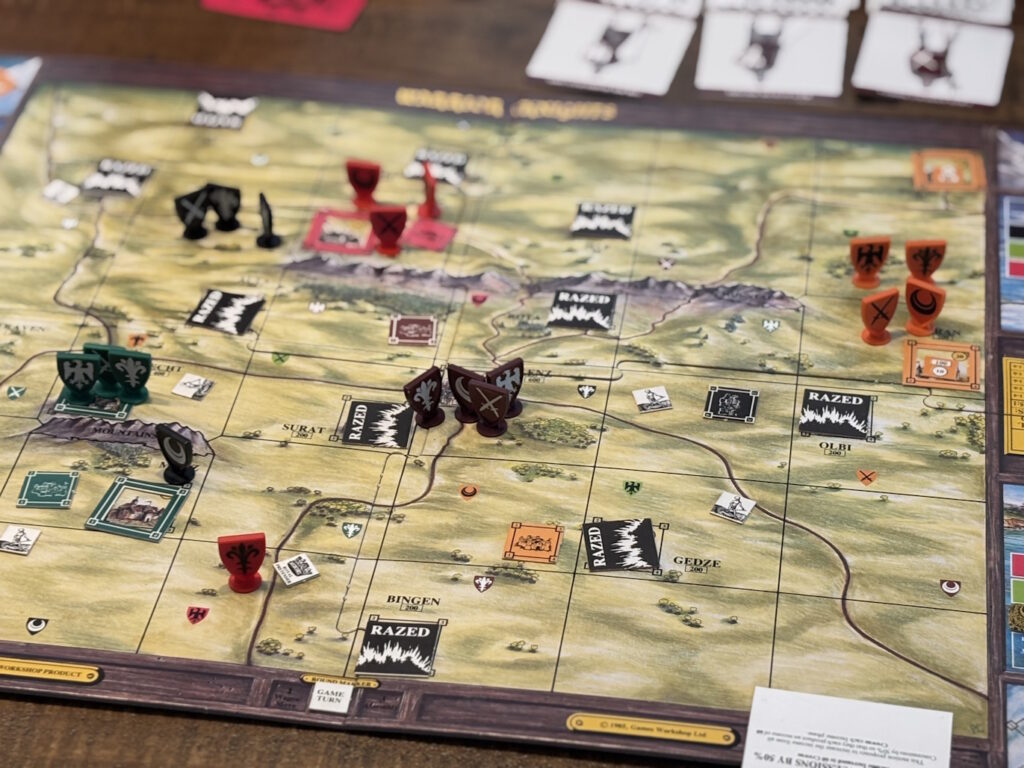
So this is definitely going into rotation and I am amazed there isn’t a modernized (components, cards, board) version out there of this.
I should have bought this in the late 1980’s or at the latest 1990’s and played, a lot. I blame the entire state of Florida for this oversight on my part.