RPG’s 2009, the year of Megacomplexity – part 2

Megacomplex RPG’s of 2009:

This is part 2 of a long ass post about the year of the most complext RPG’s.  Here is the first bit.   Below three RPG’s from 2009 that I want to discuss as testament to fulfilling player’s desire for maximum options, asymmetry and complexity. All three are fairly playable in their base format to some extent, but with their variable player powers, options, and therefore need of playtesting, all are considered behemoths in terms of system mastery.  This is not to say that they were all released in 2009, but in the case of Exalted, it was at it’s maximum popularity at this time (as far as I can remember).

Was she really so bad?
Was she really so bad? Or was it just the combat system?

Exalted. This tops the list of RPG’s that were popular in 2009 and …extremely complex. While the 2nd edition had been out since 2006, and frankly Jon Chung and that crew had broken the combat system already, 2008/2009 saw the release of a massive number of Exalted books, including what I consider the most complicated and confusing RPG publication I’ve encountered: Exalted the Fair Folk. This tome I just don’t get, and still have no idea how to create a Fair Folk character for my players to fight. The tough part about Exalted is that you, as a GM, are forced to make enemies with the same level of detail as the player characters (like Champions or Marvel Heroic RP). After a couple weeks of scratching my head, I just threw in the towel on this book, which was sad because the Fair Folk ARE the critical enemy in the Exalted universe.  The book is beautiful and fun to read, but it’s fucking useless for gaming. Of these three games, Exalted was the game that I gave the most attention and play to, and while it was what brought me back to RPG’s after about a year drought, it was a harsh mistress. I probably ran 20-30 sessions over the years and most were extremely rules-heavy combat sequences. Many of which turned out quite awesome, but at what expense? Tons of dice, massive requirement of system mastery by the players and an UNGODLY amount of work creating balanced encounters and antagonists for me, the hapless fucking GM. And for all the complexity, so easily broken down into an optimum set of charms and powers to ensure 100% success rate against players or antagonists built the same way.

I think it was the fact that the core combat system had so many steps to each action that it just went berserk as charms (the character’s powers–and enemy’s) started messing with each of those steps in an almost Cosmic Encounter-like fashion.  The designers probably thought– oh we haven’t had many charms that have dealt with X combat step yet, let’s throw some in.   In addition, the setting was extremely tied to the mechanics giving rise to arguments crossing both on various forums.  People would argue that X event could not have happened in the Exalted timeline if Chungian Combat was in place because Y Solar cannot conceivably have been killed by Z opponents…crazy fun but did make a good game to play? Some love, some love/hate.  Once my players started defensively stunting, I was done with the game.

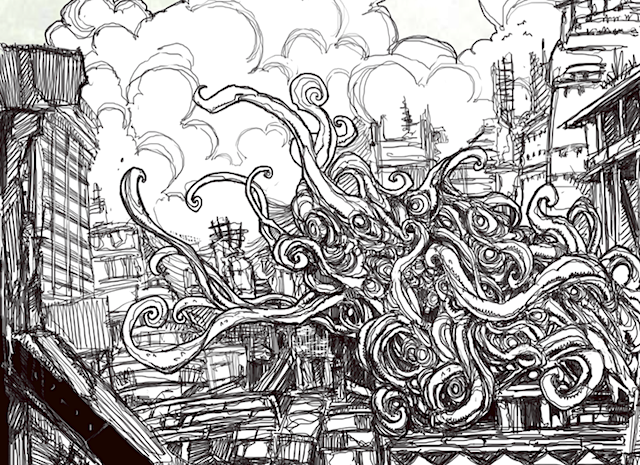
Monster/Antagonist stat blocks are huge indicators of difficulty/complexity for an RPG, especially for the hapless fucking GM.  It’s not the only measure, but when I check out a new RPG, I always look at monster/fighter stat blocks second, after reading the combat section.  As a base to compare the others, let’s look at a modern B/X stat block from the (amazing) Carcosa book circa 2011:
greatold

No Appearing: Unique
Armor Class: 19
Hit Dice: 20
Move: 120′
Alignment: Chaotic

This god is a vaguely humanoid hulk, about 20′ tall and partially scaled.  No one has ever clearly seen it since palpable darkness emanates from it’s body.  It does 3 dice of damage in combat, plus everyone within 30′ of it takes 1 die of damage each round from the crushing feel of oppression that accompanies it.

This block, for one of the most powerful entities possible to encounter, tells us how hard it is to hit with a weapon, how easy it hits others (+20 to hit on a D20), how fast it moves and how much damage it does, plus a special ability– all in 9 lines or so.  To me this is only missing Morale (which was the author’s choice not to include in the Carcosa supplement) but is otherwise complete and INCREDIBLY efficient at giving the GM the information he needs to run it at the table.  9 Lines– for a great old one!

Let’s look at a similarly powered entity from EXALTED.

Gervesin, the Greiving Lord
Demon of the Second Circle, The messenger soul of the green sun

Attributes: Str 7, Dex 4, Sta 4, Charisma 5, Manipulation 4, Appearance 4, Perception 4, Intelligence 4, Wits 3.

Virtues: Compassion 3, Conviction 4, Temperence, 3, Valor 4

Abilities: Athletics 2, Awareness 2, Dodge 2, Integrity 5, Investigation 1, Linquistics 3, Lor 2, Martial Arts 1, Melee 5, Occult 2, Presence 1, Resistance 5, Stealth 1, Survival 1, Thrown 5, War 4.

Backgrounds: Backing 3, Cult 1

Charms: (these are in another book to find out what they all do): Commandeer, Essence bite, Essence plethora, Fruit of living essence, Hollow out the soul, Hoodwink, Hurry Home, Materialize, Meat of broken flesh, Ox body technique, Portal, Possession, Principle of Motion, Shapechange, Spirit Cutting technique, Stoke the Flame, First Integrity, Melee, resistance, thrown Excellency, Second Melee and Thrown Excellency, Third Integrity, Melee, Resistance, Thrown Excellency, Divine Melee, Thrown Subordination, Infinite Melee, Thrown Mastery.

Join Battle 5

Attacks:
Thrown Green Spear: Speed 5, Accuracy 14, Damage 15L, Parry DV7, Rate 2 (ETC)

Soak: 17L/19B

Health Levels: -0/-1/-1/-1/-1/-1/-1/-1/-1/-2/-2/-2/-2/-2/-2/-4/Incapacitated

Dodge DV 7, Willpower 10, Essence 7, Essence pool 130, 

Other Notes: None (thank god).

Well by the iridescent balls of the Unconquered Sun, this is an insane amount of information– and even looks simpler that it actually is.  You can get the base attack dice from the stats, but you have to look into the charmset thoroughly to determine the essence cost for attacks that add more dice PLUS any charms that could be used at the various steps in the combat.  The number of powers this guy has is not unusual at all– and is really a metric ton compared to the B/X creature.
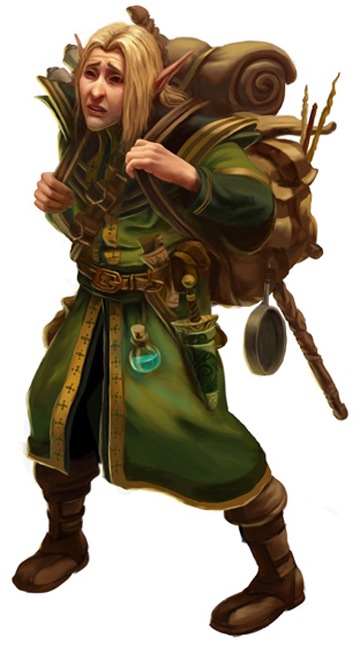
Overburdened in Pathfinder means nothing, in OD&D it means death.
Overburdened in Pathfinder means very little, in OD&D, it means laceration in the legs or feet, followed by a sharp blow to the head, followed by death.

Pathfinder: 2009 was the year Pathfinder, or D&D 3.75, was released. It is now literally a household name in RPG circles for maintaining the D&D 3.0 style of play. While extremely popular, which may preclude it from this list, I think Pathfinder gets off far too easy on the complication scale because it is so widely known (being the third iteration of D20) and the core concepts are fairly accepted. However, let’s face it, this version of D&D, while getting out of the 2nd edition doldrums back into a really good base ruleset, is needlessly complicated with simply a rule for everything, tons of classes and ridiculous system mastery for the GM. With rulebooks that have the smallest type I’ve seen, if this wasn’t considered the pinnacle of D&D to some, who likely bought the Pathfinder book as a new version of a system they were already using, I think this would be a hard sell to anyone, especially these days where the barrier to entry on this complex of a system won’t be mitigated by having a very different experimental D&D version concurrently on the shelves in 4th Edition.  That is, think about if Pathfinder came out TODAY. Even when I was heavy into Exalted, I picked up the book at Gencon 2009, read about half a page in the combat section and set it aside.  People love it, and it’s got some great adventures if you include all of 3.0/3.5, but give me nearly any OSR clone in existence to run them rather than this beast.  It was good in video games though (Temple of Elemental Evil that is).

and a monster stat block for Pathfinder around the same level as Gervisin and the B/X Great Old One stat block:

Cthulhu CR 30

XP 9,830,400
CE Colossal aberration (chaotic, evil, Great Old One)
Init +15; Senses darkvision 60 ft., true seeing; Perception +52
Aura unspeakable presence (300 ft., DC 40)

DEFENSE
AC 49, touch 29, flat-footed 44 (+12 deflection, +5 Dex, +10 insight, +20 natural, –8 size)
hp 774 (36d8+612); fast healing 30
Fort +29, Ref +29, Will +33
Defensive Abilities freedom of movement, immortality, insanity (DC 40), non-euclidean; DR 20/epic and lawful; Immune ability damage, ability drain, aging, cold, death effects, disease, energy drain, mind-affecting effects, paralysis, and petrification; Resist acid 30, electricity 30, fire 30, sonic 30; SR 41

DEFENSE
Speed 60 ft., fly 200 ft. (average), swim 60 ft.
Melee 2 claws +42 (4d6+23/19–20 plus grab), 4 tentacles +42 (2d10+34/19–20 plus grab)
Space 40 ft.; Reach 40 ft.
Special Attacks cleaving claws, constrict (3d6+23), dreams of madness, Mythic Power (10/day, Surge +1d12), powerful blows (tentacle), tentacles, trample (2d8+30, DC 51)
Spell-Like Abilities (CL 30th; concentration +42)

Constant—freedom of movement, true seeing
At will—astral projection, control weatherM, dreamM, greater dispel magic, greater teleport, insanity (DC 29), nightmareM (DC 29), sendingM
3/day—antipathy (DC 30), demand (DC 30), quickened feeblemind, gate, weird (DC 31)
1/day—implosion (DC 31), summon (level 9, 2d4 star-spawn of Cthulhu 100%), symbol of insanity (DC 30), wish M

STATISTICS
Str 56, Dex 21, Con 45, Int 31, Wis 36, Cha 34
Base Atk +27; CMB +58 (+60 bull rush, +62 grapple or sunder); CMD 97 (99 vs. bull rush or sunder)
Feats Ability Focus (nightmare), Awesome Blow, Combat Reflexes, Craft Wondrous Item, Critical Focus, Flyby Attack, Greater Sunder, Greater Vital Strike, Hover, Improved Bull Rush, Improved Critical (claw), Improved Critical (tentacle), Improved Sunder, Improved Vital Strike, Power Attack, Quicken Spell-Like Ability (feeblemind), Staggering Critical, Vital Strike
Skills Fly +36, Knowledge (arcana) +49, Knowledge (dungeoneering, engineering, geography, history, nature, planes, religion) +46, Perception +52, Sense Motive +49, Spellcraft +49, Swim +70, Use Magic Device +48
Languages Aklo; telepathy 300 ft.
SQ compression, greater starflight, otherworldly insight

SPECIAL ABILITIES
Cleaving Claws (Ex)

A single attack from one of Cthulhu’s claws can target all creatures in a 10-foot square. Make one attack roll; any creature in the area whose AC is equal to or lower than the result takes damage from the claw.

Dreams of Madness (Su)

When Cthulhu uses his nightmare spell-like ability on a creature with one or more ranks in a Craft or Perform skill, he also afflicts the creature with maddening dreams. In addition to the effect of nightmare, the target must succeed at a DC 40 Will save or contract a random insanity. This is a mind-affecting effect. A creature that already has an insanity is immune to this ability. The save DC is Charisma-based.

Greater Starflight (Su)

Cthulhu can survive in the void of outer space, and flies through outer space at incredible speeds. Although the exact travel time will vary from one trip to the next, a trip within a solar system normally takes Cthulhu 2d6 hours, and a trip beyond normally takes 2d6 days (or more, at the GM’s discretion).

Immortality (Ex)

If Cthulhu is killed, his body immediately fades away into a noxious cloud of otherworldly vapor that fills an area out to his reach. This cloud blocks vision as obscuring mist, but can’t be dispersed by any amount of wind. Any creature in this area must succeed at a DC 45 Fortitude save or be nauseated for as long as it remains in the cloud and for an additional 1d10 rounds after it leaves the area. Cthulhu returns to life after 2d6 rounds, manifesting from the cloud and restored to life via true resurrection, but is staggered for 2d6 rounds (nothing can remove this staggered effect). If slain again while he is staggered from this effect, Cthulhu reverts to vapor form again and his essence fades away after 2d6 rounds, returning to his tomb in R’lyeh until he is released again. The save DC is Constitution-based.

Non-Euclidean (Ex)

Cthulhu does not exist wholly in the physical world, and space and time strain against his presence. This grants Cthulhu a deflection bonus to AC and a racial bonus on Reflex saves equal to his Charisma modifier (+12). His apparent and actual position are never quite the same, granting him a 50% miss chance against all attacks. True seeing can defeat this miss chance, but any creature that looks upon Cthulhu while under the effects of true seeing must succeed at a DC 40 Will save or be afflicted by a random insanity (this is a mind-affecting effect). The save DC is Charisma-based.

Tentacles (Ex)

Cthulhu’s tentacles are a primary attack.

Unspeakable Presence (Su)

Failing a DC 40 Will save against Cthulhu’s unspeakable presence causes the victim to immediately die of fright. This is a death and fear effect. A creature immune to fear that fails its save against Cthulhu’s unspeakable presence is staggered for 1d6 rounds instead of killed. The save DC is Charisma-based.

Woah.  Holy shit– for a D20 that’s an insane stat block. Powers, all these stats, all these acronyms too.  While a ton of information given in order to use this monster, this one is still less complicated than the Exalted block by quite a bit.  At least the powers are all right there in the description.   What’s more this is a monster you would rarely encounter and the Exalted block would be defeated by STARTING Exalted characters…
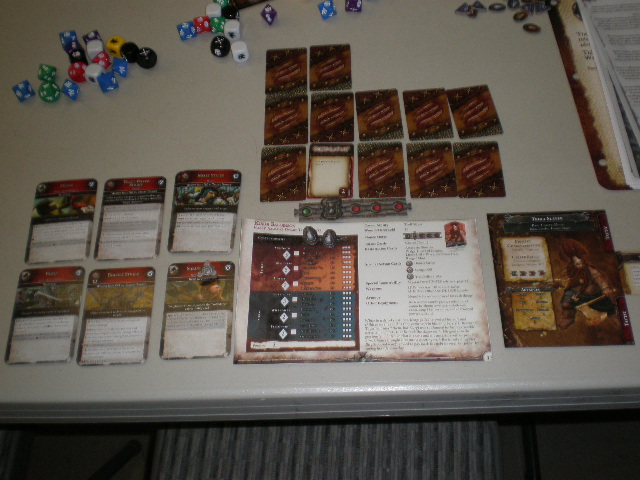
WFRP 3 character
A character sheet, and cards… and tokens…

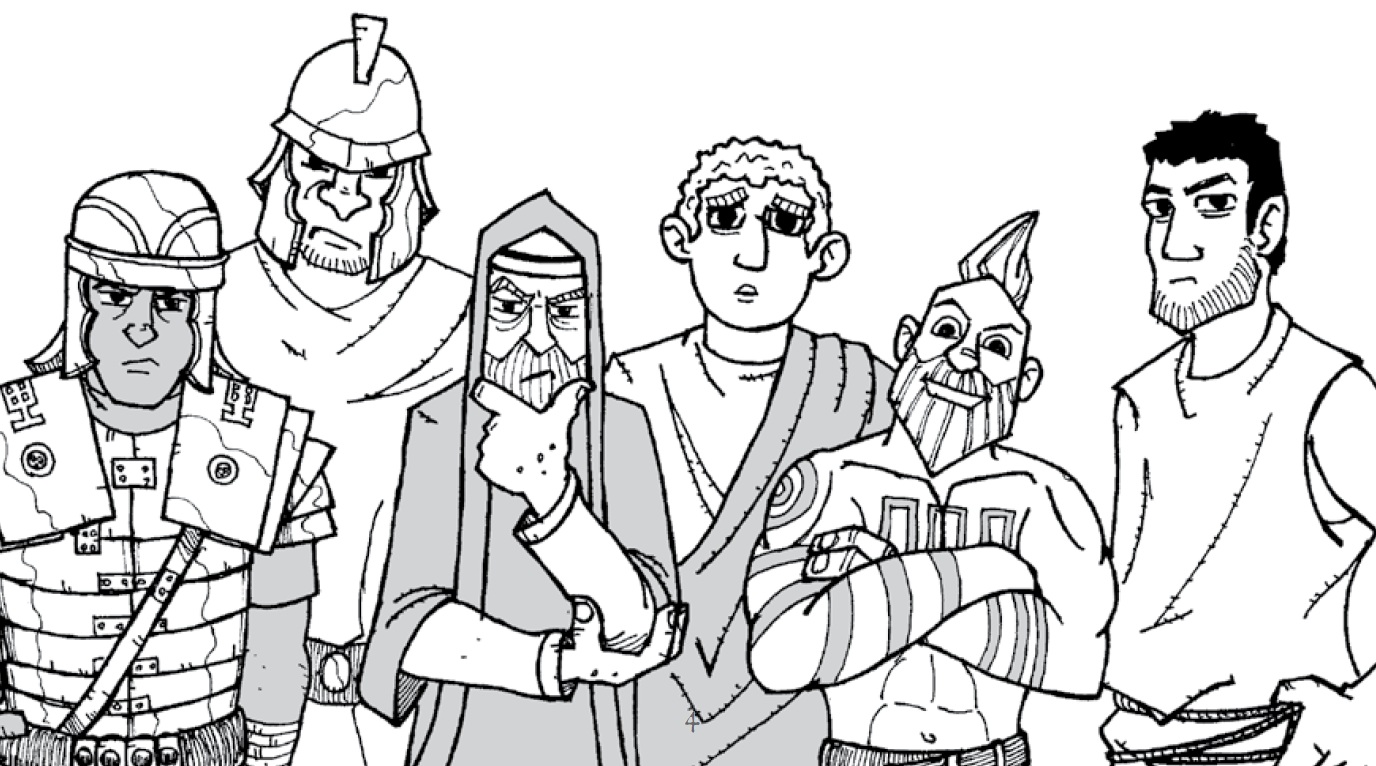
Warhammer Fantasy Roleplay 3rd Edition: I’m not sure which of these games is the most complex, but WFRP 3rd certainly takes at least 2nd. 3rd Edition WFRP’s core concept isn’t extremely complicated or difficult to understand: one builds a pool of dice, rolls them and judges the outcome by the roll, but the layer upon layer upon layer of chits and wound tokens and cards and distance markers and party cards and wound cards and stance markers and spell cards and action cards made the learning curve ridiculous, and when you got over the hump after a few plays, really didn’t add much overall and took up a FUCK ALL ton of table space to boot. The combat also, like Exalted and Pathfinder, takes FOREVER. In comparison, the Cortex-based Marvel Heroic Roleplaying does essentially the same thing in terms of the dice pool mechanic with tiny character sheets and only ONE type of token and BAM! POW! ZAP! and combat is done.  Add to this that since there were chits and counters for everything, specific NPC’s, power cards for monsters, location cards, most adventures were directly on rails, no sandboxing for you young sewer jack and rat catcher! Making one of the best parts of WFRP go missing entire.

Let’s look at a monster stat block for WFRP 3…

I’m going to Nurgle out with this one for a Greater Demon of Nurgle.
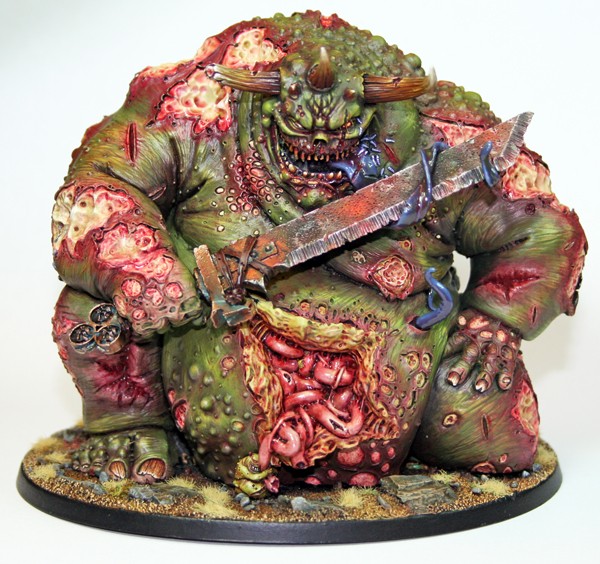
fatty
fatty

Great Unclean One
ST 7(8)
T 10(6)
Ag 5(4)
Int 6
Wp 8
Fel 6
A/C/E 10/6/8
Wounds 40
Stance: C4 (green)

Plaguefather
A great unclean one has four ranks of resilience and two ranks of training in spell craft, It favors spells with the Nurgle or chaos traits and does not need to channel or spend power to fuel it’s spells

Vile Progeny
a great unclean one’s actions gain CHAOS STAR a henchmen group of nurglings bursts forth from the great unclean one’s pustules and appear engaged with the daemon.

Card Attacks:

Purulent Attack  – these are all on handy cards– I’m not going to type these in! but it goes like [Demonic, Nurgles Weapons skill vs target defense, used by: Greater Demon engaged with target with a cost] and then lists each die roll possibility (hammers, stars, comet, skulls, etc. and the effect.

Bubonic Assault

Stream of Bile

Tally of Pestilence

That’s a lot of stuff– but it is a boss monster and the cards do help.  The WFRP3 one is seems to me to be the least complex of the three games listed, but still quite a bit to remember and it takes up a shitload of space all over every table in the house.  At least, unlike Exalted with all it’s charms in a myriad of books (and errata– don’t forget the essential erratta!) WFRP3 has the cards that you could refer to for powers.  I know I printed up a bunch of Exalted charm cards back in the day (in 2009 that is) to some good effect.

Yeah– holy shit…
Trampierfatty
What came next is what we all started with.

There’s my list of 2009’s mass complex RPG’s.  Due to unprotected sex, I’m not up on all the games that came out in 2009 and there may be another year that both the desire and the releases were more complex, but I really think looking back, 2009 was the year that really sparked people to swing the complexity pendulum back to the simple side with games since like Marvel Heroic, Numenera, all the OSR clones (except the shitty, pointless AD&D ones.. and 2nd edition? you sicko fuckers), D&D 5, 13th Age, FATE, and even though I think it sucks, Dungeonworld.  In addition, I think the crumbling of Exalted over 2007-2009 influenced people to try to make games that captured the FEEL of Exalted, without the insanely crunch, vastly complex rules but that’s an article for another day.
Roll M addon for Chrome

This is a fucking awesome thing.  It turns anything you want on a web page into a TABLE and you can roll it.    Say some of you sit there GM’ing with your laptop and need some random shit.  or on Roll20.  You look up 16th Century Male Marginalism and find some table of randy tart names– you can use the plug in to roll it right there and give a result.  This tiny little thing I just find awesome.

Try it.

and if you want some crap to roll to test:  here go.

RPG’s of 2009 – the year of mega-complexity – part 1

I was pondering my own desire for a Great Simplification in my RPG playing and GM’ing over the last few years and it lead down a path of wondering what year was the height of RPG complexity across the board? Now, sitting in 2015, the OSR is going strong, Numenera’s cypher system is still rolling forward (and the Strange) and has some very simple mechanics, 13th Age has stripped away the grid of 4th Edition and created an extremely playable D20, people are swinging off the nuts of the extremely simplified, deconstructionist spoof of D&D: Dungeon World. What’s more, Hasbro’s D&D v5 released last year, and while still fairly complex compared to the latter three versions, it has also undergone a great simplification compared especially to the two previous iterations. The pendulum has swung to the simple, but when was it at it’s apex of complexity that gave the current trend momentum?

The year I feel people were playing (and had an appetite for) the most complicated RPG’s in the history of the hobby is 2009. Since that year, I gut-feel (I ain’t going to track down sources) like the RPG community, as well as myself has been yearning for a simpler style of play, one that invokes more imagination and less about mechanics and OPTIONS. Yet, in the early 2000’s, I firmly believe that myself and many other people wanted nearly infinite complexity in our RPG games, and anything less was ‘just fucking shit we played as kids.’

Where did this desire for complexity come from in the first place? Why did we need so many character/monster/spell options and all this minutiae? People designed and produced these complex games hoping they would sell, and there was obviously a market for each being as complex as possible. But why?

I’d like to divide RPG players into two (overly) broad groups. First, the 70’s set– people that were born in the 70’s and played OD&D when it was actually published. These are the Holmes, Moldvay, Metzner kids. The second group (again this is broad) are the Lord of the Rings kids that played or started playing D&D 3.0 when the LoTR movies came out. The boost of those films to D&D and RPG’s as a whole was simply huge and there is an entire generation of people that jumped into the hobby, starting again with fantasy, during this time. What were these two groups both influenced by to make them want exceedingly complex games in 2009?  How did D&D 3.0, designed by the same guy that did Everway and 13th Age, end up being so complicated and by extension– all these other complex games!

Magic the Gathering. MTG had a huge effect on all gaming everywhere from 1993 on. I would say MTG had as big an effect as the creation and propagation of Dungeons and Dragons itself. What MTG did for gamers and game designers is to create a desire and acceptance of a vast array of asymmetric powers. A MTG deck is essentially a collection of powers that players need to know, memorize and combo. Not only do they need to know their own deck, they need to know as much about all the other cards in the game that may be played against them as well. Roleplaying games hence started having massive amounts of variable powers– especially Exalted and Warhammer Fantasy Roleplay (who even had all the player skills on cards).  MTG primed gamers minds for mass asymmetry and a desire for the same in their RPG’s.

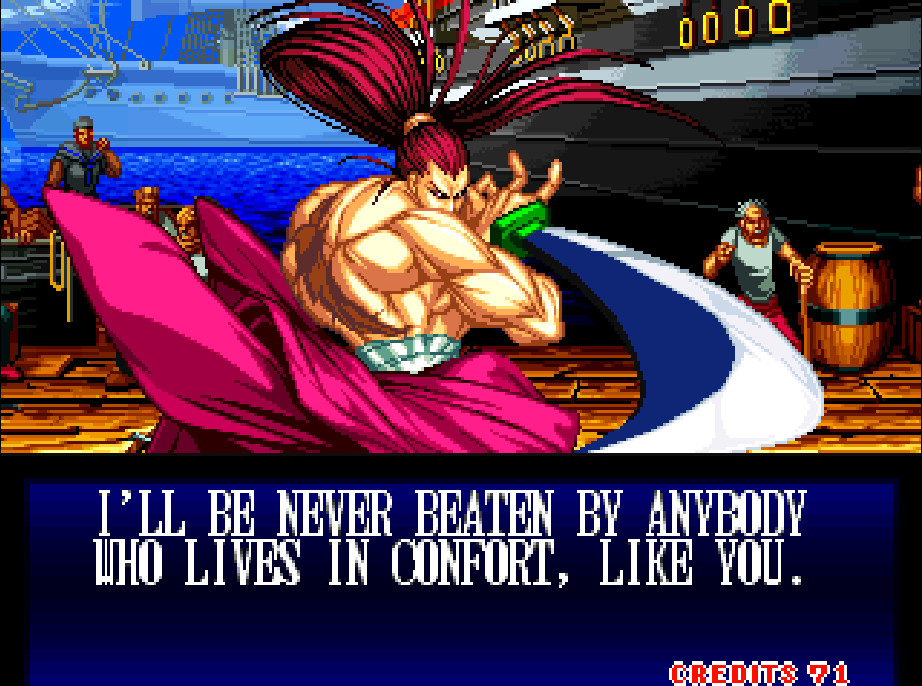
CONFORT
CONFORT–with 71 credits…

Anime, and fighting games. Especially Ninja Scroll for starters and EVERYTHING else since and by extension ALL Japanese fighting games. I spent food money in college playing Virtua Fighter and Samurai Shodown 2 and the adoration of those games culminating in Guilty Gear and Virtua Fighter 4/5 created an appetite for a system where your character fighting opponents gave the players tons of options, tons of character styles and special powers, conditions, everything. I believe fully that Anime and Fighting games were extremely responsible for the rise in complexity over the course of the 90’s and 2000’s. People eschewed the muddy murderhobos crawling around in dungeons for scraps with just a few stats and a single damage rating– they wanted heroes that could SHIN SHORYUKEN!!!  Combat, never a strong point or focus of old D&D (despite how we played as kids) became absolutely critical to RPG system design.  Once you understood what was going on in the fighting engine of King of Fighters or Samurai Shodown, it was hard to look at your PNP RPG combats the same way.  Reinforcing the trend from D&D 2nd edition– anime propagated that characters should be ‘heroes’ and not just some git with a sword and some rope stealing stuff from a tomb or abandoned dwelling.

Vampire and the D10 system. This is called the storyteller system but compared to story games these days (Hillfolk, Fate, et al.) this was really a ‘universal mechanic’ RPG more than anything. The really awesome thing about Vampire, which no one had done before well, were the variable player powers based on caste/clan.  Suddenly players were able to take a fairly straight forward (and broken until the Trinity version of the game fixed it) difficulty/successes system and layer in THEIR characters variable powers, and see how the whole mess worked together. As much as I am not a fan of the vaguely gay (remember it was still only the early 90’s–it couldn’t be blatantly gay which would have been much better!) vampire soap opera stuff myself, I, like many other, viewed the system with some sort of awe, but just wanted it to be turned loose on a genre that wasn’t so…. goth and metaphor for being a closeted gay dude. (this ended up being Trinity/Aberrant and Exalted). Because the system was easy to add options to–they did– so much…

Warhammer 40k/Fantasy: Especially the 70’s gamers started spending MASS cash on 40K and Warhammer stuff in general in the late 90’s and early 2000’s.  The game was extremely pervasive in game stores, being the bread and butter of many stores along with MTG.  Warhammer is all about army/unit asymmetry and tons of variable powers for everything, with customizable characters to the nth degree (we rip on “herohammer,” but that shit is fun both on and off the table as long as it’s balanced).  Since D&D was derived from miniatures games, 40K has a similar root.  Warhammer is the natural hardcore extension of Swords and Spells and Chaimail, both of which are awful in comparison.

Now, there have been many complicated RPG’s before 2009, especially in the realm of ‘universal’ systems such as GURPS and the HERO system (starting with Champions) as well as, arguably, TMNT (actually a really good game for it’s time!) and Rifts which really wasn’t that complicated except for all the character options and SDC/MDC bullshit (and mass addons). Phoenix Command, Twilight 2000, Rolemaster from back in the day were all COMICALLY complicated simulationist style RPG’s. These last three are games that, if you accidentally buy at a gaming flea market for a couple bucks, end up not on a shelf or drawer for later ‘research’ fodder or toilet reading, but get fired directly into the recycle bin. Yet, these games came out of an era where I think no one knew jack shit about how to design an RPG in general, the medium being all so new after all, so you have to give them a bit of a break unplayable as they were compared to (most) games of today.

Next post, three RPG’s that define 2009’s complexity to a C!

Runequest 6 – First big play session

Somehow, I convinced a pack of my knuckleheads (and my brother, who has little choice) to try out Runequest 6 last week with good results.  To be self-critical from the outset, I fucked up a lot of the rules, but my only real fudging of the dice to favor a player (I play with a GM screen still…) was probably one out of 20 or so where I accidentally let the player’s off the hook when they should have been chopped meats.  Making life hard on myself with RPG experiments as I tend to do, I converted a Lamentations of the Flame Princess adventure (Thulian Echoes) to Runequest 6 — not the easiest thing.  In this adventure, the characters find a book that details some people going to an Island about 1000 years before, but instead of reading the book or giving them the information, the players actually play through the ‘diary’ as the original peoples.  They are absolutely encouraged to cheese it up as much as possible to help the future visitors (which maybe them… maybe not) to the island if they can.  Needless to say, the Island is a fucking meatgrinder for the poor peoples of 1000 years ago.

I set the original party in 1605 England (summer, before the 5th of November…), where they were non-liveried members of the Mercers guild (read: street thugs) and just happened upon the diary while doing some shopcrastin and the like. My plan was to start off easy to get the players some familiarity with the combat system, the skills system is so intuitive these days that it really does not need much explaining.  The first combat against a near set of mooks (though anyone can kill you in Runequest really) went well and things that are quite different from most RPG’s like weapon size, action points, differential rolls, special effects were pretty easily understood– I think.  The selfish thing is, as the GM, I have had a lot of fun running Runequest combat so far because every dice roll matters– much like Marvel Heroic Roleplaying.  There’s no D20/WFRP:  “CLATTER -oh, I missed again” going on.  The players picked some fairly varied character builds, one was a 2 Action point beefsteak and the others were mostly rat-faced snipes who were more likely to toss a brickbat and then run then fight face to face.

Yet the second combat, once they had their new characters 1000 years previous, was a doozy, which ended up unfortunately being the remainder of the session, and absolute beast to run.  Four player characters + friendly NPC’s vs twelve Animated Statues is not a combat a new GM or group to Runequest should try to run.  While the players may not have noticed, a lot was forgotten and missed by this hapless GM.  I forgot when people had been wounded, I forgot when enemies had been over-pressed, forgot that some of the statues had spears, some had swords, some had shields as well, and I forgot to take into account weapon reach.  Someone with a spear can hold off an opponent until they can close range.  Again being self-critical first and foremost , I don’t think the players noticed much and had a good time because the MEAT of Runequest 6 is the combat and damn if it wasn’t fun despite the fuck ups (I did get the nearly obligatory “Chris is trying to cheat math” note that is often given to any of our group’s GM’s though).  Both of the main fighters went down (one out, one down with a leg wound), the sorcerer ran out of magic points after 5-6 castings of wrack and ran off, and the Pict was nearly killed multiple times before they were able to drop the last statue–and nearly all had to spend all of their luck points to do it. Whew.  I was imagining while playing what the combat would have been like in LotFP– these were 3HD monsters– so at least 12hp each, likely 15+ and weapons do half damage.  12 of these is a LONG fight.

Why I like the RQ combat
In the D20’s, characters just roll a die and do hit points of damage.  It’s effective when hit points are low across the board, and is fundamentally a timing mechanism for how long something can stay in the fight, but it’s so abstracted the characters in combat don’t make many choices, everything is a medium attack to no specific location. This works when shit is getting cleaved to the ground quickly, but vs high HD monsters, players often want to try something other than a medium attack to no specific location.

Contrast to D20’s, in Exalted, Fate, Feng Shui, and games that focus on the narrative stunting, the players have to create an idea in their head for what they are trying to do before any dice hit the table.  It’s fine to say “I flip [there is always some sort of flip in stunting descriptions] over the table and straddle the first guard’s neck between my thighs and then slice off the top of the second guard’s head with my cestus before I fire out my poison vaginal dart onto the first guard’s neck,” but what if it fails? What if the subsequently rolled dice say that that stunt absolutely does not happen— what happens then?  Runequest solves both the ‘a medium attack to no specific location’ problem that many RPG’s (and all D20’s) have and the pre-‘Stunting before dice hit the table’ by making the player roll the dice first, then there is an opponent reaction (if possible) and the results are applied– from this the narrative can be derived.  How does the system do this?  First, hit locations.  Your character knows what part of the enemy they have hit, and what degree of damage.  This adds a ton to the visceral aspect of combat.  Second, special effects.  Combat special effects happen extremely often– rarely was there an attack/successful parry for no damage (though this did happen), usually either the attacker or the parry-er failed or rolled a critical and one of the various combat special effects were applied.  This not only drives the narrative, but has specific system effects.   Unlike the free-form ‘consequences’ in FATE and Marvel Heroic, these are codefied completely– so players that lack in the imagination department (whether through fatigue or drink) can let the dice do their work for them, pick a mechanical effect that best suits their needs and let the narrative be derived. As a GM, I think this is quite awesome.

I could go on and on about the game (and I will eventually) but suffice to say that Runequest 6 is really badass and after making about 9 characters for the session and converting a variety of NPC’s and beasties, I can make characters in a VERY short time– my biggest gripe about the system really is that you have to have your players spend 300 points(!?) on skills (just like Call of Cthulhu) before they can get to buying equipment.  I’d rather it be like WFRP where you choose a class (say, fighter) then roll what career you were before becoming that class, and take the skills from that career.  The magic system requires a lot of GM pre-work which I was not a fan of for this session, but a small quibble since RQ6 is a toolkit system after all.  Would I convert another LotFP module? Maybe one of the big campaigns yes, but for the 2-5 session ones, likely not except for one I will not mention since one of the players sees this blog– I think there’s definitely a place for both Runequest and LotFP (and 13th Age as well) and I don’t want to try to change any of them to be more like the other– such as setting 13th Age (gonzo D20) in pre-modern Europe or adding hit locations to LotFP.  I will probably write more posts about RQ, but likely I won’t get a chance to run a game for a long time.

Dead men walking
scuttling blood-bags

Numenera: this is pretty cool

numenra8I don’t play Numenera but I have read the Player’s Guide and have the (giant) rules PDF picked up on the cheap. The book is beautiful, but I’m not sure about the game– basically there’s probably only one or two people I know that would ever even consider the setting interesting. I talk to a guy on my bus that ran it for about a year and thought the system was OK but then he switched to Dungeon World which is just a flavor-of-the-day spoof.

Anyway, Numenera sets up character generation as a phrase, such as “I am an Adjective NOUN who VERBS” and this site delivers these randomly which, frankly, for a new player is probably the way to go.

My deal with RPG’s is that I always want to try new shit, which is both awesome in that I get exposed to all the new RPG tech out their (which there has been some great stuff recently — looking at you Marvel Heroic Roleplaying, Tenra Bansho and Lamentations of the Flame Princess), but the bad side is that SYSTEMS don’t hold my interest very long. Exalted  2nd edition probably had the longest run as an interesting system, but what a beautiful and terrible mess that is.

That said, In seconds I generated the following character.  Give it a whirl!

I am a Cruel Nano who Reforges Completely

Pools
Might (Edge: 0)
7 + –
Speed (Edge: 0)
18 + –
Intellect (Edge: 1)
14 + –

Skills
Trained in all tasks relating to deception, intimidation and persuasion when interacting with characters experiencing pain.
Inability at all tasks involving discerning motives, feelings or disposition.
Training in understanding and identifying numenera

Abilities
Cruelty: When inflicting damage, can inflict 2 points less to decrease difficulty to attack target next round
Practiced With Light Weapons
Two Esoteries from the following: Hedge Magic, Onslaught, Push, Scan, Ward, Aggression, Distortion, Erase Memories, Far Step, Machine Interface, Mental Link, Resonance Field, Sculpt Flesh
Rapid Reforging

Equipment
Valuable memento from last victim worth 10 shins
Clothing
One weapons
A book about the Numenera
Three cyphers (chosen for you by the GM)
One oddity (chosen for you by the GM)

Notes
Pick a non-varjellan PC. You never understand that character’s moods or emotions
Shins
You have 4 shins to spend.
Cyphers
You can bear up to 3 cyphers.
References
Cruel
Numenera Character Options, pg. 20
Nano
Numenera Rulebook pg. 32, Players Guide pg. 21, Numenera Character Options pg. 10
Reforges Completely
Numenera Character Options pg. 73

numenera-booty
And an excuse to post a sci fi booty picture (art by Phillip Kruse (http://philippkruse.artstation.com/)


AMA with Mike Mearls

Lead developer on D&D 5.

Couple of Quotes:

“Probably the only mechanic I’m not crazy about is XP and leveling. If I could, I’d build a system where gaining a new class feature is driven by story-based prereqs. Like, you can’t learn to cast fireball until you’ve defeated a fire elemental and captured its essence, or after slaying the orc king a fighter can master a new battle axe technique.”

“More dice, fewer static modifiers. I’d use a die in place of the proficiency bonus. I like rolling dice and find it easier to teach that way.”

XP itself sort of sucks for STORY games, I loved when Warhammer Fantasy Roleplay came around and the GM just assigned a logical number of points after a session or couple of sessions.  And of course 13th Age where levelling up is completely via GM fiat — which is excellent.

Back to the old school though, I DO enjoy Lamentations/Moldvay style of XP where creature killing gives very minimal XP (fuck all that tracking) and the big haul of XP comes when silver and treasure are safe in some place outside the dungeon. Then you can take a natural break in the action and count out all the XP at the same time players are focused on counting out their silver coins.


Army Fucked

This is like a train wreck that I couldn’t look away from.  I watched nearly the entire 2 hours.  There are two videos, skip through some of the army review once you get the gist.  Mouth you will fucking love this.  This guy is being GENEROUS with his critique of these paintjobs splattered across such an amazing army to boot.  All of it looks like absolute hack shit–the vehicle models– my god what an atrocity against those sculpts.  I have no idea who the painting service is, but they won’t be around long.

Gencon Rundown 1: Elderly gay tennis courtier – An Hillfolk AAR!

I got to say the title of this post quite a bit during Gencon, first in reference to a real sad sack we have to deal with at the con but mostly during an excellent game of Hillfolk, the new award winning game from Robin Laws.

Now, I rip on Larping to no end, and stuff like Fiasco, Durance, Carolina death crawl and Hillfolk are about as close as I would ever want to come to that rather odd hobby, but these games are great and they have simple yet rules. While I like Fiasco, and Carolina Death Crawl is an amazing one shot, Hillfolk is a serious contender for the best of these types of games from what I’ve played.  This was a 3 day Gencon event hosted by a dude named Sam.

The scenario we played was straight out of DARK SHADOWS. Set in 1985 (pre-cell phones) somewhere in New England in a small fishing town where various families historically don’t like each other much and the patriarch of one of the main families has passed on. There were a few plot hooks thrown out (nothing obviously super natural in the beginning) and we were off creating characters. The character creation reminded me of the early versions of FATE, where you have plot devices and motivations attached to each other character. The created characters were awesome, there was me: an apathetic party girl from the main family line, some old doctor (the one that was called an elderly gay tennis courtier), a young man from a rival family, an evil half sister, an addict of a brother and a mostly scared all the time office assistant to the family. The GM spun all this into a crazy tale of horror and death, with our help of course. The main meat of character creation is that there are characters that want something from you that you won’t give up, like my bleached butthole in my character’s case, or something you want from another character that they won’t give you, like a pile of money to go shopping with, again in my character’s case. Each character is torn between two poles, and you will get bennies (a sort of in-game economy) if you act, and I mean ACT, in a way that shows conflict between those two poles.

Claudia Stone!

When you actually start to play (after character creation) you randomly get to create scenes. These are either roleplaying or some sort of task determining scenes (like a fight or sneaking around). Typically scenes involve you picking some of the other characters to talk with you about stuff. You usually want something from them and if you get it, or the other character refuses, you end the scene. The plot is not set, and is entirely dependent on the scenes that characters create. Some of the scenes were duds, like when you flip to some daytime soap opera and there is just some poorly written trash going on before they get to showing cleavage (I like the Mexican ones a lot more than the American Soaps for this reason). Granted, ALL of this is ad-libbed, so you have to give players a break if they’re not Constance Ford and if you are shy– ah… likely don’t play this game because you have to talk, and talk a lot about stuff that you had no idea was going on moments ago. Playing a female character for me was a challenge as many of you can imagine, but I nailed it enough to get a benny from the other players after the first “show.” I had to fall in love with one of the other characters which was sort of awkward as it was a dude, but awesome at the same time. During the rounds of scenes, the GM will interject plot scenes to move everything forward– these are likely completely off the cuff but are key as it seemed like character scenes were not the hardcore driver of the plot– we had to work around these obviously huge upcoming scenes rather than dive right in.

That said, towards the end I started getting crazy with my scenes, like a Soap that is hurting for ratings. Car crashes (hurling myself and other characters off cliffs), murder in the hospital, crazy talk and all that leading up to a blood soaked finale was amazing to be a part of.   There was just this amazing mometum that started happening about 5-6 scenes in: we had built up our characters enough to know generally how things would shake out, but no one knew what would actually happen.  The game ended with two players dead, two run away and an evil triumvirate taking shape to rule the town forever?

Final thoughts: Play this with extroverts, play it co-ed (an all-dude game, frankly, would not be very good unless your knuckleheads were good at playing women), and don’t be shy about bringing crazy shit into your scenes or calling people elderly gay tennis courtiers! (which is not my line, it’s from In the Loop BTW).  We were a bit too tame at first with setting our scenes, as the game could have gone berserk earlier, giving it a FEAST 2 vibe rather than like an 80’s soap opera that stooped to a Satanic cult plot to grab ratings.

This was the back of my character sheet, with the most important stuff during the game for the most part.

Lamentations indigogo: No Salvation for Witches

Likely the cover by the amazing Jason Rhineville

By the guy that did the Teratic Tome (A monster manual where everything has tits on it) and the solid sword and sandal hex crawl BAD MYRMIDON. Looks great. While browsing Rhineville’s art I noticed a pic for a sandbox LotFP module set during the English Civil War. If Better than Any Man was any indication, it should be badass and just horrifying at the same time.

Gencon cometh

Next week the nerdgasm of the year starts and many of my three readers will be there.  This year is ALL about the RPG’s with a new big shiny D&D version just out, a new version of Runequest that will be shaking it’s booty all over, a big shiny new book for 13th Age and Exalted….uh…. guess not.

Given the high focus on RPG’s I’m eschewing my normal Shadowfist tournament for playing some Dungeon Crawl Classics and 13th Age.  This isn’t due to not loving Shadowfist, but the new version of the game has moved in unfortunate directions, being simply a vanity project for the current developers and their kickstarter backers.

All that aside, I think this will be an awesome time as usual.  Most importantly:

BRING ON THE KILL LA KILL COSPLAY!!!!!

killlakill