Why do we play board games? It’s a question I’ve rarely asked myself or group as it’s been so ingrained in my hobby time that it really needs no answer at this point other than “because we do.” Yet, I think the WHY is all about creating the dynamics of conflict within an explorable system that is outside the realm of any real conflict. Of course, Cormac McCarthy put it better in the words of the Judge:
“Men are born for games, nothing else. Every child knows that play is nobler than work. He knows too that the worth or merit of a game is not inherent in the game itself, but rather in the value of that which is put at hazard. Games of chance require a wager to have meaning at all. Games of sport involve the skill and strength of the opponents, and the humiliation of defeat and the pride of victory are in themselves sufficient stake because they inhere in the worth of the principles and define them. But trial of chance or trial of worth, all games aspire to the condition of war, for here that which is wagered swallows up game, player, all.”
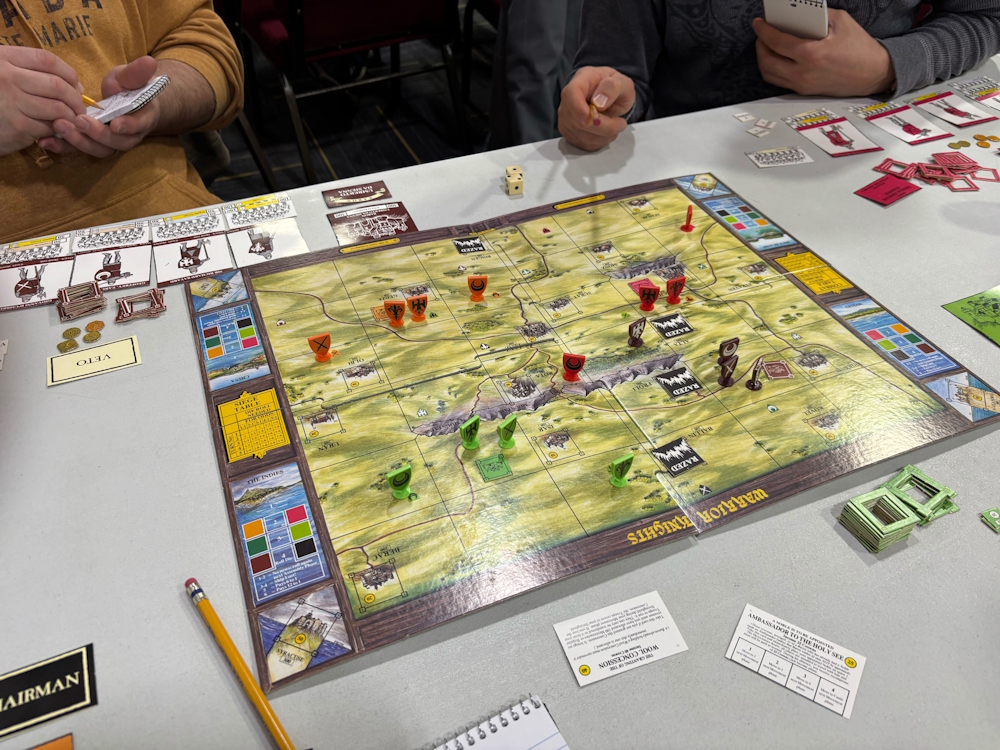
Yet a lot of games these days aren’t about conflict at all, they are more like a knitting circle where people sit around for awhile and then show what they made (I did not make this up, there’s a meme around that I got this from). Root and other games like it pushed against this trend hard, but for a long time, there were tons of games with actual ‘dudes on a map’ conflict. With that, let’s talk about Derek Carver’s 1985 classic Warrior Knights, later redeveloped completely by Fantasy Flight into their version. Both are good representations of design ideals of their time (1980s, early 2000’s respectively), the 1985 game especially so.
To start with, I have huge respect for Carver who has given several telling interviews about his design process. He simply made games and played then every week at his house with friends. Games like the ones he wanted to play did not exist (1970’s and 1980’s), so he just went and made them, not to fill a gap in published games (like area-control deck builders after deck-builders were a thing) but just to play. People that came to his house spread the word about some of these games (like Durance Vile which later became GW’s Dr. Who and if I was to guess, influenced Dungeonquest and Talisman in no small way) and some of these folks were at Games Workshop and asked to publish them. Carver did not make games to shoot out the door for publishing and hit some market, he just invented games and played them– a lot. It wasn’t playtesting, it was just play. This is quite a difference from what happens when I go to protospeil events or playtest with friends to the point where personally I will never ask anyone again ‘do you want to playtest a game for me’ but rather ‘would you like to play a game I made?’
After a long time of owning the game (almost 8 years!) I was on a Warrior Knights kick (the Fantasy Flight version) and wanted to do a comparison, so I dragged out Carver’s Warrior Knights and I was shocked even while learning the rules: the game is the absolute antithesis of modern board game design with the following aspects that HORRIFY modern gamers:
very long (3+ hours) with an emphasis on the +.
potential player elimination (people can come back, but they are weakened badly)
insanely random events that can wreck not just the leader, but any of the players, which cannot be avoided when they happen
A political phase with tons of negotiation that is central to player advancement /victory in the game
Stealing cards from other players both via voting and on the battlefield
Requires pencil and paper for various things in the game
Has a combat CRT using a single D6
You can trade money and cards back and forth between players at any time
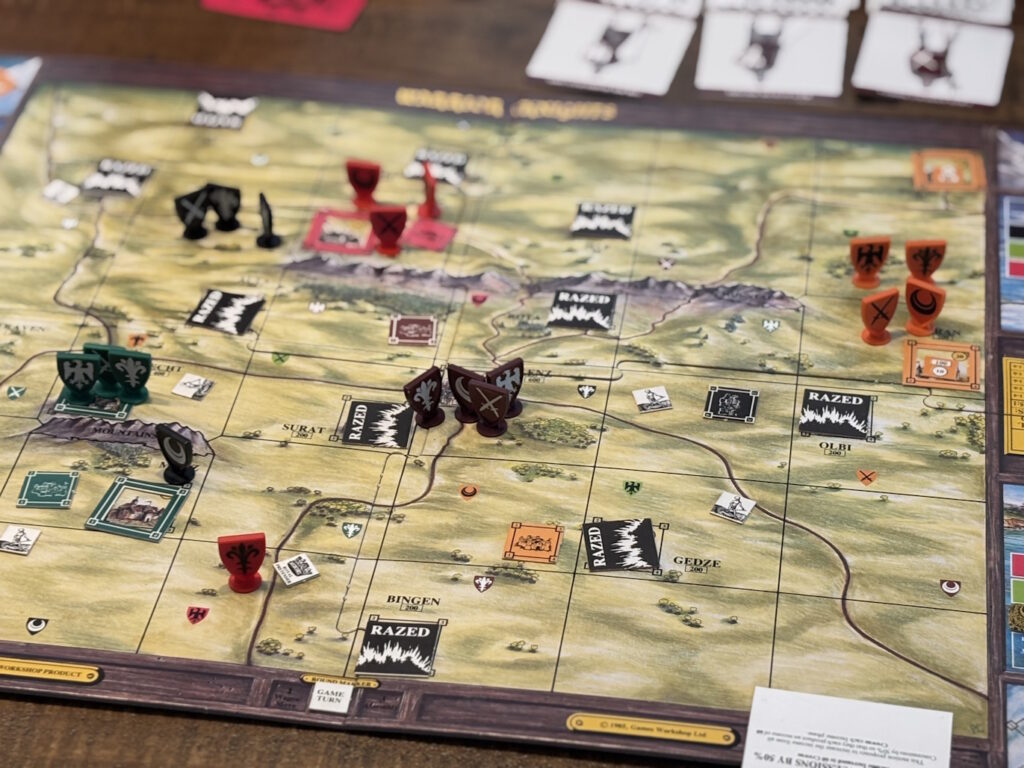
What was amazing is that despite everything listed above, everyone had a total blast. The rollercoaster this game generates is absolutely insane. For example, I sent my noble with the biggest army I had to Acre to do a little crusading for cash. All was going well and the siege of Acre was well underway. An event showed up that targeted my noble, but I though ho ho! he’s outside the normal map, but as it turns out, a peasant that noble had somehow offended had snuck onto one of the ships and murdered him in revenge, dissolving my biggest army in an instant. My only benefit was to be able to use that as a wedge to get people to attack someone other than me, or help me with votes in the Assemble. Broken-wing style players can constantly complain about bad events they got to get sympathy votes politically, and people to ease up on them in military conflict, people can sneak in stronghold attacks on unsuspecting players, players can be voted off the island in the Assembly phase and watch while their barony is schralped out by vulture players.
This version of the game accomplishes this with few rules, and what rules there are, are usually quite simple. It is absolutely possible to pick up the rules in the first turn of the game and have a decent chance of winning against experienced players because like few other games of this depth, the rules get out of the player’s way so they know what their choices mean.
A few weeks later, I got a 5 player game and while longer, it was also really quite excellent, though one of the players’ goals was to end the game as quickly as possible so went around and razed as many cities as possible to reduce the win conditions. This reduced incomes to a trickle, forcing the massive legions of the mid game to dwindle to shells of armies.
So this is definitely going into rotation and I am amazed there isn’t a modernized (components, cards, board) version out there of this.
I should have bought this in the late 1980’s or at the latest 1990’s and played, a lot. I blame the entire state of Florida for this oversight on my part.
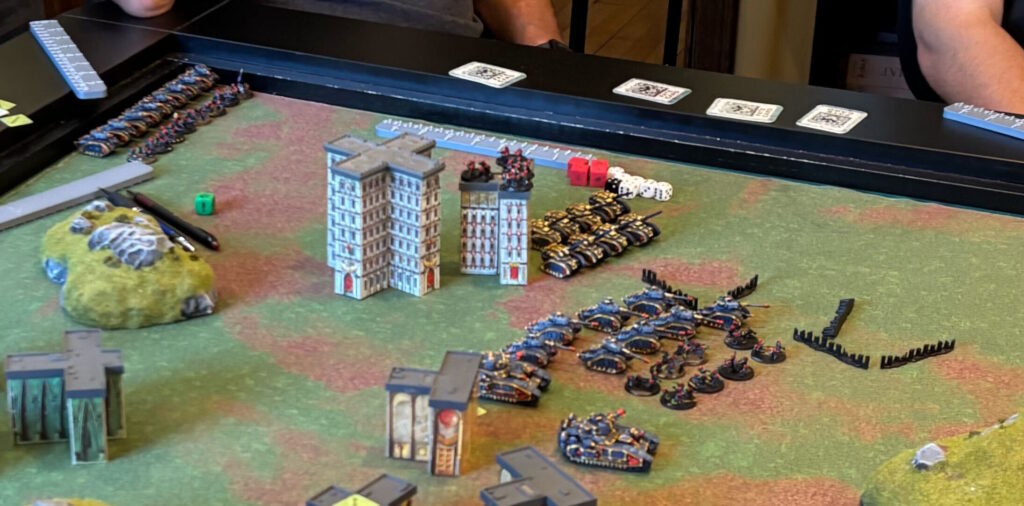
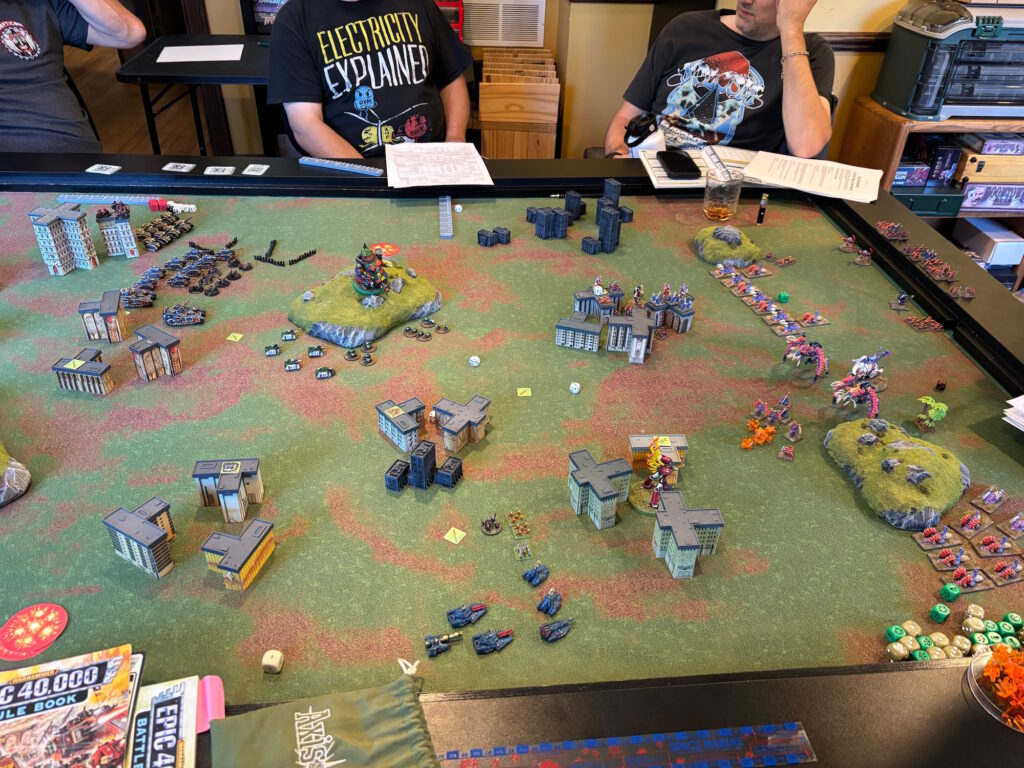
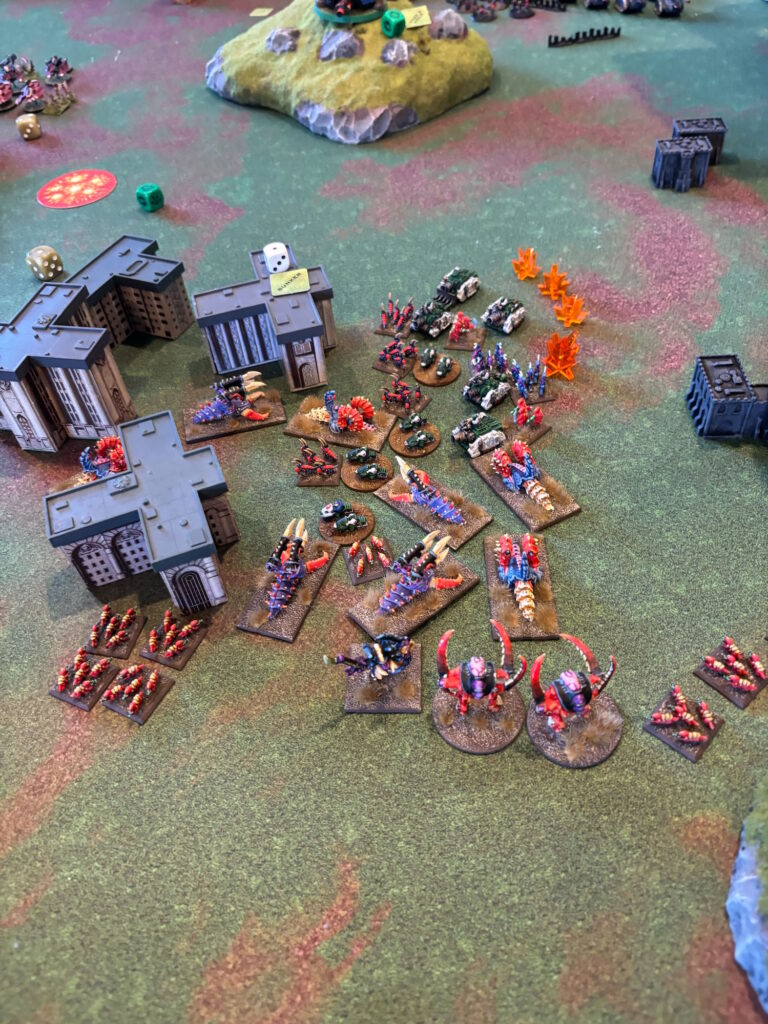
MAN! this game was a blast to play. 6 players, 9 hours or so of pure unadulterated 1990’s epic glory! This is the first really big epic 40k game I’ve played since college (before the 1997 rules came out, so it was the Space Marine 2 version with the unit cards) and I remembered why we loved this scale so much back in ye olden days. This is a semi battle report, semi-review of 1997 Epic 40k interlaced with a lot of pictures from this giant friggin game.
I talked to folks back in April to see if we could schedule an Epic 40K game at the end of July when Mouth was in town and told them only that it would be “very, very big‘ and plan for all day if they could. It turned out to be quite the large game, the biggest I’ve played since Space Marine 2 in about 1993 or so. We had 6 players, 2 for the Nids (thanks James), one Ork (Mouth), one Eldar (Dan), one Imperial Guard (Chris) and one for the Space Marines (Bill).
The Scenario
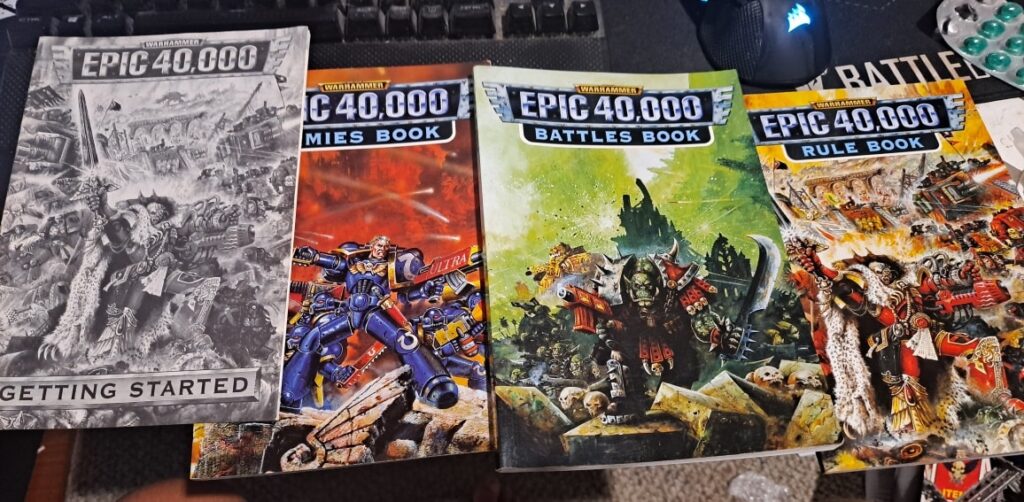
Epic 40k was released in a boxed set with ‘three little books’ for the rules, armies and battles. In the Epic 40K “Battles” book there are a slew of scenarios, and for what I wanted to do the Planetary Invasion was perfect. Not everything is on the board at the start of the game, so it gives players some time to come to grips with the system and just how big the game was going to be before it got really big. It uses hidden set up for the defenders as well as the objective markers and excellent morale system from Epic 40k.
The Orks, Mentor Legion, Eldar and Imperial guard would be the defenders and the Tyranids (all 5000+ points of them) would be the invaders. In the scenario, the defenders set up a portion of their forces all hidden (except titans and super heavy vehicles, which can never hide) and on the first turn ONLY flying and drop pod units can be moved onto the table by the attacker (the ‘nids in this case). Next, the attacker chooses a table edge and from turn 2 on, reinforcements from both sides come on to the table (based on rolls, but always at least one detachment). Ideally as all the rest of the stuff comes on the table, things on the table already aren’t there any more so the number of detachments doesn’t get overwhelming.
Fate Cards: we did use the fate cards from the base game as well as the army-specific ones from White Dwarf. These were great, but I would probably dole out a few more for this size of a battle.
We also used the 2D6 and choose the highest rule for firefights and close combat: recommended.
The Armies
One of the huge strengths (among many) of Epic 40k is that it has a very flexible detachment system, one that influenced many sets of 32mm 40k rules that came after it. Players can mix and match to come up with some really crazy detachment build outs as well as some that are HARD counters to tactics from other armies.
With this power comes great responsibility. Instead of the static detachment cards from Space Marine 2 with very generic (and not very effective) detachments, the player’s must create their own. From my last plays of Epic 40k, I learned the hard way that this can take a very long time indeed. If you do this all on game day, you will waste many precious hours doing that instead of blowing stuff up! Build out everything (long) before starting play. This has been made far easier with this super handy online tool.
My goal was to create a set of detachments that covered as many units from my huge Tyranid army as possible, and then create 1200 points of detachments for all four of the other races. With the exception of the Orks, I had to learn what detachments worked, what sucked and what everyone had for models. This took a LOT of research online and in old White Dwarf magazine, namely WD 211, 216 and 217. The Orks as you will see below were really simple to put an army together: it was ALL GARGANTS.
The Tyranids
This army included nearly everything I own to make up the massive invading force. This included a Dominatrix supported by three Hierophant titans, four combo gargoyle/Harridan units (flyers), an artillery detachment to lay disruption down and the obligatory genestealer, termagaunt and hermagaunt swarms supported by Carnifexes, Zoanthropes and Tyranid warriors. All in all, an absolutely monstrous army including over 40 termagant stands alone. This was the only army with air units as I felt the other players (except for the Eldar player) had no experience yet with this version of the game and the interdiction rules would have slowed the game down quite a bit. The air units were sort of just a distraction until turn 3 which showed just how badass flyers can be in the game, but I digress…
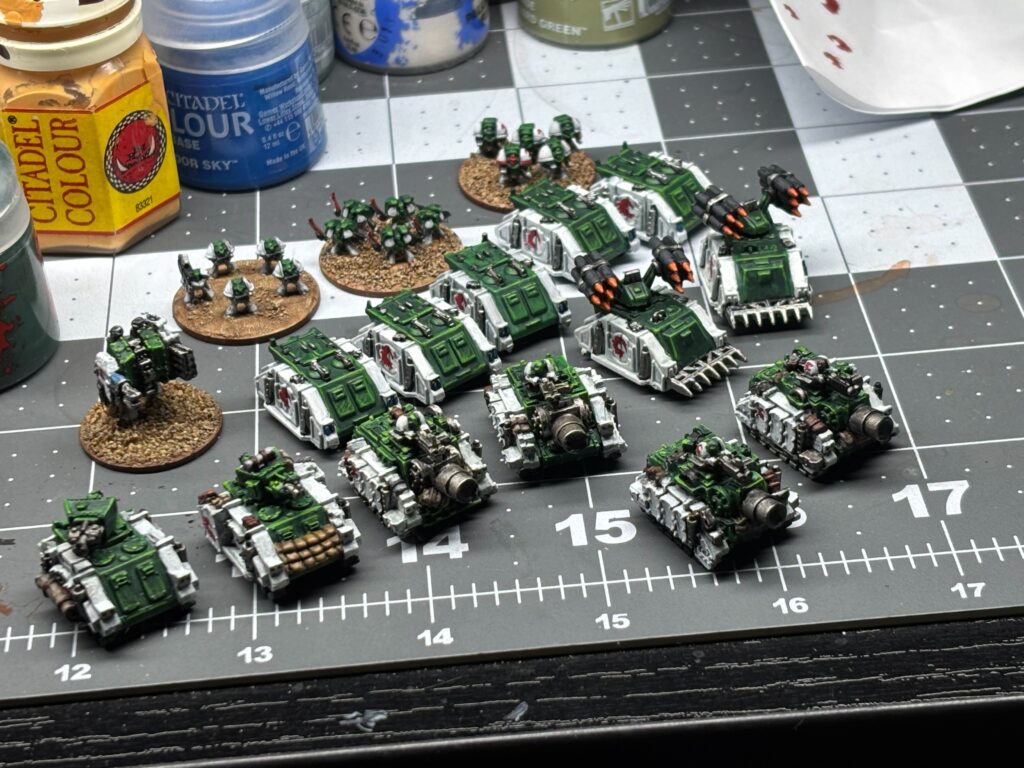
I stared from almost zero with painting my Mentor Legion in April and spent the months between then and the July game buying, assembling and painting as much of the army as I could. I meant for it to be a pure marine force and I got CLOSE but due to some unforeseen weekends out of town in July, I had to replace 500 points of a huge assault marine detachment with 2 Warhound Titans.
The main ‘hammer’ detachment was 9 bike units along with 5 Vindicators for close support. This a really good combo for a detachment as it is fast, hits really hard in close combat and can also win some firefights when needed to push back enemy detachments that are out of position. The second detachment is a more standard Marine one loaded into in Rhinos and Razorbacks. Of course, no Space Marine general is going to battle without Land raiders and there was a detachment of 5 plus 2 predators to keep enemy infantry away. I wish I had finished my massive assault force as the player playing the Marines (Bill) would have had a great time drop podding them into the middle of the Nids! I love the little dreadnought models from this version of the game but could not include any in the force unfortunately. Next time!
One of the dudes had models for the new game Legion Imperialis, so he brought a gigantic Leman Russ detachment, 8 griffons (for massive barrages) and a couple of Baneblades. It looked OK on the table with the 10mm scale difference, the Baneblades looking a lot like Ogres from the older game Ogre from Steve Jackson Games. He didn’t have a ton of infantry, which is probably good because they would just be meat for the grinder vs the ‘nids anyway.
The Eldar
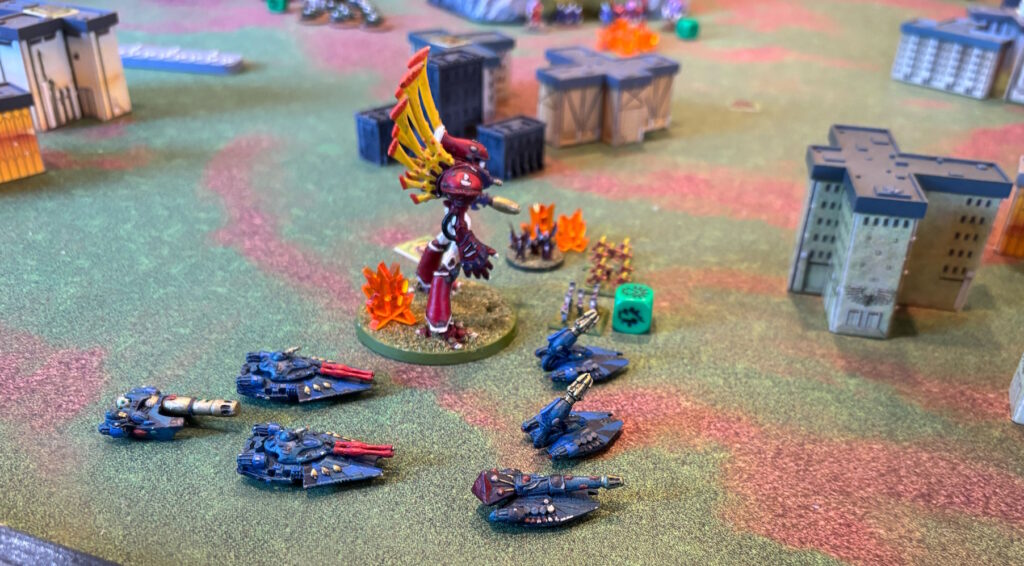
My buddy Dan has a huge amount of Eldar from ye olden days (and some newer stuff) so I just made up a list very close to what was used in the WD 216 battle report but with the edition of a Titan instead of an Avatar unit. This contained a core aspect warrior unit in grav tanks, the absolutely required night spinner detachment to lay down disruption all over and an Engines of Vaul unit with 2 scorpions and one cobra for the pop up MADNESS. Plus the Jes Goodwin sculpted masterpiece of an Eldar Phantom titan to round them out. Of the forces, this one is probably the most effective overall and balanced.
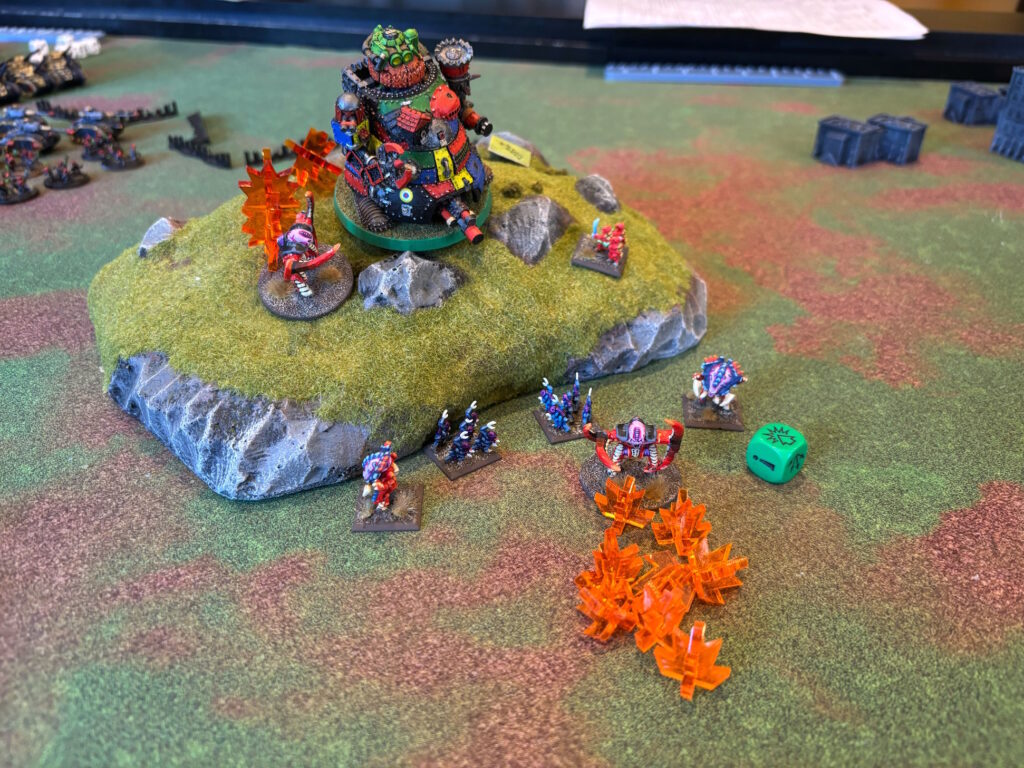
Last but not least we have our violent green friends. Though I have a large Ork army, none of the infantry or vehicles are painted and I made a rule for this game that everything on the table would be painted (and painted well, which is not hard for 6mm for the most part). As such the orks were by far the easiest to fill their 1200 points: two great gargants (one containing the Warlord) and one Slasher Gargant. I acquired three beautifully painted gargants earlier in the year, and they looked gorgeous on the table (which was good as they were hella expensive to buy).
The Imperial Guard, Orks, Eldar and Mentor Legion were the defenders, so they had to set up first, but other than War Machines (including Titans, Baneblades and Engines of Vaul) all units could be hidden. Each player rolled to see what started on the battlefield and what was in reserve, and all the players had at least one unit that started on the table. The centerpiece was the Ork Gargant, that sat his fat metal body on top of the central hill of the table. After set up, we Nid players got to choose a side come on from, and I made the mistake of selecting a short edge of the table, thinking I could rely on my speed and drop troops to win the day. This was a mistake from a game play perspective as tons of units on both sides never saw battle at all as they had to slog across the giant table.
Per the scenario, the Nids could only use flyers and mycetic swarms (drop troops) during the first turn, all other units rolled to come on the table in subsequent turns. Drop troops come on as small pieces of paper dropped from above the table by tipping a blast template!
This was a massive battle, so I just touched on the highpoints in the turn descriptions below.
The Battle – Turn 1
The Nids had the only flyers in the game so we just went all out on attack run orders the first turn. The Aerial assault by the Gargoyles and Harridans units (5 of them) were all trained on the great gargant, but unfortunately, they weren’t able to take down even half of it’s 12(!?) power fields! Lesson learned.. use the flyers somewhere else!
After the flyers ran their missions, I made my first tactical mistake and dropped one of my larger mycetic swarms directly onto the great gargant which turned out to be a slaughter as the it was able to snap fire at over half the unit, destroying a ton of them before they hit the ground. What’s more, Gargants have assault 30, so it would be very hard to take it down with the remaining swarm, which were shortly after blasted off the other side of the hill by the Leman Russ detachment anyway. I learned my lesson about snap fire, and landed my other detachments more judiciously as a screen for my incoming troops.
The Leman russ and Eldar moved into positions in the center and left respectively and were set up to hold both areas during the next turns. The Mentor Legion had only their fast attack detachment on the board and moved it quickly to support the Gargant on the hill.
The Battle – Turn 2
During turn 2 was when fully I realized that our choice to bring the Tyranids on the short table edge rather than the long was ANOTHER tactical mistake as it allowed the defenders to line up in a smaller area to shoot at the ‘nids as they came on, making it impossible to overwhelm any flank. To the south were the eldar, with the Eldar titan holding that side, and to the north was the onrush of the Imperial guard, but worse, the center was still held by the impenetrable great Gargant who was back up to 12 power fields after the useless aerial assault the turn before– this turned out to be the only Ork unit that got any action in the game as the other two gargants came on as reinforcements and could not stomp their way into battle.
The Nids rolled pretty well for reinforcements and all but one of their titans were now on the board along with a massive assault spawn detachment that was poised to take on everything in the center of the board.
In the shooting phase, along with the blasting from the Great Gargant, the Imperial guard griffons did a number on any exposed Nids, which caused a lot of pain and anguish, but that would be taken care of in turn 3 when the flyers were back online to fly attack missions…
The Battle – Turn 3
This turn started out with the total annihilation of the Imperial guard griffon unit (8 strong) from five attack waves from the gargoyles plus Harridans during the flyer missions phase. It was a slaughter not unlike the road of death from desert storm 1…except just plastic and metal pieces. While a moral victory, this really did not amount to much in the scheme of the battle as the Tyranids were hard pressed to get their forces in close enough without being destroyed from shooting.
That said, taking the entire onslaught of a concentrated Tyranid force one side of the map was way too much for both the Eldar (except the Titan) and the Mentor legion vindicator/bike detachment, both of which were destroyed. The Mentor Legion drove back a detachment of tyranids in a firefight that had been blasted by the griffon’s artillery barrage already only to be counter attacked by the biggest assault detachments in the entire tyranid force. This was the only ‘very large’ close combat in the game and while the Mentors were able to do some damage, all but one vindicator was left after the Nids were done.
While the Tyranid Titans and Dominatrix cleaned up the Eldar on the flank, for all their shots at the Eldar Titan, it did not get a scratch on the damn thing the entire game! This was deja vu from dozens of games of Space Marine in my ill-spent youth.
There were so many blast markers on the table at this point that we had to search around the house for suitable markers from other games!
The Aftermath
We had to call the game after Turn 3 due to time, but it was obvious that the Tyranids were going to take the L on this one, likely after doing quite a bit of damage to the allied forces first though. The number of Titans concentrated on the left flank would have overwhelmed it until the other Ork gargants and warhounds could get into the conflict. On the force morale score card, the Tyranids were in the 60’s and the Allied forces were still at 99 (as high as those cardboard counters can go). I would have liked to have had the 4th turn to see whether or not the Gargant could be displaced from that damn hill.
Epic 40K is Incredible and should be played as much as possible!
The 1997 rules are insanely good at this size of a battle. Despite totally new players, despite running out of time, the game went smoothly with only a few checks to the rules here and there (a lot of looking at army sheets and the titan sheets could have been better). I’ve played this version three times now and I think it is better than Epic Armageddon that followed it a few years later, far better than Space Marine 2 (which just goes into far too much detail for the size of battle I want to play) and also better than the new GW 10mm games (Imperialis) which isn’t even a contender as it only has Imperials vs Imperials.
When you play these rules and really familiarize yourself with them you realize they are an iteration and improvement on the grand-daddy of this scale of miniatures games: Advanced Squad Leader. If you have played ASL or even just SL, Epic 40K in this version will feel like a faster, cleaner and fun update to those rules. The focus on firepower rather than shooting individual weapons, the charts for number of dice to roll and the way close combat is handled is all an improvement on the fundamentals from Squad Leader. I think Jervis Johnson and Andy Chambers absolutely hit dynamite with this version– GW’s marketing department at the time just couldn’t SELL the game (along with some really ugly miniatures…).
Some other reasons (not in order):
Detachments: breaking away from the cards from Space Marine 2 was wonderful, now we could tinker with detachment builds with all sorts of units for the fight at hand, while this is extra work on the player’s part, this is really excellent and a crucial part of why this is such a flexible and fun system.
Shooting phase: There are big weapons, some special stuff like barrages and pulsa rockets, but all normal shooting uses firepower and a reference table. This makes things FAST and it works out totally fine.
Assaults and Firefights: the assault phase of the game represents a 4 turn 40K battle and detachments can either charge into close combat to wipe out the enemy (at risk to themselves) or manuver into place to get into an advantageous firefight which won’t do much damage, but will displace a detachment from where they are at and force a retreat. The combination of these two means of close engagement is the key to the game, and I hate to use the word elegant for anything but a dame, but it damn sure is.
Morale system: Each detachment contributes to an overall morale for the armies, and when detachments are broken or destroyed, they reduce morale, whoever gets to zero first (in most scenarios) loses the game. Morale can be increased by getting objectives so the game can see-saw from turn to turn.
Blast Markers: these are now used in tons of different games, and for good reason as it simplifies something a bit hard to abstract as it’s not damage, it’s not breaking of morale, but rather overall disruption, fatigue and chaos of battle for a detachment.
Well, I’ve written enough about this game, gotta get in some more plays! Thanks goes out to the Epic Remastered FB group, and the guys that created the Epic 40K Remastered detachment builder which made everything super easy for me to organize for all of these armies as the flexible detachment rules is one of the huge strengths of the system, but naturally it requires a lot of prep. GO HERE to give it a go.
I was rummaging around my stuff and found my copy of Warmaster, read it a bit on the shitter and realized I would never be able to get anyone I know to play this game despite the rules and the ease of getting into with 10mm miniatures. This reminded me that I had a ton of Epic 40K stuff based about 8 years ago (my god how time flies) and that it was just sitting around un-played since about 2016 or so. Terrible! So I decided to bust it out and start painting and at the same time was looking on Ebay for some pieces I needed and scored a fully painted Tyranid army for a bit of dross. This army is HUGE and so I figured I would get the lads together to do a big game of Epic 40K: three small armies vs a massive Tyranid horde and see how long they can hold out turn wise.
This required painting as I have to supply three of the four armies and so it begins.
RULES
I’ve played almost all the Epic rulesets (not the newest one in the 30K time period) and I am pretty much done with the Adeptus Titanicus/Space Marine 2 ruleset that I used to play in college. It’s too fiddly and the games take too long to play big stuff and Epic is ALL ABOUT THE BIG GAMES. So I was pondering either Epic Armageddon or 1997 Epic 40K and went with the latter– the reason is that the game play is super smooth and I just won’t need to explain all that much. Your detachment adds up it’s firepower in range, rolls on the chart, shit gets killed. Assaults and Fire fights have their own fairly simple rules as well. This way even if we haven’t played in awhile and may have a couple totally new players, it just won’t be tough to learn.
The biggest challenge with Epic 40k is the detachment building as it is completely open compared to other versions of the game. Luckily, these dudes built THIS to help people put together detachments really fast. The interface is a bit fucked up for building an army, but it is a HUGE help to do this. Anyway, here are some pictures of stuff I’m working on for the game. I am a SLOOOWWWWW painter so some of these miniatures I bought. Not my Mentor Legion though, that is all mine (for better or worse for the miniatures).
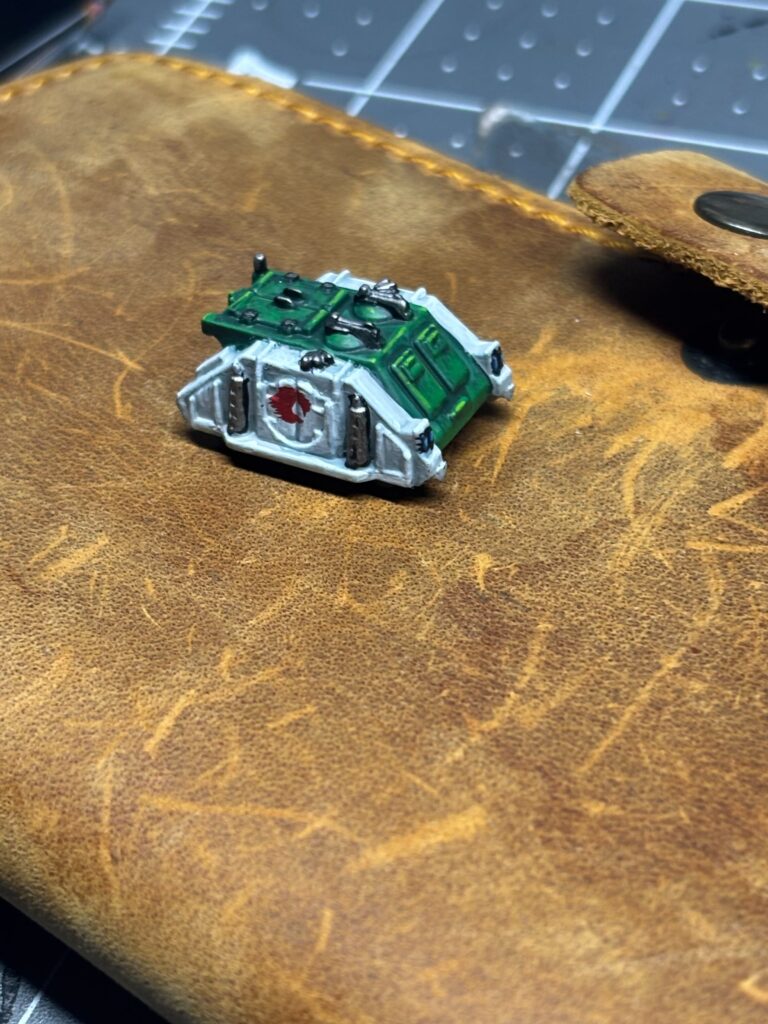
My first mentor legion vehicle, one of what will be very many Rhinos…
I bought these off a guy in the UK and though in some pieces when they arrived, a super easy fix for each of them.
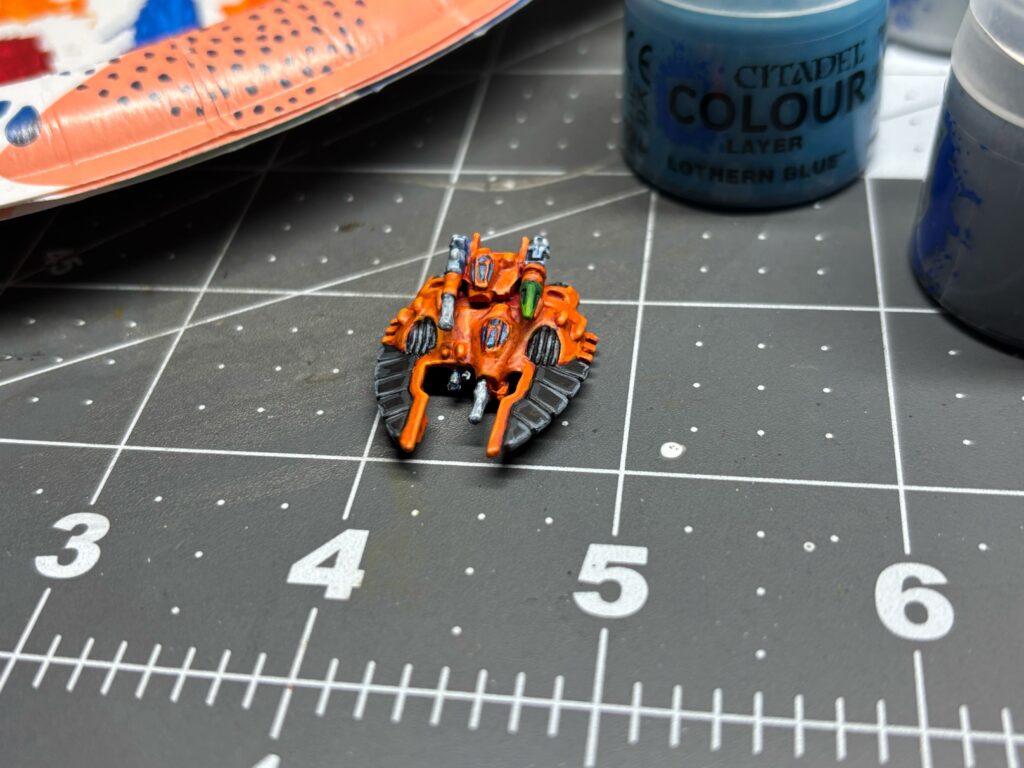
A Falcon I painted for the LOLS.
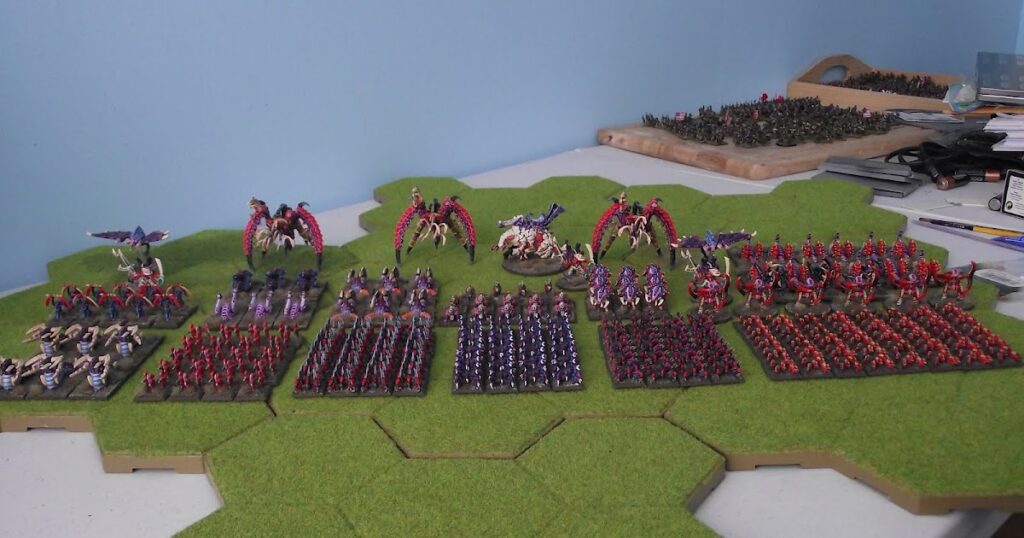
This is the entire Tyranid army, painted probably around 2012? It’s had multiple owners since the original artist.
My ‘good start’ on the first Mentor Legion detachment. Trying to find how they are supposed to look has been a tough one, but everything is turning out.
I got in a casual CASUAL game of Necromunda last week and what in the flying fuck happened to the organization of these rules? Seriously, this couldn’t be worse.
First, these are not overly complex rules, but there are tons of situational rules that enrich the game and the system. What is a drop rig? What does it do? What does Toxin do? What if something is on fire? Anyone that has played all but the simplest RPG’s (most of which are SHYTTE) will be familiar with these types of questions and it usually takes just a few minutes to look up the rule (and if there is a GM, they may make a rule on the spot to save time which is usually spot on for the situation anyway). Necromunda being a competitive thing most of the time, these questions need solid answers and can’t be hand waved by a GM. While the rules are certainly all there, they are scattered FUCK ALL throughout a ton of different books with the added bonus of having the original 2018 rulebook split between Basic and Advance rules (no one plays with the basic rules).
So the answer to the multi-rulebook issue would be to download and print on LULU the massive community version of the rules that includes errata and all that one needs to play, right? CORRECT, with the exception of that book being as FUCK ALL organized as the original books; going from core rules part 1 to special cases on tiles on the board game version, and then back to core rules. Or going from core rules to stats for a bunch of gangs and creatures that will rarely see play BEFORE going into the weapons and skills sections. In addition, it doesn’t even have an INDEX. Absolutely fuck all.
The Warcry rules are CLEANLY organized. Killteam’s rules are CLEANLY organized. What happened? This is not to say that the new Necromunda is bad at all, quite the opposite as it deals with a lot of the issues with the original version, but why the fuck would the rulebooks be like this? I can only imagine that they didn’t know that the Necromunda line would be as successful as it has and everything grew organically like some indy game where the designer has a day job? It’s really inexcusable for GW.
Anyway the game was good, though slow. Melta traps went off, there was renderizing and web-gauntletting (both brutal close combat weapons), toxic attacks, back stabs and hallway collapsing. A great time. I should have taken a bunch of pictures of the carnage, but I had my nose up the crack of the books the whole damn time!
Solution for next time: print the damn consolidated rules by UNIVERSAL HEAD.
It’s Sunday night and I’m beat. We were up until 3am playing a cracking game of A Study In Emerald wherein MOUTH failed to disclose via his actions in game which faction he was on due to rather erratic play. I was in the lead after destroying a couple royals but the Loyalists could have pulled out a win if they crushed my partner in restoration who was down to a single agent on the board. Mouth, shockingly, played a card to push the Loyalist War Track up to 10, ending the game, at which time he revealed himself to be a Loyalist. This after murdering another Loyalist player’s agents with the Vampire (Matt’s). Madness.
ASIE is a fantastic game, every time I play I get better at it and it gets more fun!
I spent some cash at the con, needless to say. Notable stuff I picked up: Decision at Elst, a Squad Leader starter kit campaign, SECRETS by Eric Lang, Ethnos, 1914 Quartermaster General and I went ahead and spent the 30$ to get the board game geek exclusive Blood Rage miniature (Hili).
I got to see CMON’s Rising Sun played, and saw someone walking around with a copy (they won it in a charity auction) so I think Rising Sun may be closer to shipping than we have info on from Kickstarter. I also got to see Massive Darkness played, which, while I kickstarted it, I’m not totally sold on the co-operative gameplay yet. Nice minis though right?
One odd game we got to play was Mr. MeeSeeks (from Rick and Morty) which is pretty great if you can play with girls and are drunk. It is not an all-guys game WHATSOEVER. I saw, but did not get to play Anatomy Park, also from Rick and Morty.
RPG’s were fun but a bit scarce this year. I played in an excellent game of Mythras based on the 80’s sci fi world Luther Arkwright. I’m going to pick up that book and see if it will work well for a BPRD style game. We played as Luther, Rose, another sex-addict character from the graphic novel, the Avengers (emma peel, johnathan steed) and Dr. Who (8th) in a sort of murder mystery, find the bomb game with dueling psychics and science! It was great fun.
My Mythras game was set in 1648 during the battle of Roicroi and the characters were Walloon deserters from a defeated tercio who fled into the town only to find it very strange indeed. Everything ended with a double hendersen and I feel I did a good job for only two hours of play.
The following day I ran Sailors on the Starless Sea, a DCC funnel adventure) for a big and rotating group of people who got exceedingly drunk during the affair. It was a lot of fun for me to try to manage the chaos, but it became too loud with the yelling for anyone to hear, so we didn’t get the adventure done on account of gin and the like. Someday I will finish running that all the way through: it is a pivotal module for DCC fans.
My favorite new game of the Con is probably Ethnos, but I really like Quartermaster General 1914 as well. We played about half a game of that and it clicked for all the players (too late at night though!). We’ll see which of those get more play. Ethnos with 6 players is really difficult to manage as a euro.
My favorite non-gaming thing was the Museum. I hope they do that every year. We get a mini one every Gary Con, but this was gencon big and had a ton of really cool stuff.
One thing my brother said on the way home was that Gencon is an anomaly from normal life because everyone is NICE. Packed in to a dealer hall, destroyed bathrooms and feeding areas you’d thing there would be dickheads and fights and yelling (remember, a LOT of people are drunk and high at gencon, like any other convention) but I never saw a single thing that wasn’t nice. That is really saying something, especially sitting in the Trump era where people seem to be going out of their way sometimes to be total cunts.
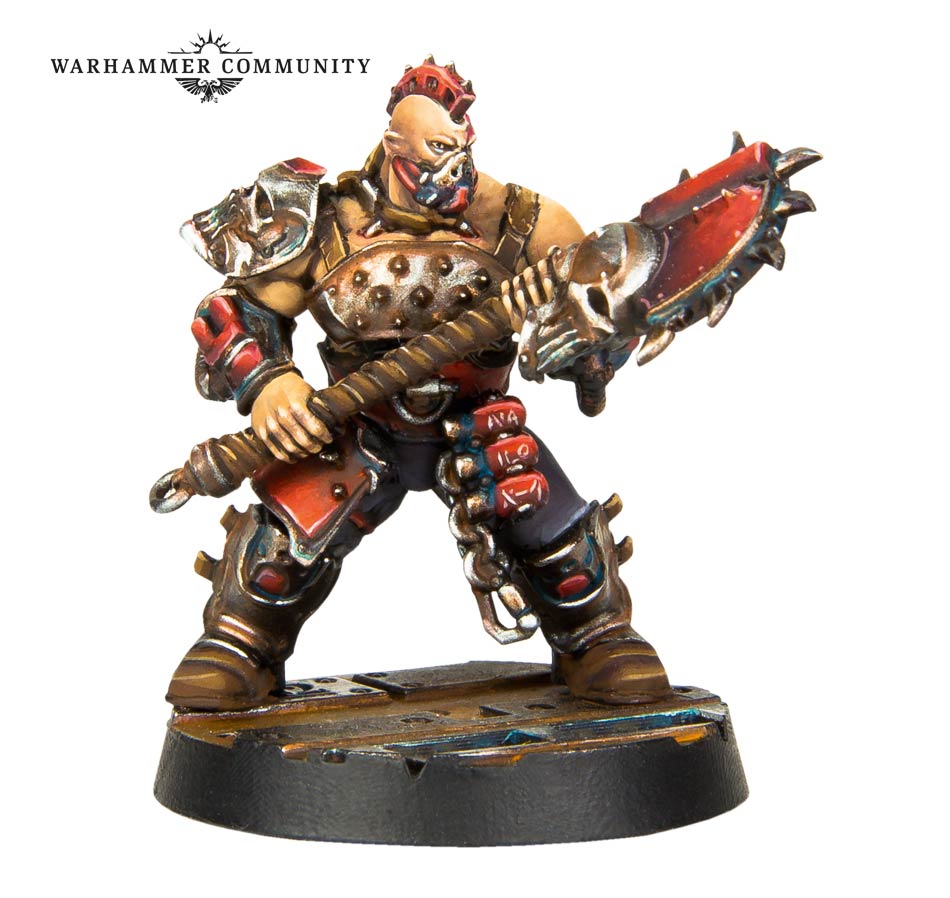
Been a long time since we’ve heard anything about Necromunda out of GW. This was posted today to the Warhammer Community. Not a lot of details on the game itself, but you can see the minis. Much bigger, on bigger bases. Sort of like going from 25mm to 28mm heroic to 32mm. Most of the original Necromunda line was good, but not great with the exception of the Eschers which appear to have been sculpted by Jes Goodwin himself. I’m looking forward to seeing the rules. Hopefully they don’t oversimplify (AOS) the game and leave it close to the original. Like I’ve mentioned many times, I think the W40k 2nd edition close combat system absolutely rules and should have been used for Mordheim as well instead of what they came up with. Let’s hope enough of 2E lives on in the new version. In any case, we will get new minis and terrain!
Updated rumors: Will have eshers and goliaths in the box, will not be IGOYG (i go you go) but will have IMPULSE move/act like AT-43. Will have skill trees, etc. Again this is just announced today.
Eight editions and I’m still rocking the 1986 beakies. Anyway, I’ve never been a serious player, but dan and I gave the new edition a spin last weekend.
8th ed. is very streamlined with very simple mechanics where once there was a lot of fiddly stuff. Gone are templates for flamers, explosions and the like and they are replaced with a flat or rolled number of hits to the unit in question. You can premeasure ANYTHING which is one of the things that made 8th Edition Warhammer Fantasy better than all previous versions. All this simplification was likely to improve speed of play and allow for very large battles. At just over 1000 points for the game, it was plenty large for my tastes.
Command points are a new thing to 40K 8th edition, something borrowed from AT-43 and I believe they are now in Bolt Action as well. In the new 40K, they allow a reroll of a die when expended at certain points, pretty much like Blood Bowl.
One very interesting thing we used were the new “Open War” cards that lay out a scenario’s objectives, special rules, terrain and the like without rolling on various charts. These were pretty neat and would work for any edition of the game.
So how did the game go? It was a ‘grab the objective’ game except that the objective didn’t show up until turn 3. While I was able to get some casualties on the Eldar, the main thing for me was holding off teleporting on my Terminators until after the objective dropped. It’s unlikely anyone will get Terminators off an objective in a couple turns. Dan’s rolling was TERRIBLE so there wasn’t much he could do in the end.
Close combat, which is a big thing in 40K despite all the guns, is similar to the old games (chargers attack first, then defenders attack back) except that failing morale checks means removing more casualties as if everything was like the undead from WFB. This is a pretty elegant solution to remove ALL instances of units running away, rallying and then coming back into the game. That said we had two close combats that went on and on round after round for awhile, with no clear winner.
I do not like that small arms fire can damage heavy vehicles (i.e.: non open topped or light transport vehicles) so that’s really odd to have someone shooting a bolt pistol at a Land Raider and have it do damage, but that’s my only real beef with the game.
Overall while I like 2nd Edition 40K the best (which fuels Necromunda and Gorkamorka), 8th is very sweet in it’s simplicity without devolving into the Age of Sigmar level.