
Post about new stuff in a new Rules and Magic book for Lamentations of the Flame Princess
The Lord of Plagues and Fevers posted some ideas he’s had for a new core rulebook for Lamentations. I have the Grindhouse edition and not the newer hardcover (that steve has) and I’ve thought since reading and running that these rules for old school D&D are… perfect. This is the game I want my kids to start with (yes, I know Lamentations art and adventures are not for kids, but the rules are so clean and crisp that I can’t think of anything better to start off with). This is the game I want to perpetually run and play characters in because no matter the conditions– drunk, tired as shit, cranky players that don’t want to learn anything new (including me sometimes) this is IT. So, I approach new rules with natural trepidation. The thread mentions a couple things of importance that he is thinking about:
2 new classes – Witchhunter and Conquistador. First one I like, second one, not sure about the name.
ALL weapons do D8 damage but you might get to roll 2 and pick the best one for certain weapons
Increased effectiveness of shields. This might be really cool and simple. (and we know that’s how people fought anyway)
Anyway, some other stuff on the whole thread here:
Tons of Aphex Twin
My god–98 tracks of old stuff released by Aphex Twin on soundcloud. This is not just experimental stuff, many are full on awesome.
https://soundcloud.com/user48736353001/14-make-a-baby

Warhammer video games cumming
Well well… while I had heard rumors of a Warhammer Total War (now confirmed via a leak– but we all knew it was coming anyway) I had no idea there would be a Battlefleet Gothic as well! BFG is one of those great rulesets from GW that I have never gotten to play. It was a huge influence on Epic40k (which tanked commercially, but I really like the rules) and many other games. I have a set of BFG with no ships that I bought off a buddy and I will have to make some out of paper or legos and try the rules out before the video game hits. This looks really great, but frankly, Warhammer games have been very hit or miss for me. Dawn of War was ok, not a great RTS by any means, and most similarly good but not great. Warhammer Quest on the ipad I thought would be amazing, but I just ZZZzzzz….
Here is a pic from the game. One to watch for sure.


New, Non-GW John Blanche art
Seminal artist and creative direction from Games Workshop (old school and new) has some recent pieces up here.

2000-2009 – The best video game of the decade is…
Oh boy, I had this article in my drafts folder since 2011 or so and just forgot about it, but at the time (and now) I feel I must crown the king of video games for the last decade. There were so many to choose from. I realize this is a bit… late. It goes without saying that 2000-2009 far outstripped any other decade for video game entertainment with the only genre I feel fell off the radar a bit were fighting games, and even those got some mega love with Virtua Fighter 4 and 5, Blazblue and Guilty Gear. There is no denying that Halflife 2 is certainly a highpoint in the decade’s games, I’m contrarian and liked Far Cry quite a bit better. I probably put more hours into Rome Total War or Morrowind than any other games, and both were contenders. Yet title can only go to the game that redefined an entire genre forever, a game that, for me, was a sleeper hit and came out of nowhere in the Spring of 2003 to be the dominant gaming addiction for almost an entire year and has remained on my various hard drives ever since: Warcraft 3.
Why? First, and probably least important on this list, the storyline. I’ve always felt as if the folks at Blizzard watched the new Star Wars movies with the same abject horror and revulsion as the rest of us and decided to show everyone how a good anti-hero story should unfold. And they did. The Arthas story line starts out a bit cheesy but then descends into madness and death and some fantastic character development. The overall plot is quite complex and intertwines through the campaigns for each of the factions running seamlessly through the base game and the expansion. However, I never once, even nearing the crazy climax of Frozen Throne, felt that I had lost it and had no idea what was going on (see Soul Nomad and the World Eaters for an example of a game that goes completely off the rails of understanding). The pacing, difficulty scaling and even character development is absolutely top drawer. Nothing I’ve played in the genre has come close. Starcraft 2 pales in comparison (they just can’t keep the cheese out of the space shit…)
Second, and most important: gameplay. Originally, Blizzard didn’t fuck around like they do now when it comes to gameplay, it has to be absolutely perfect for a game to go out the door and what’s more, it’s a moving target of perfection that was (and still is) constantly tweaked after the game was released. More that the jewel-like quality of the interface, Blizzard took on the huge risk of merging RPG elements with RTS in a way that actually works with forcing your characters into battle, either with creeps and especially with the enemy to get more powerful. This made the game reward the super aggressive, the antithesis of the lesser RTS games of the decade such as Age of Empires or Supreme Commander. You must attack the creeps, you must scout and you must harass your opponents as quickly as possible for any hope of winning. Two-player games typically last 15-45 minutes, another distinct contrast to the unfinishable games of Age of Empires or Rise of Nations RTS fans had been suffering with. Even big free-for-all games are quickly completed.
Third, in contrast to games of the time, Blizzard extricated turtling as an option. Player’s bases evaporate quickly under even a medium level attack and almost instantly with a large force. You can rely on your base for a place to quickly regroup and heal, but a base undefended by an army is one that will not be there for long. Again, unlike RTS games at the time that focused on players building up massive defenses and then throwing wave after wave of (un-microed) units at it until the resources ran out, Warcraft 3 totally shifted the focus onto the army itself. Typically you have only a handful of units of each type and with a low population cap you really can only have a single army with a few units here or there for scouting or harassment. This means that battles that take place are between one players main army and another players main army– guaranteeing that both players are not only fully engaged in the fight, but actively working to win the battle via micro during the entire engagement which brings us to micromanagement.
Warcraft 3 shifts the micromanagement focus away from the base/town/city and onto your army. I’ve heard arguments against the game that it was too much micro, but really it’s just a shift away from building units, defenses and towers to managing the movement, positioning and powers of a single army (with the accompanying heroes). Similar to base building (ugh) you have to know what to do and when to do it. The main difference is that with army micro, the management has to happen during the heat of a fight and takes, of course, a lot of practice to get down. Once you do, you realize that not only did Blizzard put the RPG into RTS but they put the Street Fighter into an RTS as well. Your heroes form the core of your ‘powers’ during battle and have to be used in conjunction with your army to pull off a series of moves. For example, I’m playing Night Elves vs Orcs. It’s about mid game and we have a dust up. He’s got a bunch of Grunts and catapults (the gruntapult tactic typical to orcs vs night elves) and I have some archers and elves riding wolves. I know that my meat (both archers and wolf elves) has light armor that takes HORRIBLE damage from Siege damage (that the catapults do very well) so I have to take them out first before they get too many shots. So I attack with my wolf ladies as a group, focus fire with my archers on a single Grunt, then teleport in with my arbiter next to one of the catapults and fire off a couple of powers (a ranged poison attack on a hero and an area effect attack) swallow a mana potion and then teleport back behind my line of Wolf-riding elf chicks. Then I check damage to my units and dance away any that are too hurt and risk going down, then refocus fire my archers onto another grunt and decide if I can press the attack or have to run away (usually in this case I’d run back home to heal up at the moon wells, then come right back and do the same thing). All of this happens in seconds. You have no time to think, you just do this out of practice. While Starcraft certainly has a level of micro similar to this, it’s so much about positioning and a lot less to do with what I feel is more fun: powers. We take a ton of things for granted these days with World of Warcraft and every copy cat game out there having powers that cost X mana and have Y cooldown period that weren’t around before Warcraft 3. Blizzard didn’t invent this, but for RTS, they perfected it. For me, every game of Warcraft 3, even against the AI, is intense, pushes my skills and best of all comes to the point of decision QUICKLY without a lot of waiting around. There is no more perfect gameplay in the genre.
Graphics. By modern standards Warcraft 3 still looks pretty damned awesome. What sold me on the game was a series of gifs made for the website in late 2002/early 2003 that showed each of the units posing and animating. Even at such low polygons, these models just ooze soul. I don’t know how Blizzard pulled it off as really there is nothing that can be compared to it at that time with such low polycounts (and yes, I am also amazed at Starcraft 2’s models as well). Again, after Warcraft 3 came out, everyone looked a what they had done and said OH YEAH, that’s how you do it.
Lastly, Warcraft three spawned an entirely new genre of games– the MOBA that has far exceeded it’s parent RTS in popularity. Unlike Diablo 3 or likely anything Blizzard ever puts out again, Warcraft 3 had huge modding capabilities and support and people took this and ran with it. Little did I know back in the day playing some weird little mod called DOTA that would spawn dozens of commercial games emulating it and that Valve would eventually own the original (and best) version while Blizzard tries to play catch up with their feeble ‘Disney-like kitchen soup of our licenses’ offering.
It’s sad where Blizzard chose to go after this game came out, but they are in this business to make money after all, and RTS games? Well likely they don’t make much money anymore. Warcraft 3 represents a time Blizzard was at their zenith of game development powers before the World of Warcraft made them billions of dollars. Like Keneda says: “Money fucked Star Wars, money fucked Diablo 3.” Nothing that has happened since can tarnish that Warcraft 3 is the best game of 2000-2009.
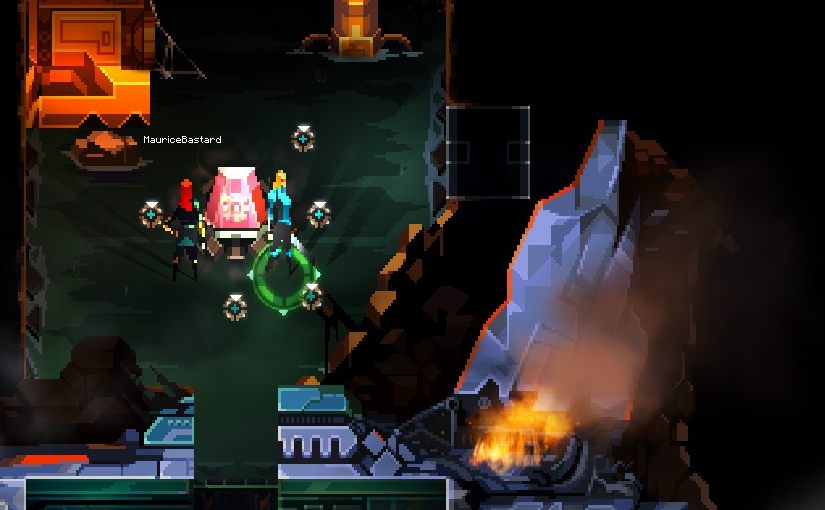
Dungeon of the Endless is fun and constantly crashes
Dungeon of the Endless is yet another game on steam with the word ‘Dungeon’ in it. The game is by the same team that did Endless Space (beautiful, but not great) and Endless Legend (an ok Civ clone). Dungeon of the Endless is their best game yet. DotE is a combination of base defense and an RPG, and it mixes those genres quite nicely.
The premise is that you are some prisoners that jettisoned/escaped onto another planet, but crashed into what appears to be some sort of bio-lab gone all sorts of wrong. You have to get to the top of the complex by bringing your power crystal to the exit elevator on various levels.
You have various prisoners that you command to open doors and fight (pretty much just that) and you can build resource bases and defenses with the stuff they find. Each door you open adds resources to your pool that you can spend (including on the extremely important levelling up of prisoners) so each level is ‘timed’ in that there are only so many doors to open and that’s it. If you waste your resources, you will become dead.
Each level builds up to the rush to the exit with the Power Crystal. As soon as a character picks up the crystal, all doors will open on the level and waves of monsters will attack (forever, please note this) until your prisoners are dead or exit. Simple premise, executed extremely well– except for the crashes.
The game crashes a lot. I’m sure in a few months this will not be so, but right now I’d say about half the time after level 5 the game will crash. It’s just one of those things.
Lastly, the game has multiplayer and I’ve tried it with Keneda. Both players get a single prisoner to use (can get more on the levels) and share what’s on the screen, but not backpacks or resources. We got fairly far and planned out our escapes quite well until, inevitably, the game crashed.
Plowing through all the indy/casual stream of shit on Steam for diamonds isn’t easy but this is one of them, burrs and all!

RPG’s 2009, the year of Megacomplexity – part 2
Megacomplex RPG’s of 2009:
This is part 2 of a long ass post about the year of the most complext RPG’s. Here is the first bit. Below three RPG’s from 2009 that I want to discuss as testament to fulfilling player’s desire for maximum options, asymmetry and complexity. All three are fairly playable in their base format to some extent, but with their variable player powers, options, and therefore need of playtesting, all are considered behemoths in terms of system mastery. This is not to say that they were all released in 2009, but in the case of Exalted, it was at it’s maximum popularity at this time (as far as I can remember).

Exalted. This tops the list of RPG’s that were popular in 2009 and …extremely complex. While the 2nd edition had been out since 2006, and frankly Jon Chung and that crew had broken the combat system already, 2008/2009 saw the release of a massive number of Exalted books, including what I consider the most complicated and confusing RPG publication I’ve encountered: Exalted the Fair Folk. This tome I just don’t get, and still have no idea how to create a Fair Folk character for my players to fight. The tough part about Exalted is that you, as a GM, are forced to make enemies with the same level of detail as the player characters (like Champions or Marvel Heroic RP). After a couple weeks of scratching my head, I just threw in the towel on this book, which was sad because the Fair Folk ARE the critical enemy in the Exalted universe. The book is beautiful and fun to read, but it’s fucking useless for gaming. Of these three games, Exalted was the game that I gave the most attention and play to, and while it was what brought me back to RPG’s after about a year drought, it was a harsh mistress. I probably ran 20-30 sessions over the years and most were extremely rules-heavy combat sequences. Many of which turned out quite awesome, but at what expense? Tons of dice, massive requirement of system mastery by the players and an UNGODLY amount of work creating balanced encounters and antagonists for me, the hapless fucking GM. And for all the complexity, so easily broken down into an optimum set of charms and powers to ensure 100% success rate against players or antagonists built the same way.
I think it was the fact that the core combat system had so many steps to each action that it just went berserk as charms (the character’s powers–and enemy’s) started messing with each of those steps in an almost Cosmic Encounter-like fashion. The designers probably thought– oh we haven’t had many charms that have dealt with X combat step yet, let’s throw some in. In addition, the setting was extremely tied to the mechanics giving rise to arguments crossing both on various forums. People would argue that X event could not have happened in the Exalted timeline if Chungian Combat was in place because Y Solar cannot conceivably have been killed by Z opponents…crazy fun but did make a good game to play? Some love, some love/hate. Once my players started defensively stunting, I was done with the game.
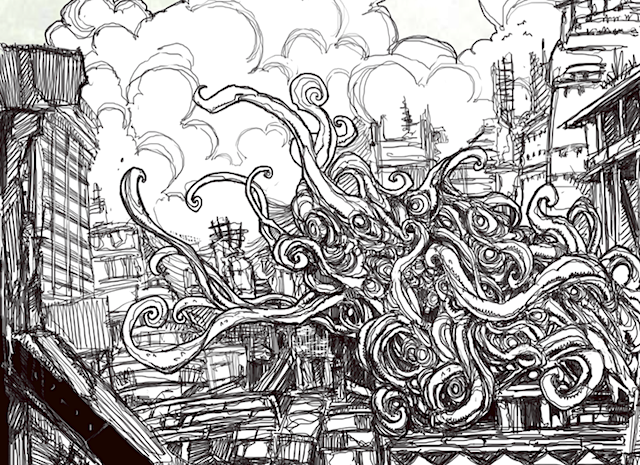
Monster/Antagonist stat blocks are huge indicators of difficulty/complexity for an RPG, especially for the hapless fucking GM. It’s not the only measure, but when I check out a new RPG, I always look at monster/fighter stat blocks second, after reading the combat section. As a base to compare the others, let’s look at a modern B/X stat block from the (amazing) Carcosa book circa 2011:
No Appearing: Unique
Armor Class: 19
Hit Dice: 20
Move: 120′
Alignment: Chaotic
This god is a vaguely humanoid hulk, about 20′ tall and partially scaled. No one has ever clearly seen it since palpable darkness emanates from it’s body. It does 3 dice of damage in combat, plus everyone within 30′ of it takes 1 die of damage each round from the crushing feel of oppression that accompanies it.
This block, for one of the most powerful entities possible to encounter, tells us how hard it is to hit with a weapon, how easy it hits others (+20 to hit on a D20), how fast it moves and how much damage it does, plus a special ability– all in 9 lines or so. To me this is only missing Morale (which was the author’s choice not to include in the Carcosa supplement) but is otherwise complete and INCREDIBLY efficient at giving the GM the information he needs to run it at the table. 9 Lines– for a great old one!
Let’s look at a similarly powered entity from EXALTED.
Gervesin, the Greiving Lord
Demon of the Second Circle, The messenger soul of the green sun
Attributes: Str 7, Dex 4, Sta 4, Charisma 5, Manipulation 4, Appearance 4, Perception 4, Intelligence 4, Wits 3.
Virtues: Compassion 3, Conviction 4, Temperence, 3, Valor 4
Abilities: Athletics 2, Awareness 2, Dodge 2, Integrity 5, Investigation 1, Linquistics 3, Lor 2, Martial Arts 1, Melee 5, Occult 2, Presence 1, Resistance 5, Stealth 1, Survival 1, Thrown 5, War 4.
Backgrounds: Backing 3, Cult 1
Charms: (these are in another book to find out what they all do): Commandeer, Essence bite, Essence plethora, Fruit of living essence, Hollow out the soul, Hoodwink, Hurry Home, Materialize, Meat of broken flesh, Ox body technique, Portal, Possession, Principle of Motion, Shapechange, Spirit Cutting technique, Stoke the Flame, First Integrity, Melee, resistance, thrown Excellency, Second Melee and Thrown Excellency, Third Integrity, Melee, Resistance, Thrown Excellency, Divine Melee, Thrown Subordination, Infinite Melee, Thrown Mastery.
Join Battle 5
Attacks:
Thrown Green Spear: Speed 5, Accuracy 14, Damage 15L, Parry DV7, Rate 2 (ETC)
Soak: 17L/19B
Health Levels: -0/-1/-1/-1/-1/-1/-1/-1/-1/-2/-2/-2/-2/-2/-2/-4/Incapacitated
Dodge DV 7, Willpower 10, Essence 7, Essence pool 130,
Other Notes: None (thank god).
Well by the iridescent balls of the Unconquered Sun, this is an insane amount of information– and even looks simpler that it actually is. You can get the base attack dice from the stats, but you have to look into the charmset thoroughly to determine the essence cost for attacks that add more dice PLUS any charms that could be used at the various steps in the combat. The number of powers this guy has is not unusual at all– and is really a metric ton compared to the B/X creature.
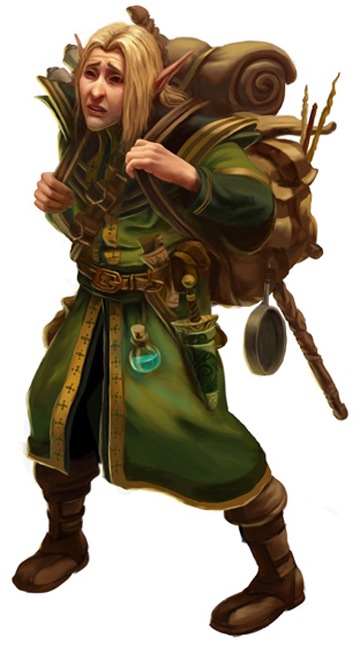
Pathfinder: 2009 was the year Pathfinder, or D&D 3.75, was released. It is now literally a household name in RPG circles for maintaining the D&D 3.0 style of play. While extremely popular, which may preclude it from this list, I think Pathfinder gets off far too easy on the complication scale because it is so widely known (being the third iteration of D20) and the core concepts are fairly accepted. However, let’s face it, this version of D&D, while getting out of the 2nd edition doldrums back into a really good base ruleset, is needlessly complicated with simply a rule for everything, tons of classes and ridiculous system mastery for the GM. With rulebooks that have the smallest type I’ve seen, if this wasn’t considered the pinnacle of D&D to some, who likely bought the Pathfinder book as a new version of a system they were already using, I think this would be a hard sell to anyone, especially these days where the barrier to entry on this complex of a system won’t be mitigated by having a very different experimental D&D version concurrently on the shelves in 4th Edition. That is, think about if Pathfinder came out TODAY. Even when I was heavy into Exalted, I picked up the book at Gencon 2009, read about half a page in the combat section and set it aside. People love it, and it’s got some great adventures if you include all of 3.0/3.5, but give me nearly any OSR clone in existence to run them rather than this beast. It was good in video games though (Temple of Elemental Evil that is).
and a monster stat block for Pathfinder around the same level as Gervisin and the B/X Great Old One stat block:
Cthulhu CR 30
XP 9,830,400
CE Colossal aberration (chaotic, evil, Great Old One)
Init +15; Senses darkvision 60 ft., true seeing; Perception +52
Aura unspeakable presence (300 ft., DC 40)
DEFENSE
AC 49, touch 29, flat-footed 44 (+12 deflection, +5 Dex, +10 insight, +20 natural, –8 size)
hp 774 (36d8+612); fast healing 30
Fort +29, Ref +29, Will +33
Defensive Abilities freedom of movement, immortality, insanity (DC 40), non-euclidean; DR 20/epic and lawful; Immune ability damage, ability drain, aging, cold, death effects, disease, energy drain, mind-affecting effects, paralysis, and petrification; Resist acid 30, electricity 30, fire 30, sonic 30; SR 41
DEFENSE
Speed 60 ft., fly 200 ft. (average), swim 60 ft.
Melee 2 claws +42 (4d6+23/19–20 plus grab), 4 tentacles +42 (2d10+34/19–20 plus grab)
Space 40 ft.; Reach 40 ft.
Special Attacks cleaving claws, constrict (3d6+23), dreams of madness, Mythic Power (10/day, Surge +1d12), powerful blows (tentacle), tentacles, trample (2d8+30, DC 51)
Spell-Like Abilities (CL 30th; concentration +42)
Constant—freedom of movement, true seeing
At will—astral projection, control weatherM, dreamM, greater dispel magic, greater teleport, insanity (DC 29), nightmareM (DC 29), sendingM
3/day—antipathy (DC 30), demand (DC 30), quickened feeblemind, gate, weird (DC 31)
1/day—implosion (DC 31), summon (level 9, 2d4 star-spawn of Cthulhu 100%), symbol of insanity (DC 30), wish M
STATISTICS
Str 56, Dex 21, Con 45, Int 31, Wis 36, Cha 34
Base Atk +27; CMB +58 (+60 bull rush, +62 grapple or sunder); CMD 97 (99 vs. bull rush or sunder)
Feats Ability Focus (nightmare), Awesome Blow, Combat Reflexes, Craft Wondrous Item, Critical Focus, Flyby Attack, Greater Sunder, Greater Vital Strike, Hover, Improved Bull Rush, Improved Critical (claw), Improved Critical (tentacle), Improved Sunder, Improved Vital Strike, Power Attack, Quicken Spell-Like Ability (feeblemind), Staggering Critical, Vital Strike
Skills Fly +36, Knowledge (arcana) +49, Knowledge (dungeoneering, engineering, geography, history, nature, planes, religion) +46, Perception +52, Sense Motive +49, Spellcraft +49, Swim +70, Use Magic Device +48
Languages Aklo; telepathy 300 ft.
SQ compression, greater starflight, otherworldly insight
SPECIAL ABILITIES
Cleaving Claws (Ex)
A single attack from one of Cthulhu’s claws can target all creatures in a 10-foot square. Make one attack roll; any creature in the area whose AC is equal to or lower than the result takes damage from the claw.
Dreams of Madness (Su)
When Cthulhu uses his nightmare spell-like ability on a creature with one or more ranks in a Craft or Perform skill, he also afflicts the creature with maddening dreams. In addition to the effect of nightmare, the target must succeed at a DC 40 Will save or contract a random insanity. This is a mind-affecting effect. A creature that already has an insanity is immune to this ability. The save DC is Charisma-based.
Greater Starflight (Su)
Cthulhu can survive in the void of outer space, and flies through outer space at incredible speeds. Although the exact travel time will vary from one trip to the next, a trip within a solar system normally takes Cthulhu 2d6 hours, and a trip beyond normally takes 2d6 days (or more, at the GM’s discretion).
Immortality (Ex)
If Cthulhu is killed, his body immediately fades away into a noxious cloud of otherworldly vapor that fills an area out to his reach. This cloud blocks vision as obscuring mist, but can’t be dispersed by any amount of wind. Any creature in this area must succeed at a DC 45 Fortitude save or be nauseated for as long as it remains in the cloud and for an additional 1d10 rounds after it leaves the area. Cthulhu returns to life after 2d6 rounds, manifesting from the cloud and restored to life via true resurrection, but is staggered for 2d6 rounds (nothing can remove this staggered effect). If slain again while he is staggered from this effect, Cthulhu reverts to vapor form again and his essence fades away after 2d6 rounds, returning to his tomb in R’lyeh until he is released again. The save DC is Constitution-based.
Non-Euclidean (Ex)
Cthulhu does not exist wholly in the physical world, and space and time strain against his presence. This grants Cthulhu a deflection bonus to AC and a racial bonus on Reflex saves equal to his Charisma modifier (+12). His apparent and actual position are never quite the same, granting him a 50% miss chance against all attacks. True seeing can defeat this miss chance, but any creature that looks upon Cthulhu while under the effects of true seeing must succeed at a DC 40 Will save or be afflicted by a random insanity (this is a mind-affecting effect). The save DC is Charisma-based.
Tentacles (Ex)
Cthulhu’s tentacles are a primary attack.
Unspeakable Presence (Su)
Failing a DC 40 Will save against Cthulhu’s unspeakable presence causes the victim to immediately die of fright. This is a death and fear effect. A creature immune to fear that fails its save against Cthulhu’s unspeakable presence is staggered for 1d6 rounds instead of killed. The save DC is Charisma-based.
Woah. Holy shit– for a D20 that’s an insane stat block. Powers, all these stats, all these acronyms too. While a ton of information given in order to use this monster, this one is still less complicated than the Exalted block by quite a bit. At least the powers are all right there in the description. What’s more this is a monster you would rarely encounter and the Exalted block would be defeated by STARTING Exalted characters…
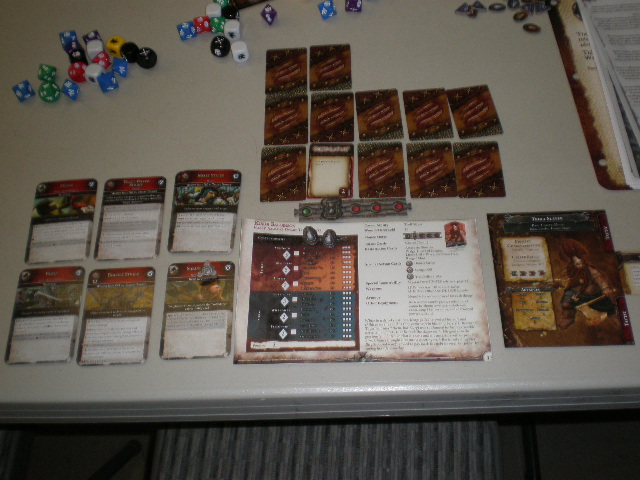
Warhammer Fantasy Roleplay 3rd Edition: I’m not sure which of these games is the most complex, but WFRP 3rd certainly takes at least 2nd. 3rd Edition WFRP’s core concept isn’t extremely complicated or difficult to understand: one builds a pool of dice, rolls them and judges the outcome by the roll, but the layer upon layer upon layer of chits and wound tokens and cards and distance markers and party cards and wound cards and stance markers and spell cards and action cards made the learning curve ridiculous, and when you got over the hump after a few plays, really didn’t add much overall and took up a FUCK ALL ton of table space to boot. The combat also, like Exalted and Pathfinder, takes FOREVER. In comparison, the Cortex-based Marvel Heroic Roleplaying does essentially the same thing in terms of the dice pool mechanic with tiny character sheets and only ONE type of token and BAM! POW! ZAP! and combat is done. Add to this that since there were chits and counters for everything, specific NPC’s, power cards for monsters, location cards, most adventures were directly on rails, no sandboxing for you young sewer jack and rat catcher! Making one of the best parts of WFRP go missing entire.
Let’s look at a monster stat block for WFRP 3…
I’m going to Nurgle out with this one for a Greater Demon of Nurgle.
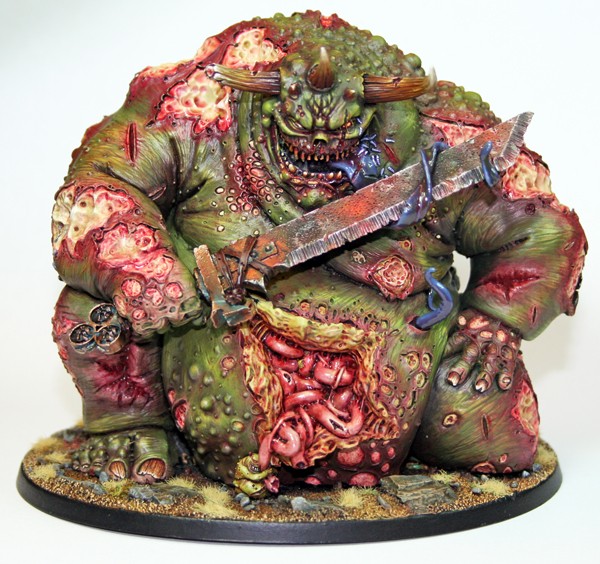
Great Unclean One
ST 7(8)
T 10(6)
Ag 5(4)
Int 6
Wp 8
Fel 6
A/C/E 10/6/8
Wounds 40
Stance: C4 (green)
Plaguefather
A great unclean one has four ranks of resilience and two ranks of training in spell craft, It favors spells with the Nurgle or chaos traits and does not need to channel or spend power to fuel it’s spells
Vile Progeny
a great unclean one’s actions gain CHAOS STAR a henchmen group of nurglings bursts forth from the great unclean one’s pustules and appear engaged with the daemon.
Card Attacks:
Purulent Attack – these are all on handy cards– I’m not going to type these in! but it goes like [Demonic, Nurgles Weapons skill vs target defense, used by: Greater Demon engaged with target with a cost] and then lists each die roll possibility (hammers, stars, comet, skulls, etc. and the effect.
Bubonic Assault
Stream of Bile
Tally of Pestilence
That’s a lot of stuff– but it is a boss monster and the cards do help. The WFRP3 one is seems to me to be the least complex of the three games listed, but still quite a bit to remember and it takes up a shitload of space all over every table in the house. At least, unlike Exalted with all it’s charms in a myriad of books (and errata– don’t forget the essential erratta!) WFRP3 has the cards that you could refer to for powers. I know I printed up a bunch of Exalted charm cards back in the day (in 2009 that is) to some good effect.
Yeah– holy shit…
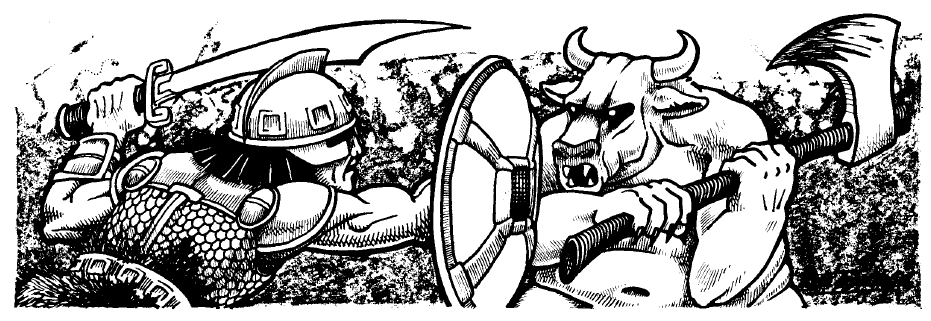
There’s my list of 2009’s mass complex RPG’s. Due to unprotected sex, I’m not up on all the games that came out in 2009 and there may be another year that both the desire and the releases were more complex, but I really think looking back, 2009 was the year that really sparked people to swing the complexity pendulum back to the simple side with games since like Marvel Heroic, Numenera, all the OSR clones (except the shitty, pointless AD&D ones.. and 2nd edition? you sicko fuckers), D&D 5, 13th Age, FATE, and even though I think it sucks, Dungeonworld. In addition, I think the crumbling of Exalted over 2007-2009 influenced people to try to make games that captured the FEEL of Exalted, without the insanely crunch, vastly complex rules but that’s an article for another day.
Roll M addon for Chrome
This is a fucking awesome thing. It turns anything you want on a web page into a TABLE and you can roll it. Say some of you sit there GM’ing with your laptop and need some random shit. or on Roll20. You look up 16th Century Male Marginalism and find some table of randy tart names– you can use the plug in to roll it right there and give a result. This tiny little thing I just find awesome.
and if you want some crap to roll to test: here go.
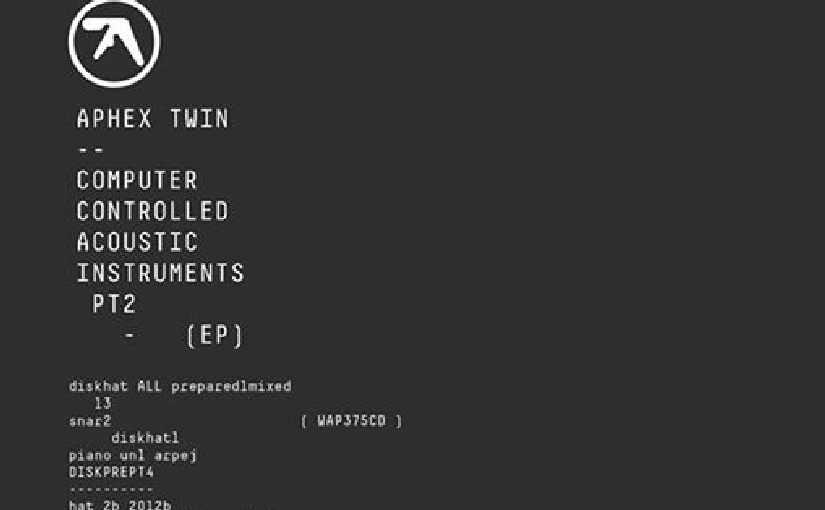

Another Aphex record… Jan 23rd!
Computer Controlled Acoustic Instruments PT 2. It’s an EP, but wtf. Awesome.
THIS is supposedly a track from it. There is a point early where you will say …. hmm– nah. But then about a minute later (especially if you have listened to Syro constantly for the last couple months) it will become obvious.